
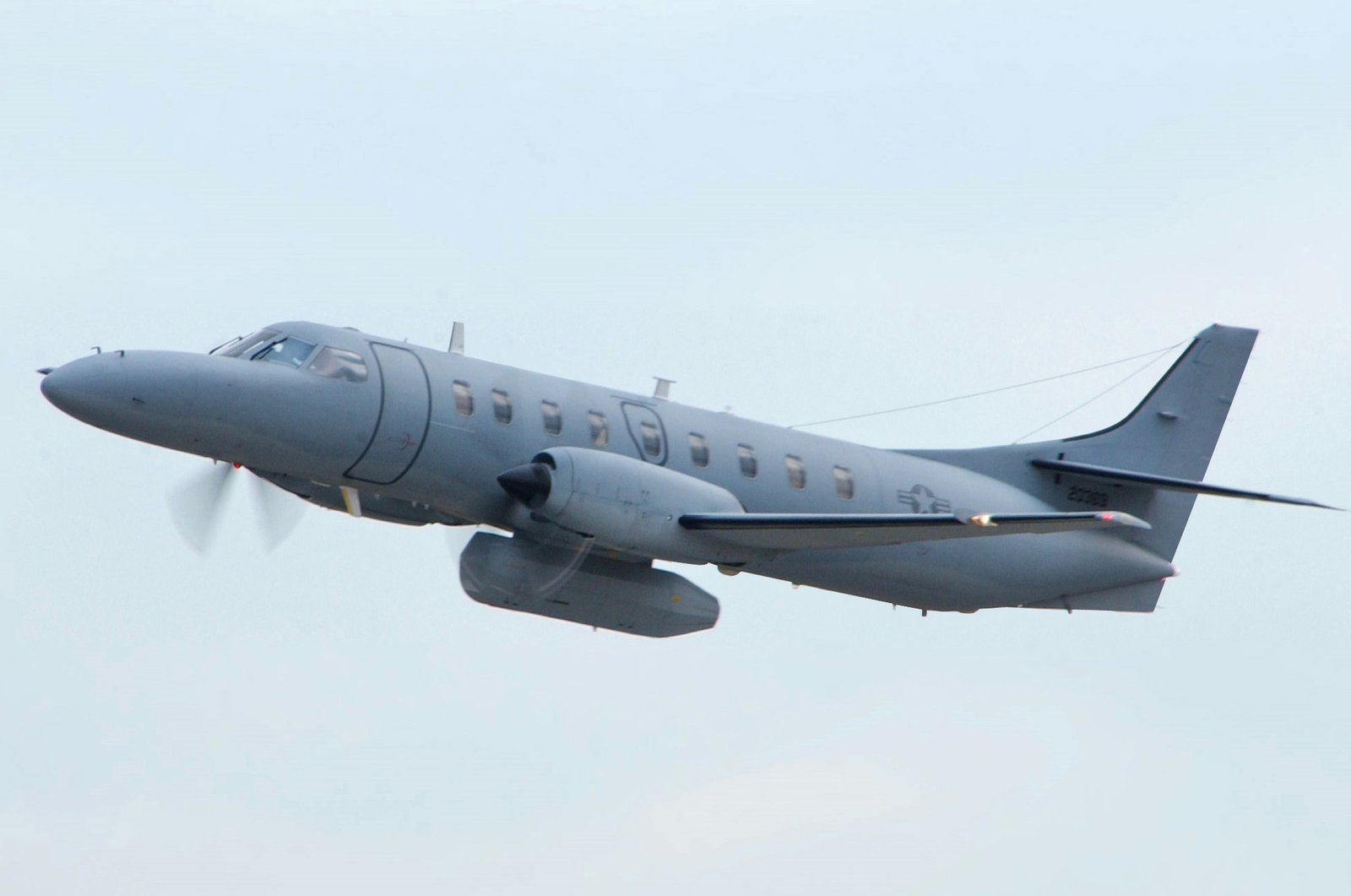
The Fairchild C-26 Metroliner is the U.S. military designation for various versions of the Fairchild Swearingen SA227 Metro/Metroliner, a twin-turboprop commuter aircraft. Rather than being produced on a dedicated military line, the C-26 consists of military conversions of the SA227 Metro III, Metro 23, and Merlin IVC airframes. The broader Metroliner family was manufactured in San Antonio, Texas, between 1968 and 2001, with the prototype first taking flight on August 26, 1969. The aircraft was developed under the leadership of Edgar "Ed" Swearingen, who founded Swearingen Aircraft; Fairchild later acquired a controlling interest in the company in 1968.
Designed as a pressurized, low-wing aircraft, the Metroliner was originally intended for regional airline service with a capacity of approximately 19 to 22 seats. The military variants maintained this basic configuration, optimizing the airframe for light-lift cargo and passenger transport. Propulsion is provided by Garrett (now Honeywell) TPE331 series turboprop engines. For example, the C-26A utilizes the TPE331-11U-601G, rated at 1,400 shaft horsepower (shp) per engine, while the C-26D is powered by the TPE-331-12UAR. Representative performance figures for the C-26A include a cruise speed of approximately 290 knots and a range exceeding 2,300 nautical miles.
In U.S. service, the C-26 has filled diverse roles. The U.S. Air Force operated the C-26A and C-26B, with the RC-26B variant serving extensively in counter-drug surveillance and domestic security missions until its retirement in January 2023. The U.S. Navy employs the C-26D for rapid-response logistics and range support at the Pacific Missile Range Facility in Hawaii, while a C-26A serves as a "flying classroom" for the U.S. Naval Test Pilot School. Additionally, the U.S. Army operated 11 C-26E (SA-227 Metro) aircraft as of January 2025 for passenger and distinguished visitor transport. Internationally, the C-26 has been operated by the air forces of Mexico, Peru, Colombia, Venezuela, Barbados, and Trinidad and Tobago.
While the original Swearingen Aircraft Corporation and Fairchild Aircraft as a major OEM are no longer active in the same capacity, the C-26's legacy is defined by its successful adaptation from a commercial commuter to a specialized military asset. It bridged the gap between small business turboprops and larger tactical transports, providing a cost-effective platform for ISR and utility missions.