
Production and Manufacturer History
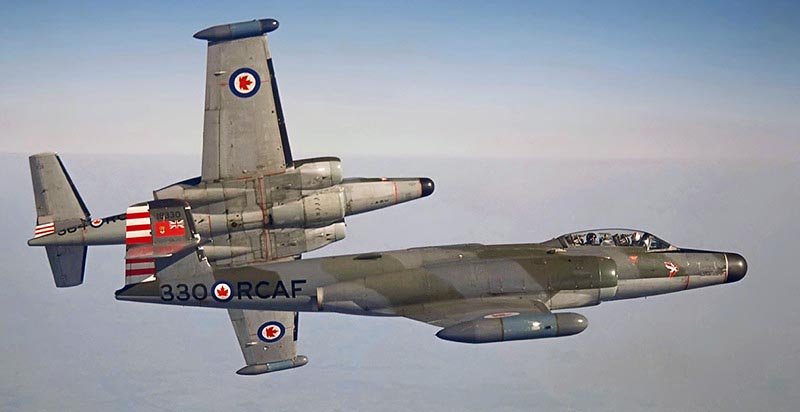
Development of the CF-100 began in October 1946 at Avro Canada, a division of A. V. Roe Canada Ltd., following an RCAF specification for a long-range, all-weather interceptor. The aircraft were produced between 1950 and 1958 at the Avro Canada plant located at Malton Airport in Ontario. A total of 692 aircraft were built across five primary marks (Mk 1–5). The manufacturer, A. V. Roe Canada Ltd., had been established in 1945 as a Canadian subsidiary of the British Hawker Siddeley Group. Following the abrupt cancellation of the CF-105 Arrow program in February 1959, the aircraft division was shut down, and the parent company was gradually wound up in the early 1960s.
Design and Technical Specifications
Designed as a two-seat interceptor, the CF-100 utilized a straight-wing twin-jet layout optimized for climb and endurance in poor weather. The prototype, serial 18101, made its maiden flight on January 19, 1950, powered by two Rolls-Royce Avon RA.3 turbojets. Production models transitioned to Canadian-built Orenda axial-flow turbojets. For example, the Mk 3 was powered by two Orenda 8 engines, each producing 6,000 lbf of thrust. The aircraft's dimensions varied by mark; the Mk 3 featured a length of 52 ft 3 in and a wingspan of 57 ft 6 in when equipped with tip tanks. A notable performance milestone occurred on December 18, 1952, when chief development test pilot Squadron Leader Janusz Żurakowski flew a Mk 4 prototype to Mach 1.10 in a dive from 14,000 meters, making the CF-100 the first straight-winged jet to achieve controlled supersonic flight.
Military Service
Introduced to the RCAF in July 1952 via No. 3 Operational Training Unit in North Bay, Ontario, the CF-100 served as a primary deterrent against Soviet strategic bombers. It operated as part of the NORAD air defense network, guided by the Mid-Canada and Pinetree Line radar systems. In 1956, four CF-100 squadrons were deployed to Europe to support NATO operations in France and Germany. While the RCAF was the primary operator, the Belgian Air Force also procured the aircraft in small numbers. The CF-100 was eventually replaced in the front-line interceptor role by the McDonnell CF-101 Voodoo starting in 1962, though it continued to serve in electronic warfare (EW) and electronic countermeasures (ECM) training roles until its final retirement in December 1981. The last military flight took place on February 10, 1982.
Legacy
Known colloquially as the "Canuck" or the "Clunk," the aircraft is remembered for its ruggedness and superior all-weather capabilities. Its development involved over 100,000 Canadians and influenced the design of the subsequent CF-105 Arrow. Today, several airframes are preserved as static museum exhibits, including a Mk 3D (RCAF 18138) at the Canadian Museum of Flight and examples at the Canadian Warplane Heritage Museum and the Air Force Museum of Alberta.