
Service History
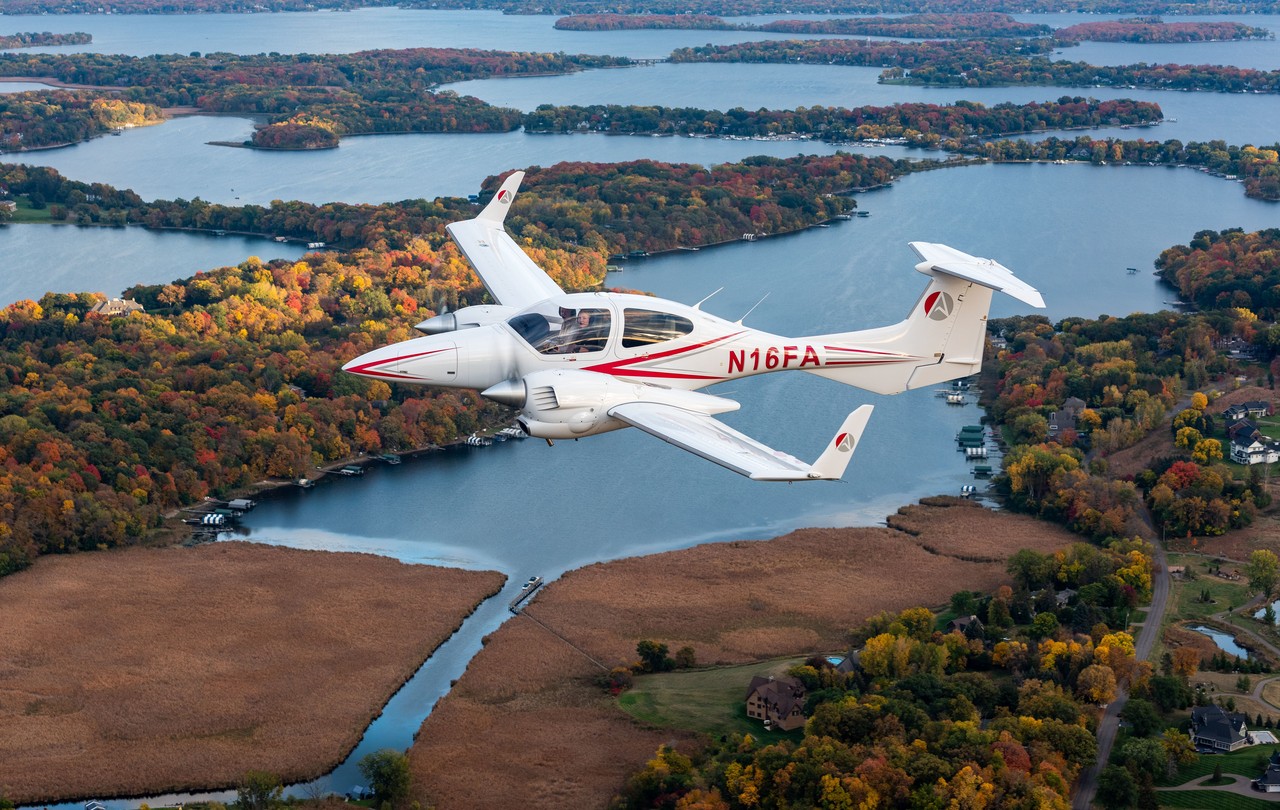
The DA42 Twin Star carved out a unique niche in general aviation by addressing the declining market for traditional light piston twins. While conventional twin-engine aircraft struggled against increasingly reliable single-engine alternatives, the DA42's diesel powerplants delivered fuel efficiency that fundamentally changed the economics of twin-engine flight. By 2012, the aircraft had become Diamond's revenue leader despite recession-hit civil aviation markets, with no direct competitors matching its diesel twin configuration.
Government and military operators embraced the DA42 for surveillance missions through the specialized DA42 MPP variant, introduced in 2007. Diamond delivered 17 units in 2008 to meet growing demand for aerial surveillance platforms, with projected annual requirements of 50-60 aircraft. Countries including Mexico, Thailand, and Turkey operate the type for border patrol and reconnaissance missions. By 2012, military and government contracts represented two-thirds of Diamond's total revenue.
The Manufacturer
Diamond Aircraft Industries traces its origins to 1981 when Austrian designer Wolf Hoffmann established Hoffmann Flugzeugbau, achieving early success with the HK36 Dimona motor glider. Following ownership changes through the 1990s, the company was renamed Diamond Aircraft Industries in 1998. In 2017, China-based Wanfeng Aviation acquired Diamond, which continues operations as the world's third-largest general aviation manufacturer with facilities in Austria and Canada.
Company founder and CEO Christian Dries conceived the DA42 in the late 1990s as Diamond's first twin-engine design, building upon the success of the single-engine DA40. Dries personally test-piloted the prototype, leading an 11-month development program that culminated in the maiden flight on December 9, 2002, at Wiener Neustadt, Austria.
Engine & Technical Innovation
The DA42's revolutionary diesel powerplants initially consisted of Thielert Centurion 1.7 engines, making it the first new European twin-engine aircraft in 25 years. When Thielert collapsed, production ceased temporarily until Diamond partnered with Austro Engine, founded in 2007 in Wiener Neustadt. The improved DA42 NG variant, powered by Austro Engine AE300 turbo-diesel engines burning Jet A1 fuel, received EASA certification on April 9, 2010, followed by FAA approval.
These diesel engines enabled remarkable fuel efficiency and range performance, demonstrated dramatically in 2004 when a DA42 completed the first non-stop transatlantic crossing by a diesel-powered fixed-wing aircraft. The type later achieved additional milestones, including a 2010 flight powered by algae-derived jet fuel and 2012 fly-by-wire technology testing that pioneered electronic flight controls in general aviation.
Performance and Pilot Perspective
The DA42's four-seat composite airframe houses twin diesel engines that deliver exceptional operating economics compared to traditional gasoline-powered twins. The aircraft's ability to burn readily available Jet A1 fuel rather than increasingly expensive aviation gasoline provides significant operational advantages, particularly for high-utilization operators.
Aviation Consumer statistics indicate Diamond aircraft demonstrate three times the safety record of competitors, largely attributed to the reliable diesel powerplants and modern design features. The DA42's high service ceiling and endurance capabilities make it particularly suitable for surveillance and long-range missions that would be prohibitively expensive in conventional twins.
Production and Legacy
Diamond achieved EASA certification for the DA42 in May 2004, launching production at facilities in Austria and Canada. Despite the production hiatus caused by Thielert's bankruptcy, manufacturing resumed in 2009-2010 with the Austro-powered variant. Total production has exceeded 1,000 aircraft, with continuing orders sustaining the production line.
The DA42's influence extends beyond its direct production numbers through its role in developing unmanned variants. The design served as the foundation for the Aeronautics Defense Dominator MALE UAV, expanding the type's impact into military surveillance applications.
Recognition of the DA42's design excellence includes the Golden A' Design Award 2020 for the DA42-VI variant. The original prototype, which completed the historic first flight in 2002, was donated to Vienna's Technical Museum in November 2014, where it remains on display in the Transport exhibition, preserving the legacy of this pioneering diesel twin for future generations.