
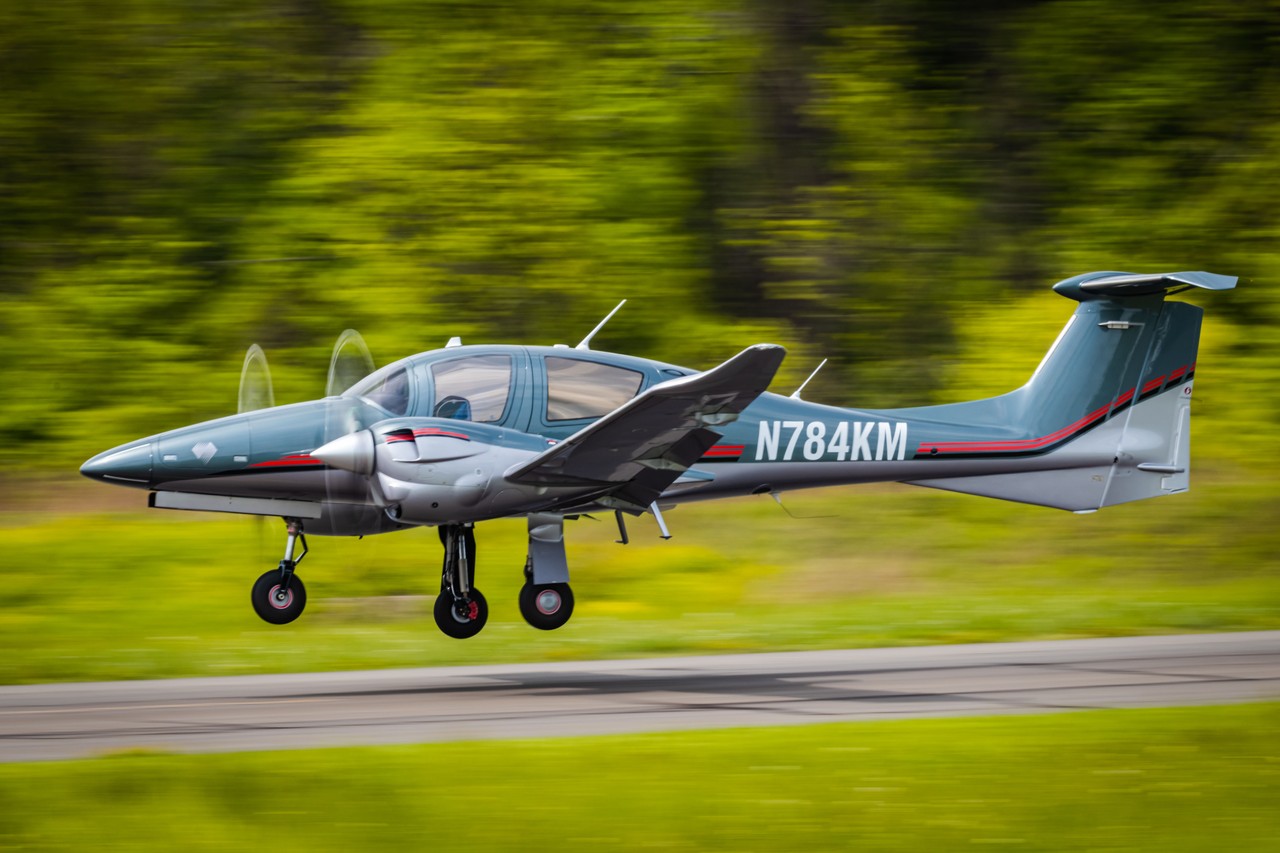
Market Innovation
The DA-62 emerged as Diamond Aircraft's answer to the aging fleet of gasoline-powered light twins, offering what the company marketed as "twin power with single-engine simplicity." By early 2024, Diamond had delivered exactly 273 aircraft since production began in 2015, establishing the DA-62 as a viable alternative to traditional designs from Beechcraft and Piper. The aircraft burns readily available Jet A fuel rather than increasingly expensive 100LL aviation gasoline, providing significant operational cost advantages for high-utilization operators.
Design Philosophy
Under the leadership of managing director Manfred Zipper, Diamond's design team based the DA-62 on the DA50 fuselage but optimized it for twin-engine efficiency. Originally designated DA52, the aircraft incorporated high-aspect-ratio wings and carbon fiber construction to minimize drag. The prototype achieved 16.6 miles per gallon during testing, dramatically better than comparable gasoline twins. Development took just six months from announcement in March 2012 to first flight in April 2012.
Diamond Aircraft Legacy
Diamond Aircraft Industries traces its roots to Hoffmann Flugzeugbau, founded in 1981 in Friesach, Austria, initially producing the H36 Dimona motor glider. The company established its Wiener Neustadt facility in 1987 for the HK36 Super Dimona and evolved through the 1990s into Diamond Aircraft, becoming a pioneer in composite aircraft construction and diesel aviation engines. Key milestones included DA42 approval in 2005 and DA62 EASA certification in 2015. Chinese company Wanfeng Aviation acquired 60% of Diamond Canada in 2016, but the company continues operations at facilities in Wiener Neustadt, Austria, and London, Ontario, Canada.
Powerplant Innovation
The DA-62's twin Austro AE330 engines represent a significant advancement in aviation diesel technology. Each 2.0-liter turbocharged engine produces 180 horsepower and burns Jet A-1 fuel through common-rail injection with EECU single-lever control. Austro Engine, a Diamond subsidiary formed after Thielert's 2008 bankruptcy, manufactures these engines based on Mercedes-Benz automotive technology. The engines initially carried a 1,000-hour time between overhaul limit, increased to 1,800 hours in 2019, making them economically competitive with traditional aviation gasoline engines.
Operational Characteristics
The aircraft accommodates one to two crew members plus five to seven passengers, with an optional third row of seats. Maximum takeoff weight reaches 2,300 kilograms (5,071 pounds) while empty weight is 1,570 kilograms (3,461 pounds). The fuel system holds 86 US gallons (326 liters) of Jet A fuel. Three-bladed MT composite propellers (MTV-6-R-C-F/CF 194-80) provide efficient and quiet operation, addressing noise concerns common with diesel aircraft.
Current Operations
Production has steadily increased from the initial two units delivered in 2015, reaching 53 aircraft in 2022. Notable operators include German Chancellor Friedrich Merz, a certified pilot who owns and flies his own DA-62. The aircraft serves primarily private owner-pilots and flight training schools, though the DA-62 MPP (Multi-Purpose Platform) variant supports law enforcement, search and rescue, and surveillance operations. Standard equipped pricing reached $1,471,950 in 2024.
Global Expansion
Diamond announced plans in January 2023 for Aeromot in Brazil to begin assembly from kits supplied by Diamond Aircraft Canada starting in 2025, targeting 50 aircraft annually primarily for South American markets. This expansion reflects growing international demand for efficient diesel twin aircraft as aviation fuel costs continue rising and environmental regulations tighten.
Industry Impact
The DA-62's success has validated the market for modern diesel twins, proving that composite construction and automotive-derived engines can create viable alternatives to traditional designs. With 273 aircraft delivered and production continuing, the DA-62 bridges general aviation toward more sustainable operations amid concerns about 100LL fuel availability and environmental impact. The aircraft demonstrates that efficiency-focused design can succeed in a market segment traditionally dominated by decades-old powerplant technology.