
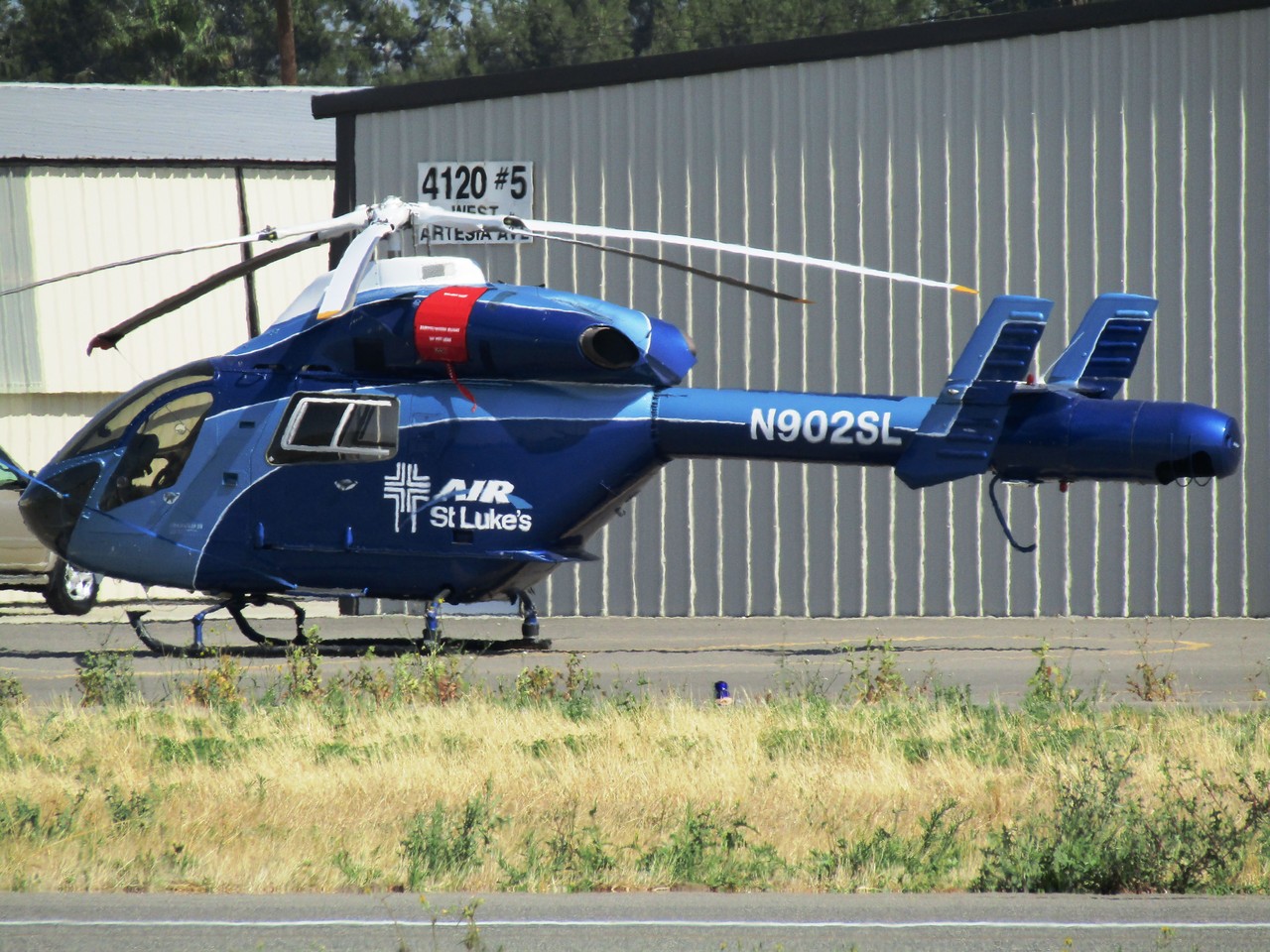
Service History
The MD-900 Explorer carved a specialized niche in the commercial helicopter market during its brief three-year production run from 1994 to 1997. At least 30 aircraft were delivered to operators across seven countries, including the United States, Japan, Korea, Germany, Switzerland, Luxembourg, and Venezuela. The helicopter found primary roles in passenger charter services, corporate transport, and utility operations, capitalizing on its ability to carry eight occupants in greater safety than conventional tail rotor designs.
The Explorer's commercial significance extended beyond raw numbers, as it represented the first successful application of NOTAR technology in a twin-engine helicopter. This innovation addressed one of helicopter aviation's most persistent safety concerns—tail rotor strikes, which historically accounted for numerous accidents in confined landing areas.
The Manufacturer
McDonnell Douglas Helicopters launched the Explorer program in January 1989 under the initial designation MDX, building upon their earlier success with NOTAR technology in the single-engine MD-520N. The company had evolved from Hughes Helicopters, which McDonnell Douglas acquired in 1984, transforming it into McDonnell Douglas Helicopter Systems by the 1990s.
The helicopter division's independence ended when Boeing acquired McDonnell Douglas in 1997, just as MD-900 production was concluding. Boeing subsequently sold the civil helicopter assets to MD Helicopters, Inc., which continues operations from the original Mesa, Arizona facility. This transition ensured the Explorer lineage survived corporate restructuring, with MD Helicopters maintaining production of the improved MD-902 variant.
Engine & Technical Innovation
Two Pratt & Whitney Canada PW206A turboshaft engines power the MD-900, each delivering 464 kilowatts through a sophisticated transmission system. Alternative powerplant options included the Turbomeca TM319-2 Arrius 2C engines rated at 478 kilowatts, providing operators flexibility in performance characteristics.
The Explorer's revolutionary NOTAR system replaces the conventional tail rotor with a tailboom-mounted fan and direct jet thruster arrangement. This design eliminates the vulnerable tail rotor assembly while providing effective anti-torque control through aerodynamic principles rather than mechanical complexity. The system significantly reduces maintenance requirements and operational noise compared to traditional configurations.
Advanced construction techniques distinguished the MD-900 from contemporary helicopters. The entire airframe utilized composite materials, reducing weight while increasing structural integrity. Full computer-aided design (CAD) methodology streamlined manufacturing processes, while a bearingless main rotor system minimized mechanical complexity. Digital avionics included Full Authority Digital Engine Control (FADEC) and liquid crystal displays featuring two six-inch integrated screens—sophisticated technology for the early 1990s.
Development Timeline
Prototype development commenced with ten aircraft constructed, seven designated for ground testing and three for flight trials. Manufacturing partnerships included Hawker de Havilland of Australia, which produced airframe components for initial prototypes. The second prototype, registered N900MD, achieved first flight on December 18, 1992, beginning an intensive certification program.
FAA certification arrived on December 2, 1994, enabling immediate commercial deliveries that same month. The rapid transition from certification to customer delivery demonstrated McDonnell Douglas's confidence in the design and manufacturing processes. However, production concluded in 1997 as the company prioritized the enhanced MD-902 model with uprated PW206E engines.
Performance Characteristics
Operational specifications positioned the MD-900 competitively within the light twin helicopter market. With an empty weight of 1,481 kilograms and maximum takeoff weight of 2,722 kilograms, the Explorer offered substantial payload capacity. Internal fuel capacity of 600 liters provided the 630-kilometer maximum range, while cruise speed of 274 km/h enabled efficient point-to-point transportation.
Single-pilot IFR certification, achieved in February 1997, expanded operational utility by permitting all-weather operations with reduced crew requirements. This capability proved particularly valuable for charter operators and corporate flight departments seeking operational flexibility.
Legacy and Continuing Impact
The MD-900's brief production run belied its technological significance in helicopter development. NOTAR technology validation in a twin-engine platform influenced subsequent helicopter designs, while composite construction techniques became industry standard. The Explorer demonstrated that advanced materials and digital systems could be successfully integrated into production helicopters without compromising reliability.
MD Helicopters' continued production of Explorer variants confirms the design's enduring viability. The MD-902 successor incorporates lessons learned from MD-900 operations while maintaining the fundamental NOTAR and composite construction advantages that distinguished the original model.
Though no specific museum examples are documented, the MD-900's influence persists in modern light twin helicopters. Its pioneering integration of NOTAR technology, composite construction, and digital avionics established benchmarks that continue shaping helicopter development three decades after the program's 1989 launch.