
Service History
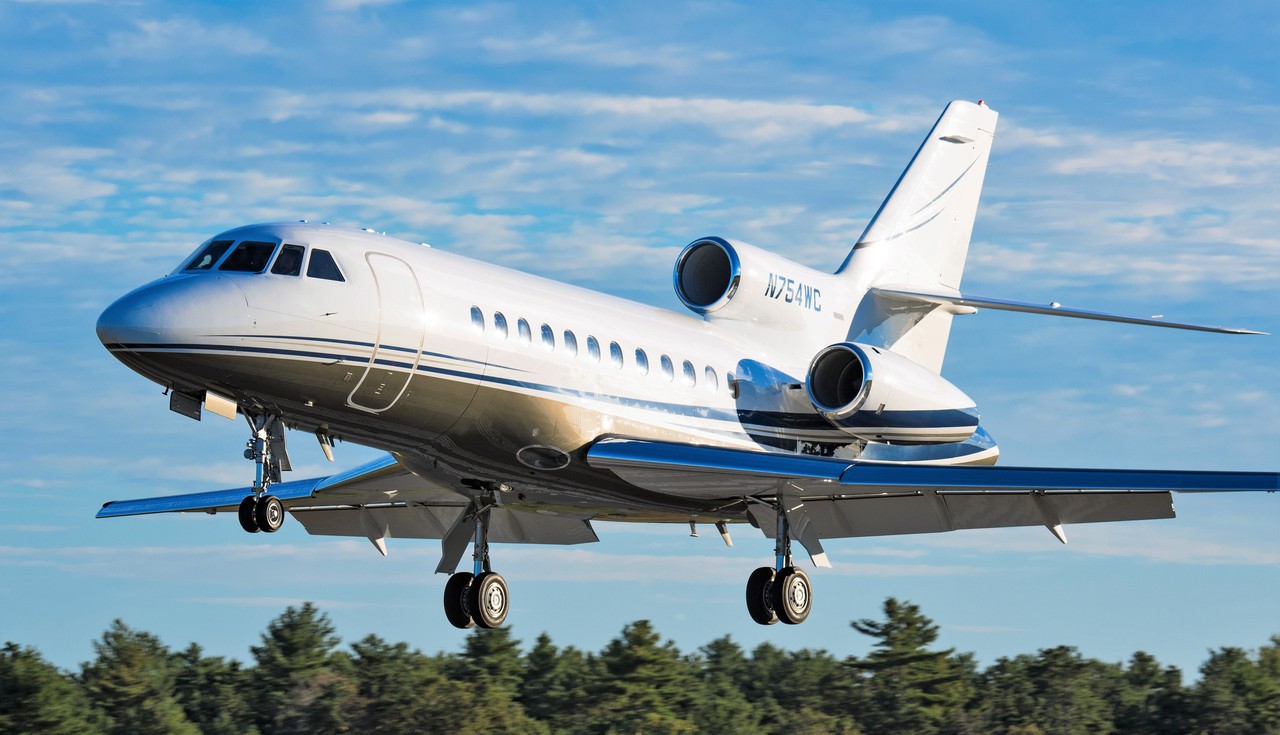
Since entering service in 1986, the Falcon 900 has dominated the long-range business jet market with over 500 tri-jets delivered across multiple variants. The aircraft carved out a unique niche in corporate aviation by offering airline-like range capabilities in a mid-size business jet configuration. By 2000, fractional ownership programs had acquired 60 Falcon jets, with continuous expansion in this growing market segment. The platform's success contributed to Dassault's achievement of delivering more than 2,700 business jets across the entire Falcon family by May 2023.
The Manufacturer
Dassault Aviation traces its origins to 1938 when Marcel Bloch established an engine factory in France that became the company's headquarters. The company gained international recognition primarily through its Mirage fighter aircraft series, with Dassault jets demonstrating Mach 2 capability in level flight by 1958. This military aviation expertise provided the technological foundation for the company's entry into business aviation. Today, Dassault Aviation continues operating under the same name, maintaining both military and civilian aircraft production lines from its Mérignac facility in France.
Engine & Technical Details
The original Falcon 900 employs three Honeywell TFE731-5BR-1C turbofan engines, each generating 21.13 kN (4,750 lbf) of thrust in a distinctive tri-jet configuration. Later variants received upgraded powerplants, with the Falcon 900EX featuring TFE731-60 engines producing 22.24 kilonewtons (5,000 pounds-force). The aircraft requires a two-pilot crew and incorporates advanced avionics systems that evolved from basic instrumentation to the sophisticated Honeywell Primus Epic EASy cockpit in later models. Computer-aided design technology enabled Dassault engineers to achieve precise weight and performance predictions during development, a notable advancement for 1980s aircraft manufacturing.
Performance & Pilot Perspective
The Falcon 900 delivers exceptional range performance with the original variant capable of 4,750 nautical miles, while the modern 900LX extends this to 4,800 nautical miles with blended winglets. Test pilots Hervé Leprince-Ringuet and Jérôme Résal conducted the maiden flight, establishing the aircraft's flight characteristics that pilots praise for stability and handling qualities. The tri-jet configuration provides redundancy valued in long-range operations, though it requires more complex systems management compared to twin-engine competitors. Maximum takeoff weight reaches 20,640 kg (45,503 lb) with fuel capacity of 8,690 kg (19,160 lb).
Production Evolution & Variants
Dassault has continuously refined the Falcon 900 through multiple variants since 1984 production began. The Falcon 900B introduced more powerful engines, followed by the 900C in 2000 as a replacement model. The Falcon 900EX, launched in 1996, became a significant success with its 4,500 nautical mile range and Honeywell Primus avionics integration. The 900EX EASy variant (2004-2009) featured advanced Honeywell/Dassault Primus Epic EASy avionics. Currently, the Falcon 900LX represents the production standard, having received FAA and EASA certification in July 2010 with 82 aircraft manufactured through recent years.
Specialized Applications
Beyond corporate transport, the Falcon 900 serves specialized roles including the Falcon 900 MSA maritime patrol version equipped with search radar for the Japan Coast Guard. Dassault developed an experimental 900B variant with laminar flow wings to demonstrate drag-reducing technology using modified airfoils and layer stabilization based on computational fluid dynamics studies. These applications showcase the platform's adaptability beyond traditional business aviation missions.
Legacy and Current Status
The Falcon 900 platform represents nearly four decades of continuous production and technological advancement in business aviation. By July 2017, the broader Falcon family had delivered its 2,500th aircraft, with more than 2,100 aircraft in service among 1,230 operators across 90 countries, accumulating 17.8 million flight hours. The Falcon 900LX continues production today, demonstrating the enduring market appeal of Dassault's tri-jet design philosophy. The aircraft's success established Dassault as a permanent competitor in international business aviation markets, leveraging military aircraft expertise into civilian applications with remarkable effectiveness.