
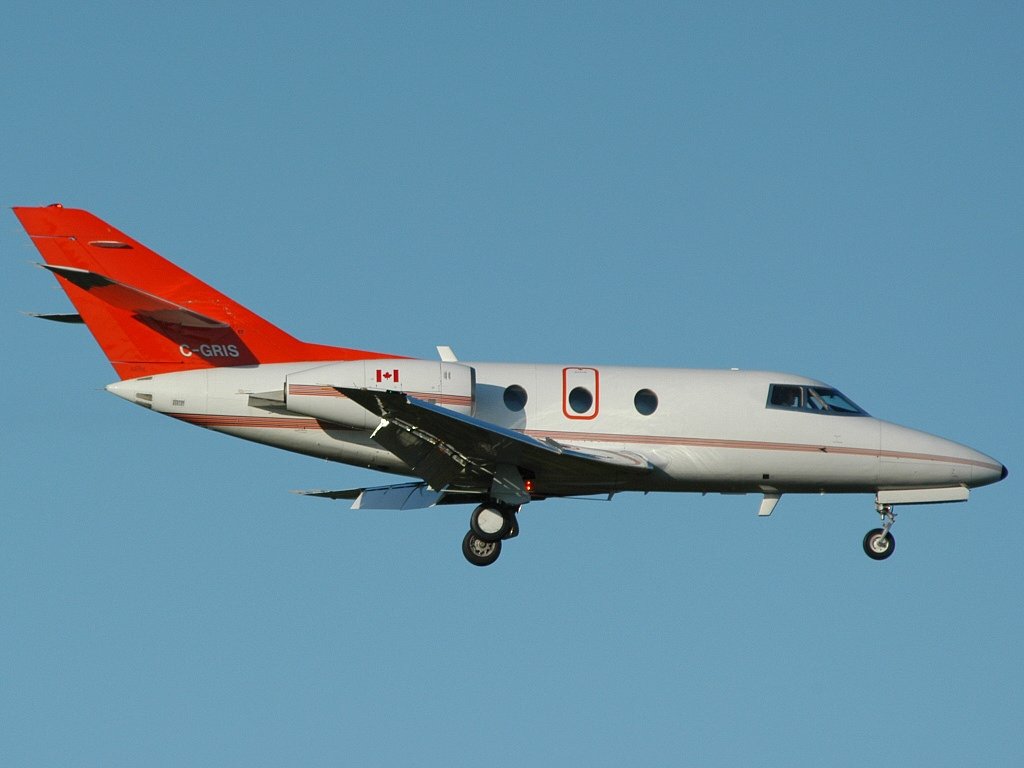
Design and Development
The Falcon 10's creation began on May 5, 1969, when Benno Claude Vallières of Dassault's Paris Saint-Cloud Design Department proposed a "mini Falcon 20" concept. This initiative responded to growing demand from Pan American Airways and French Air Force personnel for a high-performance aircraft serving 4-7 passengers. Unlike many aircraft that evolved from existing designs, Vallières engineered the Falcon 10 as an entirely new platform, incorporating a non-circular fuselage and innovative wing design with slotted flaps.
Test pilots Hervé Leprince-Ringuet and Jean Coureau lifted the prototype from Bordeaux-Mérignac Airport on December 1, 1970. The aircraft immediately demonstrated its designer's fighter-like engineering philosophy, delivering performance that exceeded contemporary business jets by 10-20 percent. However, this aggressive approach initially created handling challenges that required airfoil modifications before certification.
Technical Innovation
Powered by twin Garrett AiResearch TFE731-2 turbofans producing 3,230 pounds of thrust each, the Falcon 10 achieved remarkable performance figures for its size. The aircraft reached a maximum speed of 492 knots, climbed at 4,600 feet per minute, and operated at altitudes up to 45,000 feet. Its 1,560-nautical-mile range on 3,340 liters of fuel made transcontinental flights feasible in the compact airframe.
The TFE731 engine series, introduced by Garrett in 1969, proved smaller than competing powerplants while maintaining exceptional reliability. These turbofans enabled the Falcon 10's outstanding short-field capabilities, allowing operations from runways as brief as 3,300 feet—a critical advantage for accessing smaller airports unavailable to larger corporate aircraft.
Production and Early Service
Dassault Aviation began production in 1971 at its Bordeaux-Mérignac facility, continuing through 1989 with 226 total aircraft completed. The production run included 189 standard Falcon 10s manufactured from 1973 to 1982, followed by 37 improved Falcon 100 variants from 1983 to 1989. Serial numbers ranged from 001 through 190 for the original series.
Pan Am Business Jets became the launch customer, signing a protocol for 40 aircraft plus 120 options at the 1969 Paris Air Show. This substantial commitment, approved by French Secretary Jacques Chirac, validated the market demand Vallières had identified. Lufthansa's subsidiary Travelair ordered 15 aircraft for operations across Germany and Scandinavia, further establishing the type's European presence.
FAA certification arrived in 1973, delayed by a tragic test flight accident on October 31, 1972, that claimed two pilots' lives. This setback forced Dassault to address the fighter-like handling characteristics through design modifications before achieving airworthiness approval.
The Manufacturer Legacy
Dassault Aviation traces its origins to 1938 when Marcel Bloch established an engine factory in France. After World War II nationalization created Société Nationale Industrielle Aérospatiale, Marcel Dassault regained control during the 1960s, launching the Falcon series with the 20-passenger Falcon 20 prototype in 1963. The company avoided major mergers affecting Falcon 10 production and continues operations today under the Dassault Aviation name, producing modern variants like the Falcon 7X and 2000S.
Operational History
The Falcon 10 achieved its design goal of becoming the fastest business jet of the early 1970s, filling a crucial market niche between larger corporate aircraft and turboprop alternatives. Its military-grade construction standards, derived from Dassault's fighter aircraft experience, provided exceptional durability for civilian operations.
The French Navy currently operates six Falcon 10s with Escadrille 57S for instrument training and utility missions. Morocco employs the type for general governmental purposes, while Air Nunavut in Canada utilizes Falcon 10s for commercial passenger operations in challenging northern conditions.
Market Impact and Legacy
By 2018, used Falcon 10 aircraft commanded prices between $300,000 and $600,000, reflecting continued demand for their combination of performance and economy. More than 20 examples remain active worldwide, testament to the type's enduring utility and Dassault's ongoing parts support.
The Falcon 10's significance extends beyond its production numbers, establishing design principles that influenced subsequent business jet development. Its emphasis on short-field performance, high-altitude capability, and compact efficiency created a template for the modern light business jet category, proving that smaller aircraft could deliver airline-quality performance for specialized missions.