
Service History
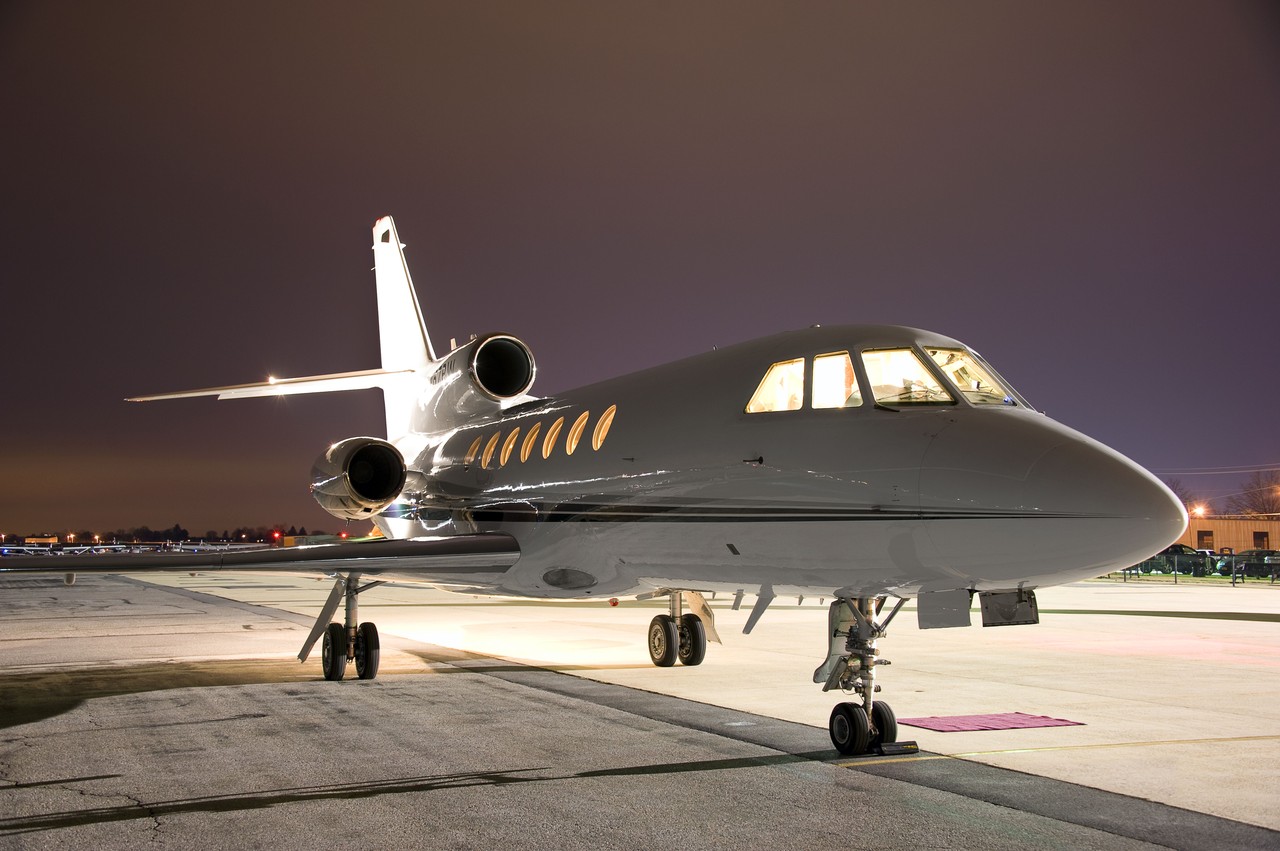
The Falcon 50 dominated the long-range business aviation market for over three decades, fundamentally changing how corporate executives conducted international business. During its 32-year production run, 347 aircraft were delivered, including 248 original Falcon 50s and 99 upgraded Falcon 50EX variants. The aircraft enabled direct flights between major business centers like New York and London, eliminating the need for fuel stops that had previously characterized business aviation. By the 1990s, the Falcon 50 had become synonymous with transatlantic corporate travel, operating routes that were impossible for earlier business jets.
Design Innovation and Development
In 1974, Dassault engineers recognized that existing business jets could not meet the growing demand for direct transatlantic flights due to regulatory restrictions on twin-engine aircraft over water. The solution was a three-engine configuration using Garrett TFE731-3-1C turbofans, which satisfied safety regulations while providing the necessary range and performance. The design team, led by engineers who would later see test pilots Hervé Leprince-Ringuet and Gérard Joyeuse conduct the maiden flight from Bordeaux-Mérignac Airport, incorporated supercritical wing technology—making the Falcon 50 the first civil aircraft to feature this advanced aerodynamic innovation.
The supercritical wings represented a breakthrough that delayed the onset of shock waves, improving fuel efficiency and high-altitude performance. This technology proved so successful that Dassault later adapted it for the Falcon 900 and Falcon 2000 series. The aircraft received French and U.S. certification in 1979, with first deliveries beginning in 1980.
Manufacturing Excellence
Dassault Aviation orchestrated production across three specialized French facilities through an innovative partnership with Aerospatiale and government backing. The fuselage and 55 percent of the airframe were constructed at the Aerospatiale plant in Saint-Nazaire on France's west coast, while wings were built at Dassault's Colomiers facility in the southwest. Final assembly and testing took place at the Mérignac facility in Nouvelle-Aquitaine, creating a distributed manufacturing system that maximized French aerospace expertise.
This multi-site approach allowed Dassault to leverage specialized capabilities while maintaining quality control. Production of the original variant continued until 1996, when the improved Falcon 50EX entered service with upgraded Honeywell TFE 731-40 turbofans, enhanced avionics, and an auxiliary power unit as standard equipment.
Performance and Capabilities
The Falcon 50's cabin measured 23.5 feet long, 6.1 feet wide, and 5.8 feet tall, providing 700 cubic feet of passenger space configured for nine travelers in typical layouts, with capacity for up to twelve passengers. The baggage hold accommodated approximately ten suitcases, ensuring each passenger could carry substantial luggage for extended international trips. The aircraft's 3,400-nautical-mile range enabled nonstop flights across the continental United States and direct North Atlantic crossings.
The upgraded Falcon 50EX demonstrated even more impressive performance, climbing to 41,000 feet in just 23 minutes—a capability that allowed it to quickly reach optimal cruising altitudes and avoid weather systems. This high-altitude performance, combined with the three-engine configuration, provided operators with exceptional reliability and safety margins over oceanic routes.
Military and Government Service
While primarily designed for civilian use, the Falcon 50 spawned the Gardian 50 variant for maritime and surveillance operations. The French Navy operated eight Gardian 50s for coastal patrol, environmental monitoring, and surveillance missions, demonstrating the platform's versatility beyond corporate transportation. These military variants featured specialized equipment for their reconnaissance roles while maintaining the basic airframe's proven reliability.
Legacy and Impact
The Falcon 50 established Dassault as a premier manufacturer of long-range business jets and proved that European companies could compete successfully in the American-dominated corporate aviation market. Its success validated the tri-jet configuration for business aviation and demonstrated that sophisticated aerodynamic innovations like supercritical wings could be successfully adapted from military to civilian applications.
Production concluded in early 2008 after 347 aircraft had been delivered, making it one of the most successful ultra-long-range business jets ever manufactured. The aircraft's pioneering transatlantic capability opened new possibilities for international business travel and established performance benchmarks that influenced subsequent business jet development. Many Falcon 50s remain in active service today, testament to their robust design and enduring utility in corporate and government operations worldwide.