
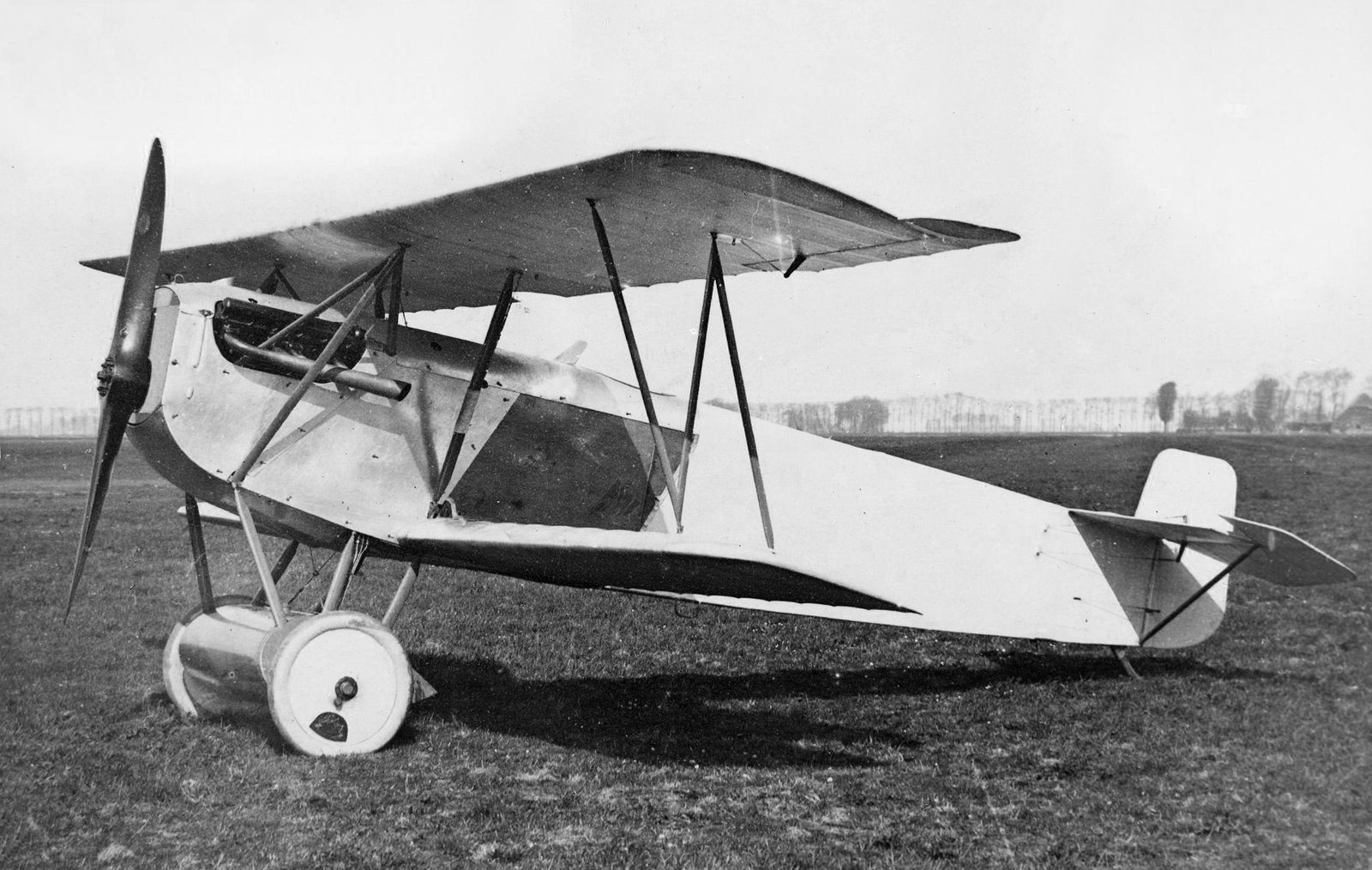
The Fokker D.IX was a single-seat, single-engine fighter prototype developed by Fokker-Flugzeugwerke in the Netherlands. Emerging in 1921, the aircraft was designed as a late-stage, high-performance evolution of the highly successful Fokker D.VII concept. The D.IX sought to push the boundaries of the D.VII formula by incorporating a significantly more powerful powerplant, reflecting the broader aviation trend of the post-World War I era to increase fighter performance.
Only one D.IX airframe was ever constructed. The prototype first flew in 1921, though a specific date for the maiden flight was not recorded. Technically, the aircraft featured a length of 8.99 meters, a wingspan of 7.09 meters, and a height of 2.74 meters. Its wing area totaled 22.11 square meters. In terms of weight, the prototype had an empty weight of 874 kg and a gross weight of 1,253 kg.
Powerplant configurations varied during the aircraft's short lifespan. It initially flew using a water-cooled V-8 Hispano-Suiza 8Fb engine producing 300 hp. Following its acquisition by the U.S. Army Air Service in 1922, the aircraft was refitted with a Wright M-2 engine. The Wright M-2 was a licensed, locally produced version of the Hispano Type 42 and provided an increase in power to 320 hp. This engine configuration allowed the D.IX to reach a maximum sea-level speed of 223 km/h and a cruise speed of 188 km/h, with a total range of 471 km. Its climb performance was noted at 6.3 minutes to reach an altitude of 1,980 meters.
While the D.IX never entered production or operational combat service, it underwent experimental evaluation in the United States. Shipped to McCook Field, the aircraft was redesignated as the PW-6. During this phase, the U.S. Army Air Service equipped the fighter with two fixed 7.7 mm machine guns mounted in the upper engine cowling, which fired through the propeller. Despite these modifications and the increased power, the U.S. evaluation concluded that the aircraft was not worth further development. Today, the D.IX is regarded as a lost prototype with no surviving airframes in flying condition.