
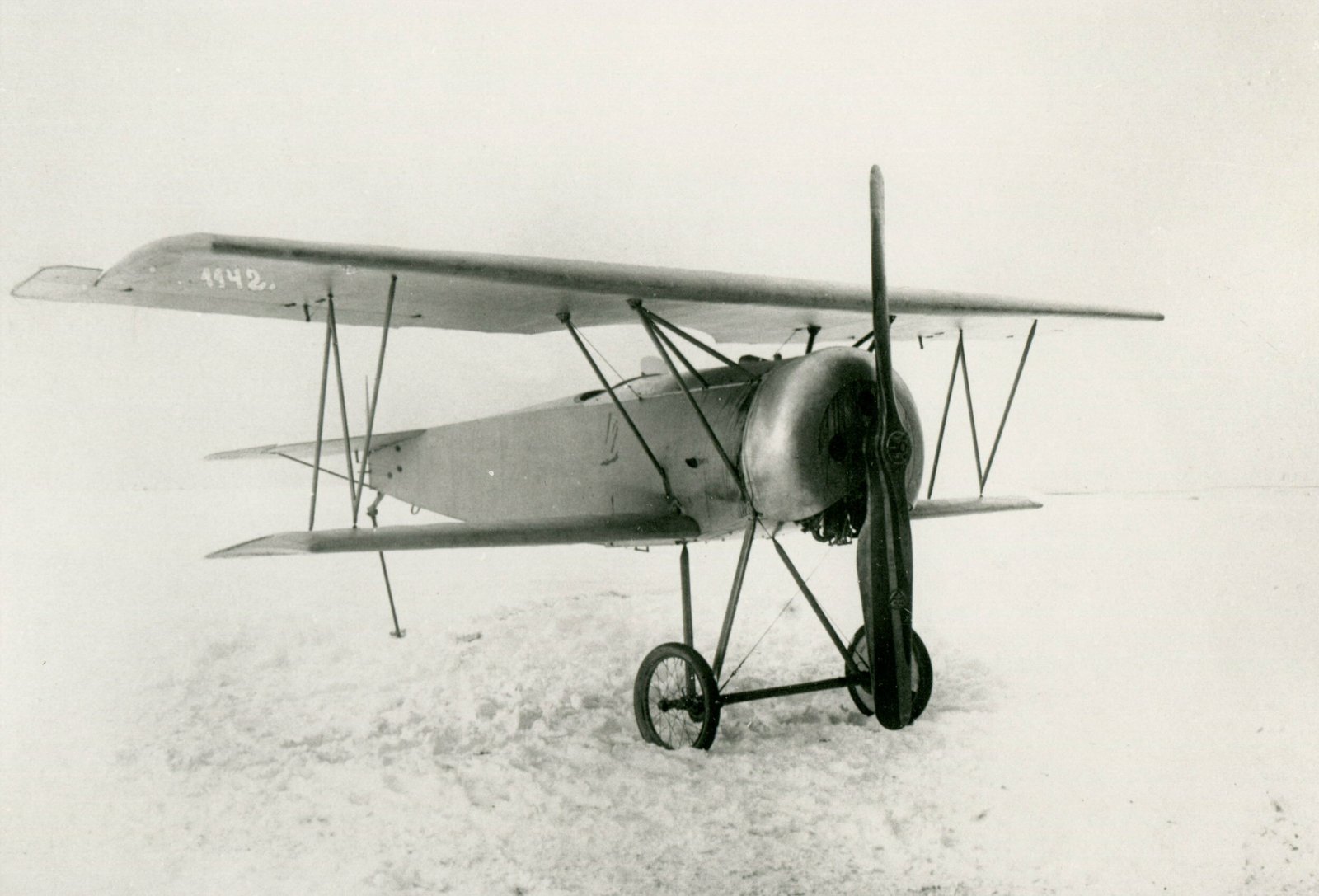
The Fokker D.VI was a short-lived but influential German single-seat fighter developed during the final stages of World War I. Designed by Reinhold Platz, the aircraft represented a hybrid engineering approach; it utilized the fuselage and empennage of the Fokker Dr.I triplane combined with scaled-down cantilever wings derived from the Fokker D.VII. This design philosophy eliminated the need for external wing bracing, a hallmark of Fokker's evolving structural technology.
Development began in late 1917 with the construction of two prototypes, V.13/1 and V.13/2. These aircraft participated in fighter trials at Adlershof in January 1918, where they were recognized as the premier rotary-powered aircraft of the competition. Following these trials, the type passed its official German Typenprüfung (type test) on March 15, 1918, receiving the military designation D.VI. Production was handled by Fokker-Flugzeugwerke, with deliveries commencing in April 1918 and concluding in August 1918. A total of 59 aircraft were produced to fulfill an order from the German Army (Idflieg).
Technical specifications varied by engine fit. The V.13/1 prototype used a 108 kW (145 hp) Oberursel Ur.III, while the V.13/2 used a 119 kW (160 hp) Siemens-Halske Sh.III. Of the 59 production aircraft, 47 were equipped with the 82 kW (110 hp) Oberursel Ur.II rotary engine, and 12 utilized the 160 hp Goebel Goe III rotary engine. The standard Oberursel-powered variant achieved a maximum speed of 197 km/h (123 mph) and a service ceiling of 6,000 meters. For armament, the D.VI carried two synchronized 7.92 mm LMG 08/15 "Spandau" machine guns.
Operationally, the D.VI served with the Luftstreitkräfte and the Austro-Hungarian Luftfahrtruppen, the latter receiving seven aircraft. Within Germany, many were assigned to Kampf Einsitzer Staffeln for bomber interception, where the air-cooled engine allowed for rapid takeoff readiness. Frontline service ended by September 1918, after which the aircraft were relegated to home defense and training units. Notable pilots include Bavarian ace Leutnant Kurt Seit of Jagdstaffel 80b, who achieved five victories flying the D.VI and D.VII. Post-war, the Romanian Air Corps captured six D.VIs during a 1919 conflict, and the Royal Hungarian Air Force also operated the type. While no original airframes survive today, the D.VI is preserved through replicas, including a full-scale flying reproduction at the Old Rhinebeck Aerodrome.