
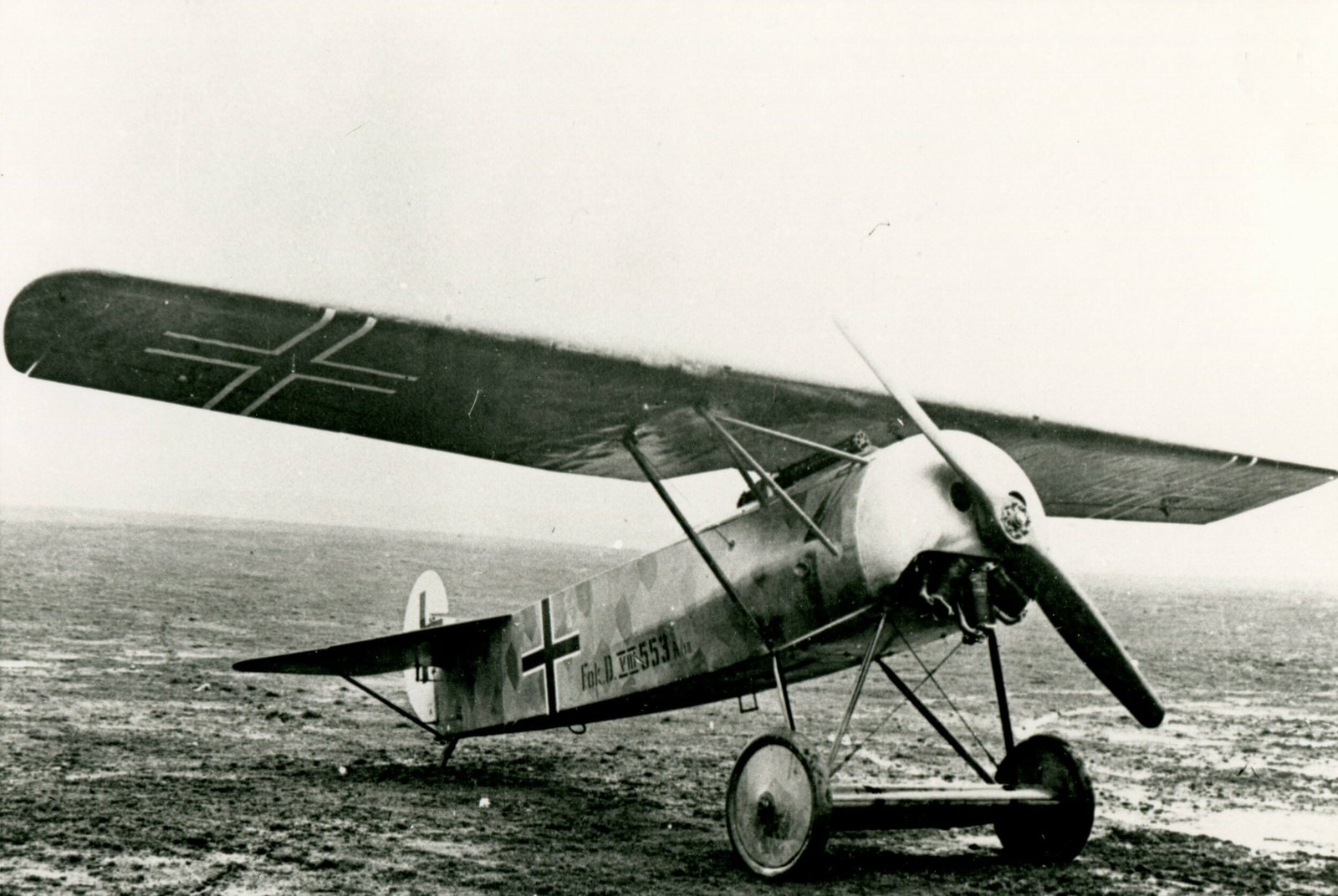
The Fokker D.VIII, originally designated as the Fokker E.V, was a late-World War I German single-seat fighter monoplane. Designed by Reinhold Platz, the aircraft was characterized by its parasol-wing configuration, which placed the wing above the fuselage to provide pilots with excellent upward and downward visibility. A defining technical feature was its thick, cantilever wooden wing, which eliminated the need for external bracing wires or struts, significantly reducing drag. This innovative design earned the aircraft the nickname "Flying Razor" among British airmen due to its thin profile and small frontal area.
Production took place in 1918 at Fokker-Flugzeugwerke factories in Germany, specifically in Schwerin and Leipzig. While production totals vary, estimates suggest approximately 380 to 381 airframes were built, though only about 85 reached front-line service before the Armistice on November 11, 1918. The aircraft was powered by a single 9-cylinder, air-cooled Oberursel UR.II rotary piston engine producing 82 kW (110 hp). Despite the advanced airframe, the UR.II was considered an obsolete powerplant by 1918, and its performance was further hindered by castor oil shortages in Germany.
Operational history was brief and marred by structural failures. After entering service on August 5, 1918, several E.V aircraft suffered wing failures resulting in three fatal crashes. Investigations revealed substandard subcontractor work and inner wing rot caused by wet weather. Consequently, the fleet was grounded in mid-August for a wing redesign. The modified aircraft returned to service in early November 1918 and were redesignated as the Fokker D.VIII. Due to this timing, the aircraft saw very limited combat; the only reported aerial victory occurred on August 17, 1918, achieved by Lt. Emil Rolff of Jasta 6.
Following the war, the D.VIII saw limited paramilitary and international service. The Polish Air Force operated captured examples during the Polish–Soviet War, and the Soviet Air Force utilized one captured aircraft into the mid-1920s. Other operators included the Belgian Air Force, the Dutch Luchtvaartafdeling, and the United States Army Air Service, which tested a D.VIII (designated P-165) at McCook Field, Ohio, until 1927. Today, no original wartime airframes are known to survive; however, full-scale reproductions are displayed at the Museum of Flight and the Military Aviation Museum.