
Design and Development
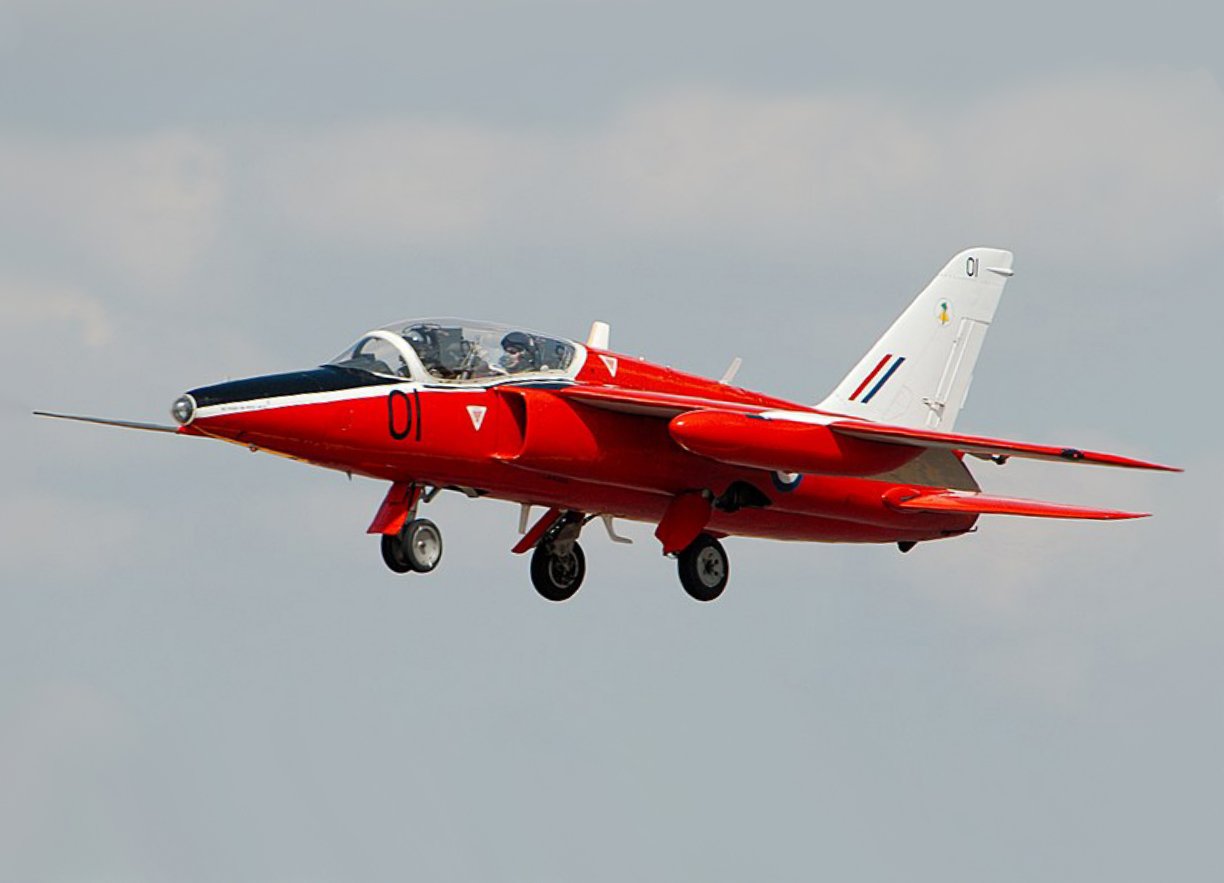
Designed in the mid-1950s by W.E.W. Petter, the Folland Gnat was conceived as a "minimum" fighter. Petter's philosophy focused on creating a lightweight, low-cost aircraft that could be manufactured and maintained without the need for highly specialized tools, making it accessible for nominally industrialized nations. The resulting aircraft was a tiny, single-seat, subsonic, swept-wing jet that was, for a period, the smallest jet fighter in the world. The prototype first took flight on July 18, 1955.
Production and Manufacturer History
The aircraft was developed by Folland Aircraft Ltd, based in Hamble, Hampshire. In 1959, Folland was acquired by the Hawker Siddeley Group, and by 1977, these interests were absorbed into the state-owned British Aerospace (BAe), which later became BAE Systems. While UK production began with the prototypes in the mid-1950s, the aircraft saw extensive licence-production in India by Hindustan Aeronautics Limited (HAL). HAL produced 193 Gnats in Bangalore, with the final Indian-built aircraft leaving the production line in 1974.
Technical Specifications and Performance
Depending on the variant, the Gnat was powered by different models of the Bristol Siddeley Orpheus turbojet. The Gnat T.1 trainer utilized the Orpheus 100, producing 4,230 lbf of thrust, while the fighter variants often used the Orpheus 701. The fighter configuration (F.1) measured approximately 8.7 meters in length with a wingspan of 6.76 meters. Performance varied by model; the T.1 trainer reached maximum speeds of 636 mph with a service ceiling of 48,000 feet and a climb rate of 20,000 ft/min. The F.1 fighter was capable of reaching 695 mph (Mach 0.98). The fighter variant was armed with two 30 mm ADEN cannons and four under-wing hardpoints for rockets or two 500 lb bombs.
Military Service and Legacy
The Gnat served several nations in diverse roles. The Royal Air Force (RAF) operated the Gnat T.1 as an advanced jet trainer from 1962 until 1978. It also served as the original mount for the RAF's Red Arrows (and the earlier Yellowjacks) aerobatic team. Finland operated the Gnat F.1, and on July 31, 1958, pilot Lauri Pekuri became the first Finn to break the sound barrier in the type. Yugoslavia also acquired the F.1 variant.
The Indian Air Force (IAF) was the largest operator, entering service in March 1960. The Gnat earned the nickname "Sabre Slayer" during the Indo-Pakistani War of 1965 due to its success against Canadair Sabres. During the 1971 conflict, Flight Lieutenant V. P. Vadera flew Gnat E1076 on 20 combat missions. The IAF phased out the Gnat between 1976 and 1978, though the design served as the basis for the indigenous HAL Ajeet. Today, examples are preserved at the March Field Air Museum and the Planes of Fame Air Museum in the United States.