
Service History
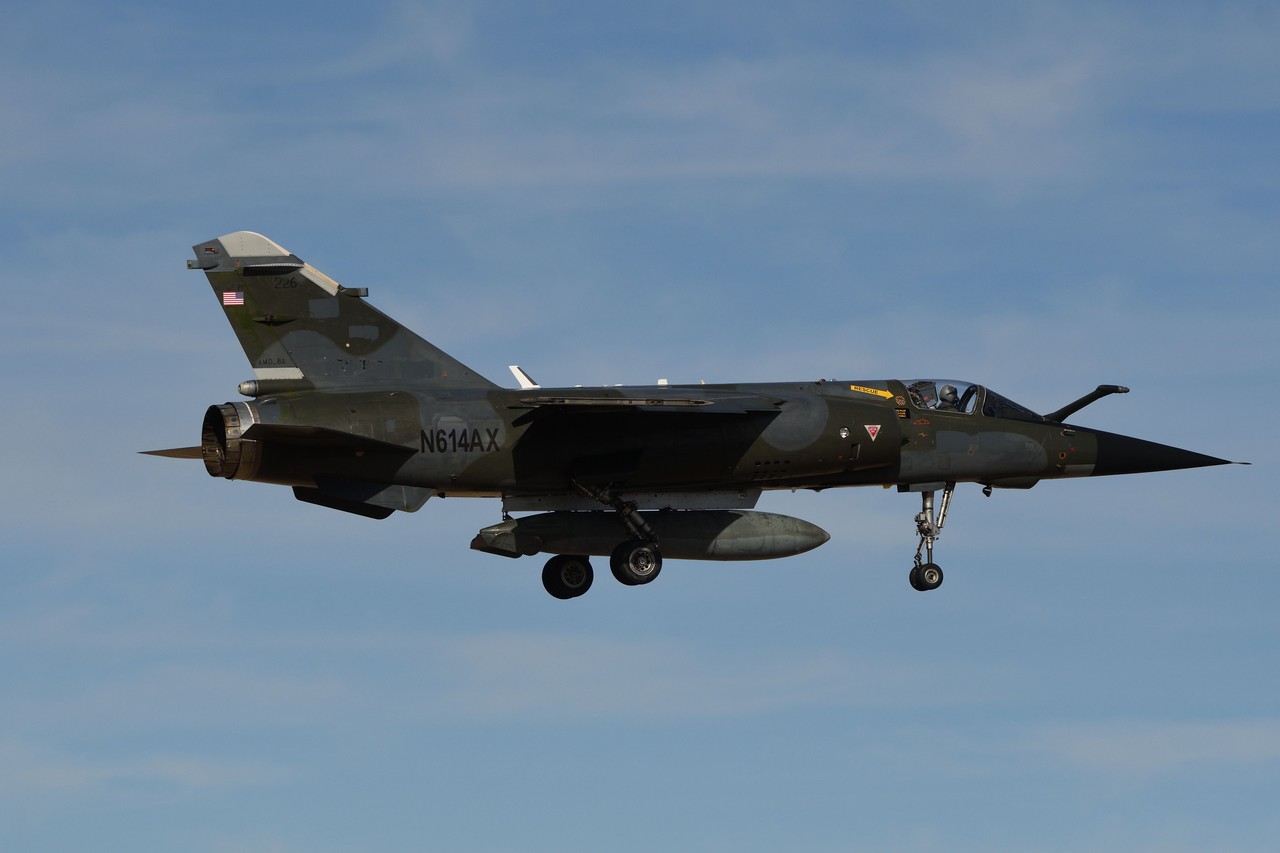
The Mirage F1 achieved remarkable export success, serving with fourteen air forces across four continents. France operated the type as its primary interceptor from May 1973, with the F1C variant entering squadron service in 1974. International operators included Ecuador, Gabon, Greece, Iran, Iraq, Jordan, Kuwait, Libya, Morocco, Qatar, South Africa, and Spain, plus United States aggressor squadrons. Of the 726 aircraft produced, 473 were delivered for export, demonstrating the aircraft's appeal in the competitive fighter market of the 1970s and 1980s.
Combat Operations
The F1 saw extensive combat during the Iran-Iraq War from 1980 to 1988, where Iraqi F1s performed both air superiority and ground-attack missions. During the 1991 Gulf War, Iraqi Mirage F1s suffered losses against coalition forces. South African F1AZ variants participated in the Border War, while Moroccan F1s conducted operations against Polisario forces. The aircraft's multirole capability proved valuable in these conflicts, transitioning seamlessly between interceptor and ground-attack roles.
The Manufacturer
Dassault Aviation, originally founded in 1929 as Société des Avions Henri et Maurice Farman, underwent significant transformation under Marcel Dassault following World War II. The company had already established its reputation with the Mirage III series, producing over 1,400 units that entered service in 1961. During the 1970s, Dassault integrated with Breguet Aviation and continued evolving into its current form. The F1 program began as a private venture after the cancellation of the larger Mirage F2, demonstrating Dassault's ability to adapt quickly to changing market conditions. Today, Dassault Aviation remains a major aerospace manufacturer, having successfully transitioned the lessons learned from the F1 into subsequent designs like the Mirage 2000.
Design Innovation
Dassault's engineering team developed the F1 specifically to address the limitations of delta-wing aircraft in low-altitude operations. The high-mounted swept wings provided significantly better low-speed handling and enabled shorter takeoff distances compared to the Mirage III. Internal fuel capacity increased by 40 percent over the Mirage III, dramatically improving mission range. The conventional tail configuration enhanced maneuverability, while integration of the Cyrano radar system provided all-weather intercept capability.
Engine and Performance
The production F1 utilized the SNECMA Atar 9K-50 afterburning turbojet, producing 15,000 pounds of thrust and enabling the aircraft to reach Mach 2.2 at altitude. SNECMA, now known as Safran Aircraft Engines, had developed the Atar series throughout the 1960s specifically for high-performance French military aircraft. The 9K-50 variant represented a significant improvement over the prototype's 9K-31 engine, providing the power necessary for the F1's demanding mission requirements.
Development Tragedy and Triumph
The F1's development began promisingly when the first prototype achieved its maiden flight on December 23, 1966, with test pilot René Bigand at the controls at Melun-Villaroche. The aircraft reached Mach 2 in January 1967, validating the basic design concept. However, tragedy struck on May 18, 1967, when flutter destroyed the first prototype, killing Bigand. Development continued with the first preproduction aircraft, dubbed "Super Mirage F1," flying on March 20, 1968, piloted by Jean-Marie Saget. Second and third preproduction aircraft followed on September 18, 1969, and June 17, 1970, respectively.
Variants and Specialization
Dassault produced twelve distinct F1 variants to meet diverse operational requirements. The F1A served as an export ground-attack variant, notably operated by South Africa. Two-seat F1B and F1D variants provided training capabilities. The F1C formed the backbone of French interceptor squadrons, while 79 F1C/200 aircraft built between 1977 and 1983 featured aerial refueling probes for extended range missions. The F1E offered enhanced multirole capability, and the experimental F1.M53 variant, first flying on December 22, 1974, tested the more powerful M53 engine that would later power the Mirage 2000. The F1R provided dedicated reconnaissance capability for intelligence gathering missions.
Legacy and Preservation
More than fifty years after introduction, limited numbers of Mirage F1s remain operational with several air forces worldwide as of 2023. The first preproduction aircraft is preserved at the Musée de l'Air et de l'Espace at Le Bourget, France, serving as a testament to this successful design. The F1's legacy lies in proving that high-performance interceptors could excel at both short-field operations and low-altitude missions, filling a crucial capability gap during the Cold War era. Its export success established Dassault as a reliable partner for nations seeking advanced fighter aircraft, while its design philosophy directly influenced the development of the Mirage 2000 series that succeeded it in French service.