
Development and Design
The PA-32R-300 Lance emerged from necessity when Piper Aircraft lost its Comanche production capability to a devastating 1972 flood that destroyed critical manufacturing tooling. Piper's engineering team responded by developing a retractable-gear variant of the successful PA-32 Cherokee Six, creating what would become the company's new flagship single-engine aircraft. The prototype took its maiden flight on August 30, 1974, with customer deliveries beginning in October 1975.
The Lance represented a significant advancement in general aviation design, combining the spacious cabin and heavy-lift capabilities of the Cherokee Six with the performance benefits of retractable landing gear. The aircraft featured an all-metal, low-wing configuration similar to the twin-engine Seneca, with which it shared production facilities. Engineers incorporated several innovations including a four-tank fuel system with 94 gallons of usable capacity and an optional seventh seat positioned between the center pair of seats.
Production and Variants
Piper manufactured the Lance at its Vero Beach, Florida facility from 1976 through 1978, initially marketing it as the Cherokee Lance. Production numbers demonstrate the aircraft's market acceptance: 523 units delivered in 1976, 548 in 1977, and 68 in 1978, totaling 1,139 aircraft across the early Lance models. The Lance II variant followed with 572 deliveries in 1978 and 231 in 1979.
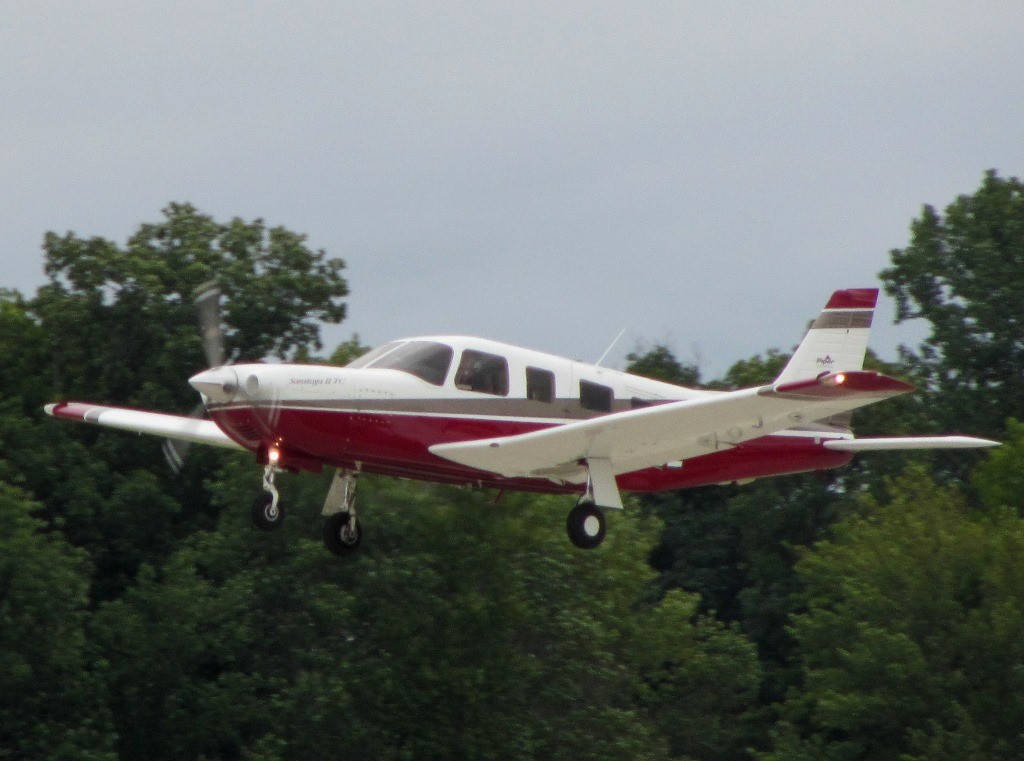
A significant development occurred in 1977 with the introduction of the T-tail configuration on certain models. This design change positioned the horizontal stabilator outside the propeller wash for improved aerodynamic efficiency. However, the T-tail created low-speed handling challenges that led to its eventual abandonment in favor of the conventional tail design.
The turbocharged variant, designated PA-32RT-300T Turbo Lance, utilized the Lycoming TIO-540-S1AD engine, distinguishing itself with a single oval air intake positioned below the propeller hub. This was an industry first for the configuration and allowed the aircraft to cruise at 175 knots true airspeed at 10,000 feet while consuming 20 gallons per hour at 75 percent power.
International Production
The Lance's success extended beyond Piper's Florida facility through licensing agreements with international manufacturers. Embraer and NAIVA in Brazil produced 150 EMB-721C Sertanejo aircraft based on the PA-32R-300 and PA-32RT-300 designs, followed by 55 EMB-721D Sertanejo variants derived from the PA-32R-301. Additional license production occurred in Argentina through CHINCUL and in Colombia via AICSA, bringing total international Sertanejo production to 205 aircraft.
Engine and Performance
The PA-32R-300 Lance was powered by the Lycoming IO-540-K1G5D, a normally aspirated, flat-six piston engine producing 300 horsepower. This powerplant, manufactured by Lycoming Engines (a division of Textron), featured a 2,000-hour time between overhaul interval. The turbocharged variants employed the TIO-540-S1AD with an 1,800-hour TBO.
Performance specifications positioned the Lance as a true cross-country machine. The normally aspirated version achieved a maximum speed of approximately 201 mph in cruise configuration, while the turbocharged variant could reach 222 mph. Range extended to 852 miles, with the turbo model demonstrating a service ceiling of 20,000 feet and an initial climb rate of 1,050 feet per minute.
The Manufacturer's Journey
Piper Aircraft's development of the Lance occurred during a period of significant corporate change. Founded in 1927 by William T. Piper as Taylor Brothers Aircraft Manufacturing Company and renamed Piper Aircraft in 1930, the company had established itself as a major general aviation manufacturer. However, ownership shifted multiple times during the Lance's production years: Bangor Punta acquired Piper in 1969, followed by Chris-Craft Industries in 1970.
Subsequent decades brought additional ownership changes through Gulfstream Aerospace in the 1980s, Newco during a 1990s bankruptcy, and American Capital in the 2000s. The company emerged from bankruptcy in 1995 and continues operations today under Piper Aircraft, Inc., currently owned by the Brunei Ministry of Finance and Brunetti Group since 2020.
Legacy and Transition
Production of the Lance series concluded in 1979, marking the end of a successful but relatively brief manufacturing run. The aircraft transitioned to the Saratoga series in 1980, which continued the PA-32R lineage through 2009 when Piper ceased production of the entire PA-32 line. The Lance had successfully fulfilled its mission as Piper's post-Comanche high-performance single-engine aircraft, bridging the gap between the company's training aircraft and the demands of serious cross-country flying.
The Lance's significance in aviation history lies in its role as a transitional aircraft that demonstrated how established manufacturers could rapidly respond to production challenges through innovative engineering. By adapting existing designs with modern improvements, Piper created an aircraft that served the luxury single-engine market during the challenging economic environment of the 1970s general aviation industry.