
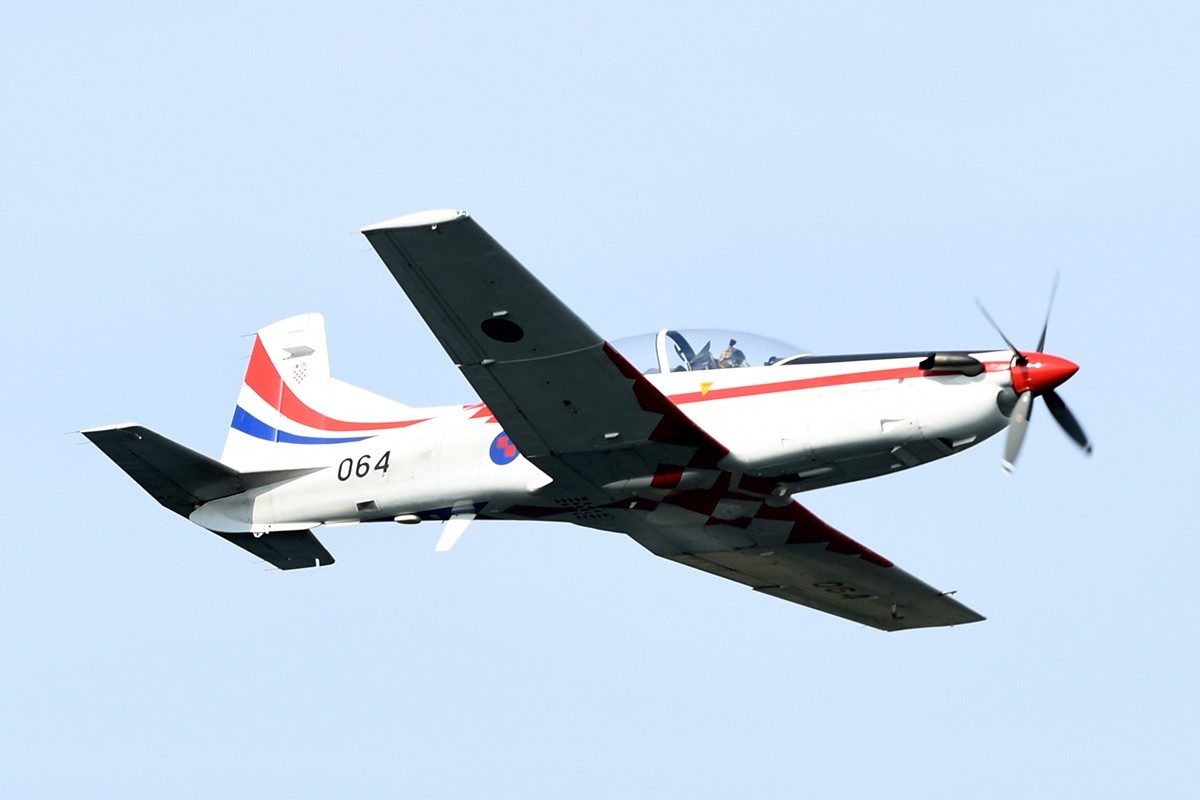
The Advanced Trainer Revolution
The PC-9 emerged as Pilatus Aircraft's answer to the growing complexity of modern fighter aircraft training requirements. By the mid-1980s, military air forces worldwide faced escalating costs in pilot training programs that traditionally required multiple aircraft types to progress from basic flight instruction to combat-ready proficiency. The PC-9's design philosophy eliminated these intermediate training stages, providing a single platform capable of handling everything from initial flight instruction through advanced aerobatics and weapons systems training.
Development and Design Innovation
Pilatus engineers developed the PC-9 as an advanced evolution of their successful PC-7 trainer, which had first flown on April 12, 1966. The new design incorporated several revolutionary features for military training aircraft of the 1980s, including a significantly larger cabin, tandem ejection seats for enhanced safety, and double the power output of its predecessor. The aircraft featured a distinctive stepped seating arrangement that provided the rear-seat instructor with superior visibility over the student pilot, while a forward-mounted airbrake system allowed for more precise approach control during training exercises.
Certification came in September 1985, with serial production commencing immediately afterward. The Swiss manufacturer continued building the PC-9 until approximately 1999, when it was superseded by the more advanced PC-21 trainer.
Powerplant Excellence
At the heart of the PC-9's performance lay the Pratt & Whitney Canada PT6A-62 turboprop engine, a member of the legendary PT6 family that began production in 1963. While rated at 1,150 shaft horsepower, the engine was derated to 950 shaft horsepower for the PC-9 application, providing optimal performance characteristics for training operations. This powerplant selection proved crucial to the aircraft's success, offering the reliability and consistent performance characteristics essential for intensive flight training operations.
The PT6A-62's free-turbine design incorporated advanced hot-section durability features and flat-rating capabilities that ensured consistent power output across varying atmospheric conditions. This reliability became a cornerstone of the PC-9's operational success, as training aircraft require exceptional dispatch reliability to maintain rigorous flight training schedules.
Global Military Adoption
The PC-9 found immediate acceptance among international air forces seeking modern, cost-effective training solutions. The Royal Australian Air Force became one of the largest operators, acquiring 67 PC-9A variants with first deliveries beginning in 1987. These aircraft were manufactured under license by Hawker de Havilland in Australia, beginning local production in 1988 for the RAAF's 2 Flying Training School at Pearce.
Other significant operators included air forces from Angola, Bulgaria, Croatia, Chad, Cyprus, Iraq, Ireland, Mexico, Myanmar, Oman, Saudi Arabia, Slovenia, Switzerland, Thailand, and the United Kingdom. Germany operated the specialized PC-9B variant configured for target-towing duties during the 1990s. The German configuration demonstrated the aircraft's versatility beyond primary training roles.
Production Variants and Legacy
Pilatus manufactured approximately 265 to 280 PC-9 aircraft across all variants during the production run. The baseline PC-9 was followed by the PC-9A for Australian service, the specialized PC-9B target-towing variant for Germany, and the PC-9M introduced in 1997 with revised tail and fuselage configurations.
The PC-9's most significant legacy emerged through its role as the foundation for the Beechcraft T-6 Texan II program. Initially designated the Beech Pilatus PC-9 Mk II in the early 1990s partnership, this derivative became the standard primary trainer for both the United States Air Force and Navy, with over 700 examples built. This relationship multiplied the PC-9's influence on pilot training far beyond the original Swiss production numbers.
The Manufacturer's Heritage
Pilatus Aircraft Ltd., founded on December 16, 1939, brought over four decades of specialized aircraft experience to the PC-9 program. The Swiss company had established its reputation through innovative STOL designs like the SB-2 Pelikan for alpine operations and achieved breakthrough success with the PC-6 Porter, which debuted in 1959 and remained in production until 2022.
By the PC-9 era, Pilatus had expanded beyond its original focus, having acquired glider manufacturing rights and successfully redesigned aircraft like the B-4 glider as the PC-11 in 1972, producing 322 examples. The company's international expansion included establishing Pilatus Aircraft China in 2013 for PC-6 and PC-12 production.
Continuing Service
Many PC-9 aircraft remain in active military service decades after production ended. The type's robust construction and reliable powerplant have enabled sustained operations well into the 21st century. Notable preserved examples include aircraft A23-020, the first Australian-built PC-9A delivered in 1988, now displayed at Fighterworld in Williamtown, New South Wales, Australia.
The PC-9's impact on aviation training continues through its derivatives and the training methodologies it pioneered. Its cost-effective approach to advanced pilot training influenced an entire generation of military training aircraft design, proving that a single, well-designed platform could replace multiple training aircraft types while reducing overall program costs and complexity.