
Development and Design
Aerospool developed the WT-10 Advantic as an ambitious expansion of their proven WT9 Dynamic platform, recognizing a market demand for affordable four-seat amateur-built aircraft. The design team focused on creating a composite aircraft that would retain the successful characteristics of the two-seat WT9 while providing increased passenger capacity and enhanced performance through modern construction techniques.
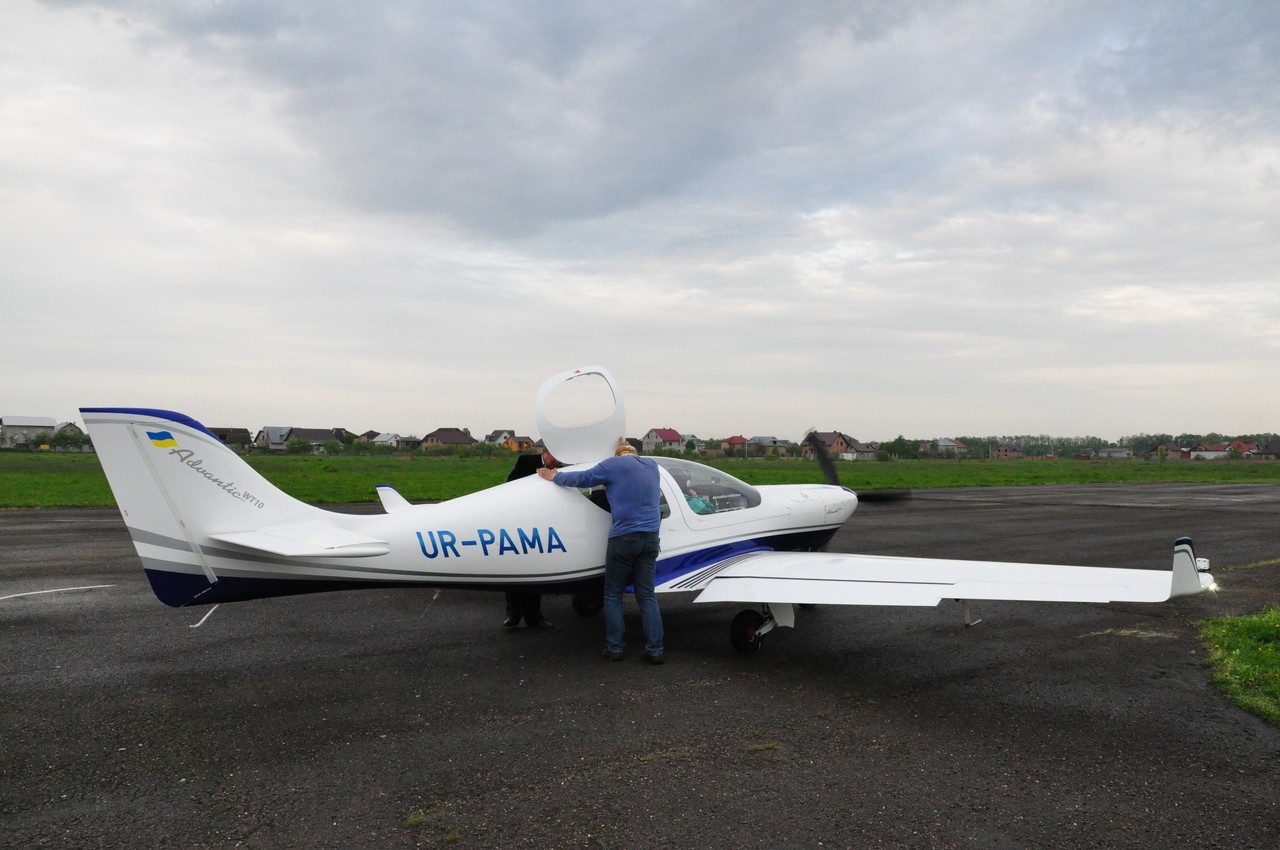
The aircraft incorporates several notable design features that distinguish it within the amateur-built category. Its cantilever low-wing configuration provides excellent structural efficiency, while the composite construction reduces weight and allows for complex aerodynamic shapes. The enclosed cockpit features a forward-hinged bubble canopy for pilot access and a separate rear seat hatch for passenger entry, maximizing convenience in ground operations.
Retractable tricycle landing gear enhances the aircraft's performance profile and provides modern ground handling characteristics. The inclusion of flaps improves low-speed handling, crucial for an aircraft designed to operate from shorter airfields typical of general aviation operations.
Technical Specifications and Performance
The WT-10 Advantic utilizes the Rotax 914 turbocharged engine, a four-cylinder, four-stroke powerplant producing 115 horsepower. This Austrian-manufactured engine provides liquid and air cooling systems and drives a three-bladed MT-Propeller in tractor configuration. The turbocharging system enables maintained performance at higher altitudes, expanding the aircraft's operational envelope beyond naturally aspirated competitors.
With a wingspan of 9.4 meters and wing area of 10.61 square meters, the aircraft achieves a wing loading of 80.1 kg/m². Maximum gross weight varies by configuration: 750 kg for three-seat operation and 850 kg for four-seat configuration. The fuel system accommodates 126 liters, providing substantial range for cross-country operations.
Performance figures demonstrate the aircraft's capability in the light aircraft category. Maximum speed reaches 250 km/h, while cruise speed settles at 210 km/h. Stall speed of 88 km/h indicates docile low-speed characteristics, enhanced by the flap system. The climb rate of 3.75 meters per second provides adequate performance for typical general aviation missions.
Production History and Manufacturing
Production began in 2015 at Aerospool's facility in Prievidza, Slovakia, following extensive prototype testing that commenced with the first flight in April 2013. The company has maintained continuous production, with at least 15 documented aircraft completed through various construction numbers ranging from the prototype WT10/01/2013 to production aircraft numbered through AD-015.
Aerospool remains active in the amateur-built aircraft market, having established its reputation with the successful WT9 Dynamic series in the early 2000s. The company operates under its original name and corporate structure, with no documented acquisitions or mergers affecting operations. The WT-10 represents the manufacturer's evolution into the four-seat market segment while maintaining focus on kit aircraft for amateur construction.
Operational Service and Registration
The WT-10 serves primarily in private ownership and small commercial operations throughout Europe. Notable registrations include the prototype OM-DYX in Slovakia from 2013, LY-BBW registered in Lithuania in 2015, and Ukrainian registrations UR-POMA and UR-PAMA from 2016. Additional Slovak examples include OM-ADB from 2017 and OM-ADC from 2019, demonstrating consistent production and delivery schedules.
Operational history includes both private ownership and small commercial entities such as Reficier JTL sro operating OM-LUC. The aircraft fulfills typical general aviation roles including personal transportation, training applications, and recreational flying.
Safety Record and Incidents
The type's operational history includes two documented accidents reflecting typical general aviation operational challenges. On July 28, 2021, UR-PAMA crashed near Sheparivtsi, Ukraine, resulting in four fatalities and complete aircraft loss. This incident represents the most serious accident involving the type to date.
A second incident occurred on July 31, 2024, when OM-LUC experienced minor damage at Mlynica Airfield in Slovakia with no fatalities. This ground incident resulted in repairable damage, demonstrating the aircraft's structural integrity in lower-energy impacts.
Current Status and Legacy
Production continues as of the latest available data, with multiple aircraft remaining active on various European civil aviation registries. The WT-10 Advantic represents Aerospool's successful transition from two-seat to four-seat aircraft design while maintaining the amateur-built market focus that characterizes the company's approach.
The aircraft's significance lies in providing an accessible entry point into four-seat composite aircraft ownership for amateur builders, filling a specific niche between simpler two-seat designs and more complex certified aircraft. Its ongoing production and active operational status demonstrate market acceptance of the design's capabilities and cost-effectiveness in the amateur-built category.