
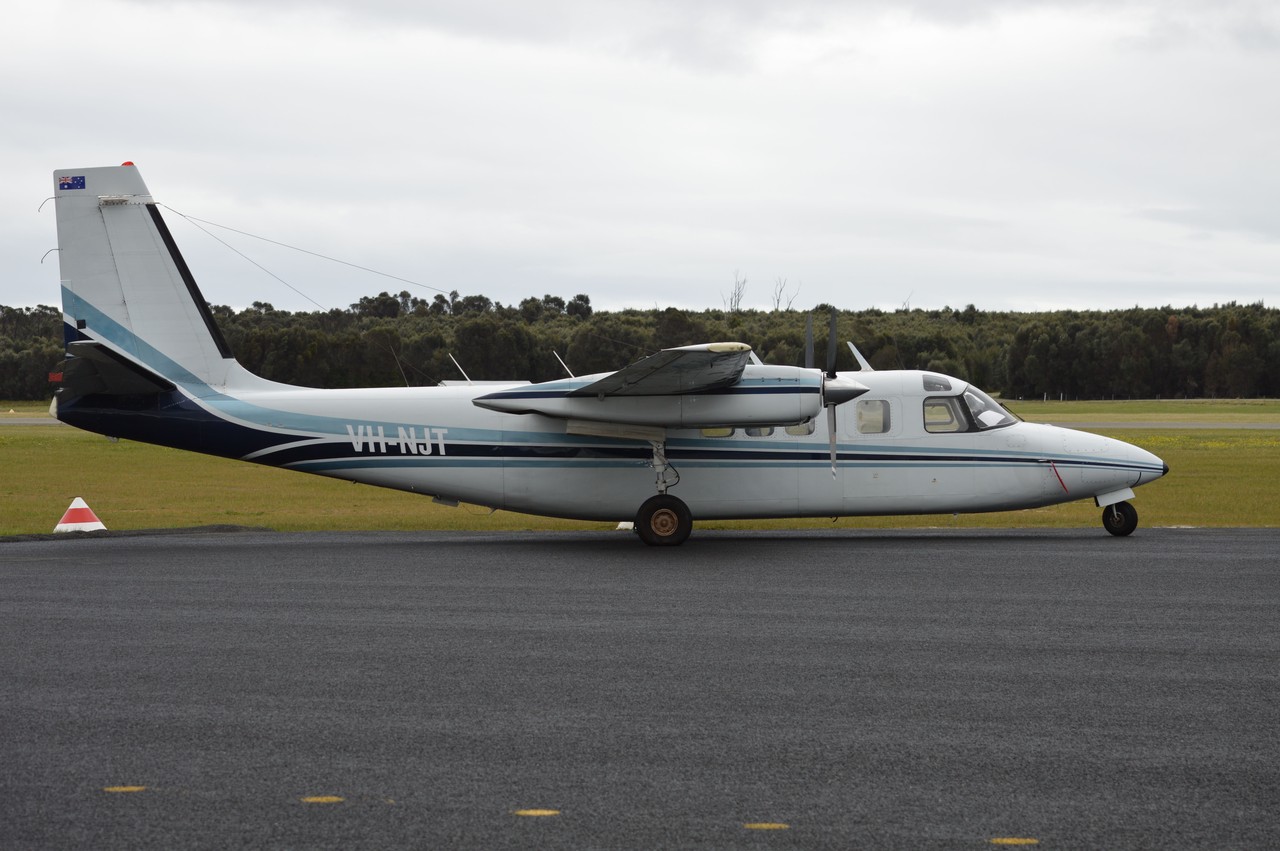
Development and Design Philosophy
The Commander 685 emerged during the golden age of corporate aviation as manufacturers competed fiercely for the lucrative executive transport market. Rockwell International developed the 685 as a stretched, pressurized variant of the proven Commander airframe, directly challenging established players like Cessna's 400 series and the Piper Navajo in the cabin-class twin market.
Engineers extended the fuselage by six feet compared to earlier models, creating space for six passengers in airline-style comfort while maintaining the high-wing configuration that had proven successful throughout the Commander lineage. The aircraft incorporated the same pressurized cabin technology used in the turbine-powered Turbo Commander, allowing comfortable flight at altitudes up to 24,000 feet where weather and turbulence posed fewer challenges.
Technical Innovation
The 685's most distinctive feature was its upswept winglets, an advanced aerodynamic refinement that reduced drag and improved fuel efficiency years before such devices became commonplace on commercial aircraft. These winglets gave the Commander 685 a unique profile that distinguished it from competitors.
Powering the aircraft were twin Continental engines producing 435 horsepower each, specifically strengthened to handle higher manifold pressures than previous installations. These engines delivered 60 additional horsepower compared to earlier Commander variants while maintaining a 1,200-hour time between overhaul. The powerplants enabled the 685 to achieve its impressive 255-mph cruise speed at optimal altitude, making it genuinely competitive with turboprop aircraft in speed while operating on less expensive avgas.
Manufacturing Heritage
The Commander story began with Leland Smith and his associates, who established manufacturing operations near Oklahoma City after their prototype design was rejected by both Beech and Fairchild in the late 1940s. That original L3805 prototype first flew on April 27, 1948, launching a lineage that would span nearly four decades.
Rockwell International acquired Aero Commander in 1965, incorporating it as a division during the height of general aviation's expansion. The company invested heavily in developing pressurized variants, recognizing that executive customers demanded airline-level comfort and all-weather capability. However, corporate restructuring in 1970 saw the Commander division disappear into Rockwell's broader aerospace operations.
Market Performance and Challenges
Despite its advanced features and impressive performance, the Commander 685 faced significant headwinds in the marketplace. The 1973 oil crisis dramatically increased operating costs for thirsty piston engines, while improving turboprop technology offered similar performance with greater reliability and prestige. Corporate flight departments increasingly viewed turbine power as essential for professional operations.
Production numbers reflected these market realities. When Rockwell ended piston Commander production at the close of 1979, only 66 Model 685 aircraft had rolled off the assembly line. This limited production run made the 685 exclusive but also economically unviable for continued development.
Operational Characteristics
Pilots praised the Commander 685 for its stability and capability in challenging weather conditions. The aircraft excelled at low-visibility approaches, with its high-wing design providing excellent ground visibility and predictable handling characteristics. The spacious cockpit accommodated two crew members with professional-grade instrumentation suitable for serious instrument flying.
Passengers appreciated the genuine airline-style comfort, with the pressurized cabin eliminating the fatigue associated with high-altitude flight in unpressurized aircraft. The six-passenger configuration provided generous space compared to light twins, while the separate crew compartment enhanced privacy and reduced noise levels.
Legacy and Final Years
Rockwell's exit from the piston aircraft market came in 1981 when the company sold the entire Commander product line to Gulfstream Aviation. Gulfstream, primarily focused on jet development, continued limited production until 1986 when the final Commander rolled out of the factory. The company then concentrated exclusively on its successful jet programs.
Support responsibilities transferred to Precision Aircraft Corporation, which evolved into Twin Commander in 2003. This specialized company continues providing parts, service, and expertise for all Commander variants, ensuring that surviving 685s remain viable for operation.
Current Status
Today, the Commander 685 occupies a unique niche among vintage aircraft enthusiasts and operators seeking pressurized piston-twin capability. Its rarity makes each surviving example valuable, while its advanced systems and performance capabilities ensure continued relevance for specialized missions. The aircraft represents the technological pinnacle of an era when manufacturers pushed piston engine technology to its absolute limits before turbine power definitively claimed the high-performance market.