
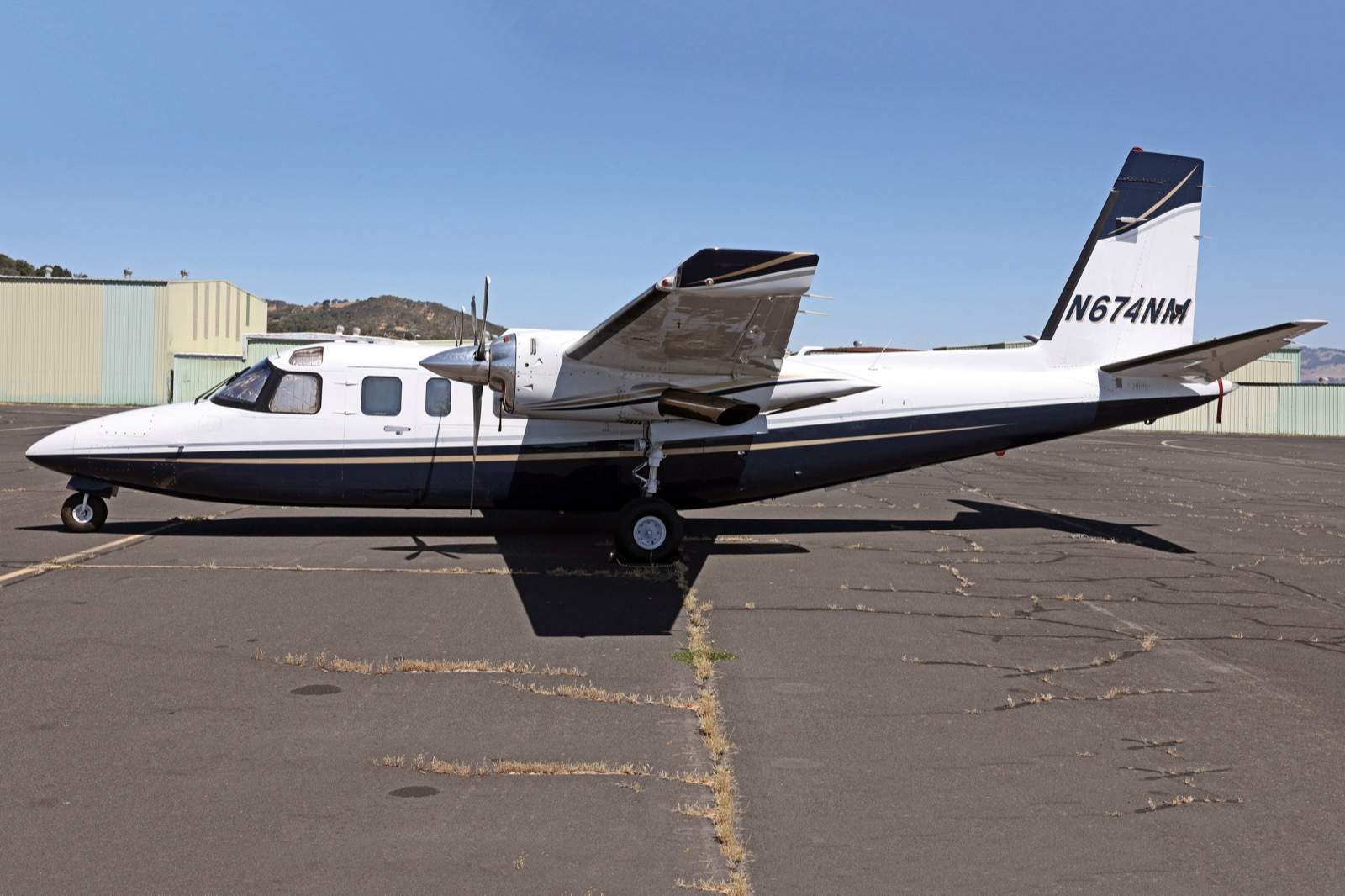
The Turboprop Revolution
The 680T emerged during a pivotal period in aviation history when turboprop engines were transforming the business aircraft market. By adapting the proven Model 680FL/P airframe to accept Garrett AiResearch TPE331-43 turboprops, Aero Commander created a machine that offered the reliability and performance advantages of turbine power while maintaining the familiar handling characteristics that had made the Commander series popular among corporate pilots.
Each TPE331-43 engine delivered 575 shaft horsepower, providing substantially more power than the supercharged piston engines used in earlier variants. This powerplant selection proved prescient—the TPE331 series would become one of aviation's most widely used turboprop engines, powering dozens of aircraft types over subsequent decades.
Rapid Development and Refinement
The 680T's development cycle reflected the intense pace of 1960s aviation advancement. After initial certification in September 1965 at 8,950 pounds gross weight (initially 8,500 pounds), engineers quickly identified opportunities for improvement. By 1966, significant modifications emerged: the aircraft was recertified with increased gross weight to 8,950 pounds, removal of the 32-inch wingtip extensions, enhanced takeoff power, new propellers, and expanded operating limits.
Remarkably, all previously delivered 8,500-pound aircraft were retrofitted to the new configuration, demonstrating Aero Commander's commitment to fleet standardization. This rapid evolution established a pattern that would characterize the entire turboprop Commander family.
The Manufacturer's Evolution
Aero Commander's corporate journey paralleled the broader consolidation occurring throughout the aerospace industry. Originally founded as Aero Design and Engineering Company in the late 1940s, the firm adopted the Aero Commander name in 1950 as its aircraft gained recognition. The company's acquisition by Rockwell International in 1965—the same year the 680T achieved certification—reflected the growing importance of the Commander line.
This ownership transition proved beneficial for the 680T program, as Rockwell provided the resources necessary to support turboprop development while the company refined manufacturing processes at its production facilities. The investment paid dividends as subsequent variants built upon the 680T's foundation.
Limited Production, Lasting Impact
Despite its significance as the Commander series' first turboprop, the 680T had a remarkably short production life. Between 1965 and 1967, only 56 aircraft rolled off the assembly line before giving way to improved variants. The 680V Turbo Commander, certified on June 13, 1967, incorporated lessons learned from 680T operations, while 36 examples were built. The evolution continued with the 680W Turbo II Commander, certified February 5, 1968, of which 46 were manufactured.
This rapid succession of variants reflected both the 680T's success in proving the turboprop concept and the competitive pressure to continuously improve performance and capabilities. Each iteration built upon its predecessor's strengths while addressing operational feedback from pilots and operators.
Operational Excellence
Pilots consistently praised the 680T for its exceptional handling characteristics, describing it as extremely "pilot friendly." The aircraft's 25,000-foot service ceiling provided flexibility for weather avoidance and favorable winds, while the twin-turboprop configuration offered redundancy and reliability superior to piston-powered alternatives.
The unpressurized cabin, while limiting high-altitude passenger comfort, proved advantageous for certain commercial applications. Related piston-powered variants like the 680FL found success as small package freighters with operators including Combs Freightair during the 1970s and 1980s, and Suburban Air Freight through the 1990s, demonstrating the airframe's cargo-carrying versatility.
Corporate Succession and Continuing Legacy
The Commander line's ownership continued evolving long after 680T production ended. Rockwell sold the entire product line to Gulfstream Aviation in 1981, with Chrysler subsequently acquiring Gulfstream in 1985. Gulfstream terminated Commander production in 1986, ending an era that had begun in the late 1940s.
However, the Commander story didn't end with production cessation. Support and service responsibilities were acquired by Precision Aircraft Corporation, which evolved into Twin Commander in 2003. This company continues providing parts, service, and support for the entire Commander fleet, ensuring that surviving 680T aircraft can remain operational decades after leaving the factory.
Technical Innovation and Market Impact
The 680T's most significant contribution lay in demonstrating the viability of turboprop conversion for proven airframes. Rather than designing an entirely new aircraft, Aero Commander's engineers showed that existing successful designs could be enhanced through powerplant upgrades, a concept that would influence aircraft development for decades.
This approach proved particularly valuable in the business aviation market, where operators demanded the reliability and performance of turbine power but needed the economics and airport flexibility that smaller aircraft provided. The 680T helped establish turboprops as the preferred power source for this market segment, influencing competitors and setting standards that persist today.