
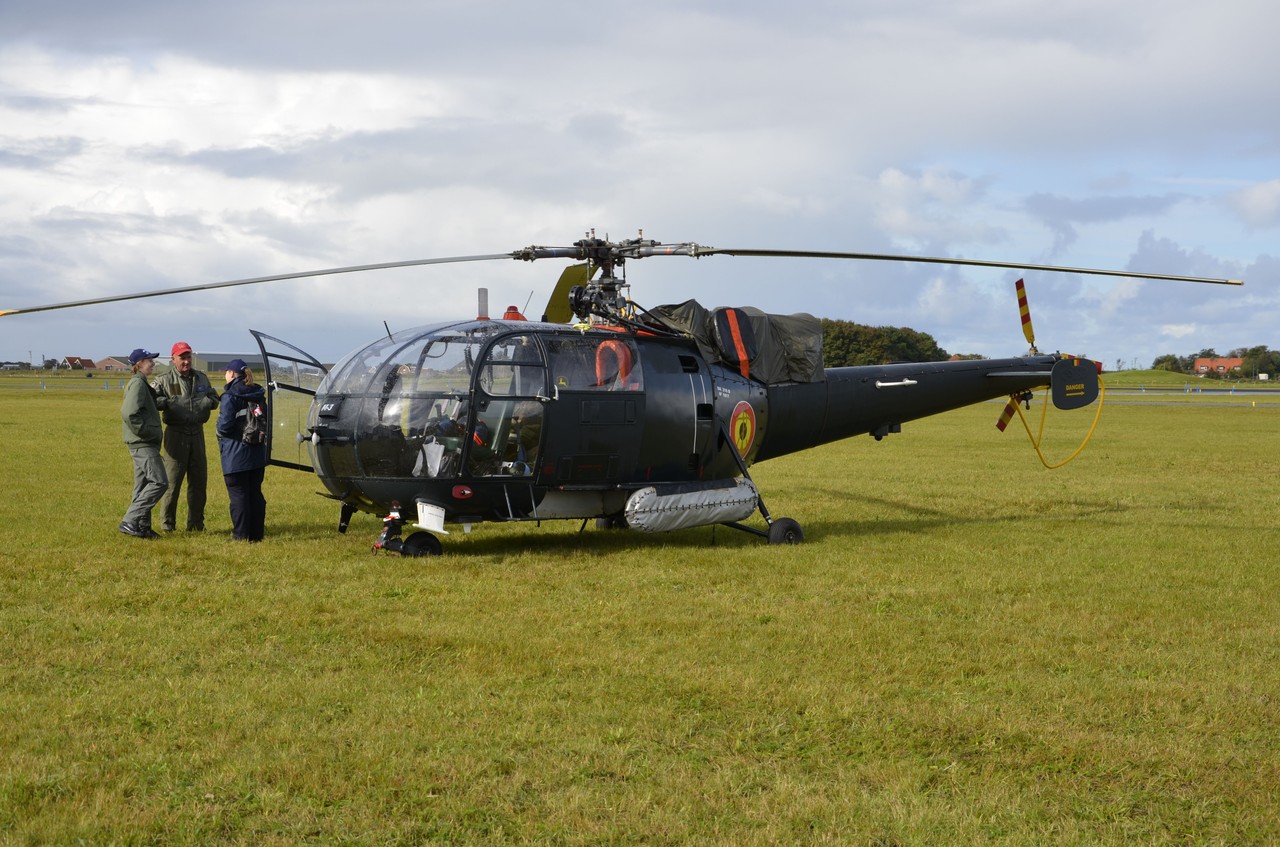
Service History
The Alouette III achieved remarkable global penetration, with total production exceeding 2,000 units across all manufacturing locations. French production alone yielded approximately 1,450 aircraft of the SA 316 and SA 319 variants before the main production line at Marignane closed in 1979. The helicopter's success stemmed from its exceptional adaptability—it served 120 customers across 80 countries, demonstrating unprecedented international appeal for a light helicopter.
By the end of 2018, the worldwide Alouette III fleet had accumulated more than 7 million flight hours, with nearly 180 helicopters still in active service. This longevity, spanning six decades from first flight to continued operations in the 2020s, illustrates the fundamental soundness of the design and its continued relevance in modern aviation.
Military Operations
The Alouette III served extensively with military forces worldwide, primarily in utility and transport roles rather than combat missions. The French Air Force operated the type for 32 years, with most aircraft retired by 2004, though the last three French military Alouettes continued flying until 2022.
The South African Air Force operated 70 Alouette III helicopters by 1990, accumulating more than 346,000 flight hours throughout the fleet's service life before the final aircraft was withdrawn in June 2006. The Irish Air Corps demonstrated the helicopter's search-and-rescue capabilities during 44 years of service, completing 1,717 rescue missions that saved 542 lives and flying 2,882 air ambulance flights while accumulating over 77,000 flying hours.
The Canadian Coast Guard operated the type from 1966 to 1990, using it for maritime patrol and rescue operations from bases like Victoria. The helicopter's reliability in harsh coastal conditions proved its worth in demanding operational environments.
International Production
The Alouette III's design success enabled extensive licensed production that continued long after French manufacturing ended. Hindustan Aeronautics Limited in India produced over 350 units as the HAL Chetak, with production continuing into the 2020s. New aircraft were delivered as recently as 2019 and 2021, marking 60 years of continuous Indian service by 2022.
Romania's Industria Aeronautică Română manufactured more than 200 units as the IAR 316, while Switzerland's F+W Emmen built 60 aircraft for local requirements. The Netherlands assembled additional units through Fokker and Lichtwerk facilities, demonstrating the design's adaptability to different manufacturing environments.
The Manufacturer
Sud Aviation developed the Alouette III as successor to the earlier Alouette II, drawing upon accumulated experience in light helicopter design. Sud Aviation later merged into Aérospatiale during French aerospace industry consolidation, and the helicopter division eventually became part of today's Airbus Helicopters through subsequent corporate acquisitions.
The company's achievement with the Alouette III established France as a major helicopter manufacturer, competing successfully with American and Soviet designs during the Cold War era. The helicopter's commercial success provided crucial revenue that funded development of later rotorcraft programs.
Engine and Technical Innovation
The Alouette III utilized two primary powerplant options during its production life. Initial SA 316A aircraft featured the Turbomeca Artouste engine producing 570 horsepower, providing adequate performance for most utility missions. The later SA 319B variant, which first flew on 10 July 1967, employed the more powerful Turbomeca Astazou XIVB engine generating 870 horsepower with improved fuel efficiency that extended range and endurance.
Both engines were manufactured by Turbomeca, establishing a successful French partnership that became characteristic of European helicopter development. The modular construction allowed for easy maintenance and role adaptability, contributing significantly to the helicopter's operational longevity.
Performance Characteristics
The Alouette III achieved a normal operating speed of 185 kilometers per hour with an empty weight of approximately 1,140 kilograms. Its maximum gross weight of 2,200 kilograms provided substantial payload capacity for a single-engine helicopter. The 11.02-meter main rotor diameter delivered excellent lifting capability while maintaining reasonable ground handling dimensions.
Pilots appreciated the helicopter's predictable handling characteristics and robust construction that tolerated demanding operational conditions. The spacious cabin accommodated various mission equipment configurations, from stretchers for medical evacuation to specialized sensors for patrol work.
Legacy and Current Status
The Alouette III represents a landmark achievement in rotorcraft design, proving that European manufacturers could compete globally in the helicopter market. Its successful transition to licensed production in multiple countries, particularly India's continued HAL Chetak manufacturing, demonstrates the design's enduring operational value.
Museum examples preserve the type's heritage, including the Irish Air Corps Museum's oldest Alouette (number 195) maintained in "rotors running" condition and the Canadian Museum of Flight's 1966 French-built example. These preserved aircraft serve as testimony to one of the most successful light helicopters ever produced, bridging the gap between early rotorcraft experiments and modern helicopter operations.