
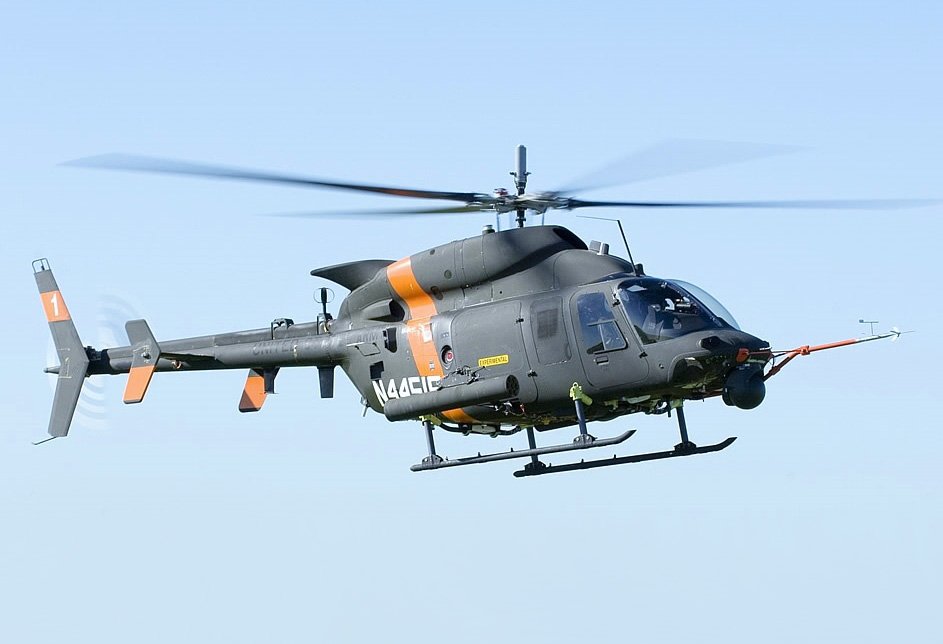
The Bell ARH-70 Arapaho was developed as the winning proposal for the United States Army's Armed Reconnaissance Helicopter (ARH) program. Selected in July 2005, the aircraft was intended to serve as a light armed scout, optimized for urban combat environments, to replace the aging OH-58D Kiowa Warrior. The design philosophy centered on utilizing a proven commercial airframe to reduce acquisition and life-cycle costs. Consequently, the ARH-70 was derived from the Bell 407 civil helicopter, modified with military avionics, targeting systems, and forward-looking infrared (FLIR) sensors.
Technically, the ARH-70 was a single-engine helicopter featuring a four-bladed main rotor and a two-bladed tail rotor. It was powered by a single Honeywell HTS900-2 turboshaft engine, which delivered 970 shaft horsepower (723 kW). The aircraft's configuration allowed for a crew of two pilots and up to six passengers in the cabin, with a useful load capacity of 1,868 lb (847 kg). In terms of performance, the Arapaho reached a maximum speed of 140 knots (161 mph) and a cruise speed of 113 knots, with a service ceiling of 20,000 ft and a range of 162 nautical miles. Planned armament included a GAU-19 0.50 in Gatling gun on a pylon and Hydra 70 2.75 in rockets on outboard pylons, with potential integration for AGM-114 Hellfire missiles.
The ARH-70 performed its first flight on 20 July 2006. However, the program was plagued by cost growth and schedule delays. While the Army initially sought a low-cost solution, total program estimates rose from an original target of US$3.6 billion to approximately US$6.4 billion for 520 aircraft. Due to these financial and scheduling issues, the U.S. Army stopped funding development in 2007. The program was formally terminated on 16 October 2008, after the Department of Defense declined to certify the project to Congress. Only four prototypes were ever completed, each costing an estimated US$14.5 million. Because the program ended before low-rate initial production, the ARH-70 never entered operational service or saw combat. Its legacy remains a programmatic case study in the challenges of adapting commercial platforms for specialized military roles.