
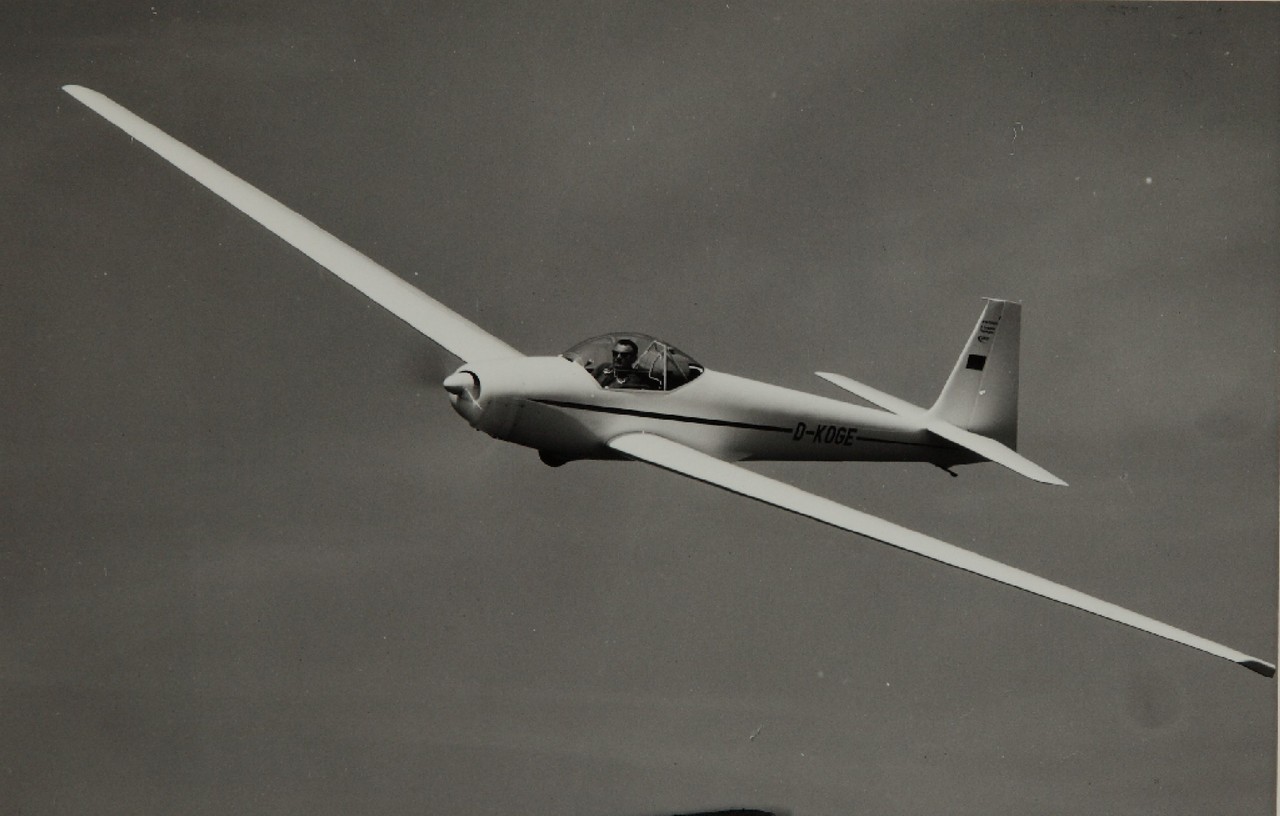
Competition Success and Record Setting
The ASK 14 immediately proved its capabilities in competitive soaring. At the first international motor glider contest held at Burg Feuerstein, West Germany in 1970, ASK 14 aircraft swept the podium by taking second, third, and fourth places in the single-seat class. This remarkable showing demonstrated the design's effectiveness against international competition.
In 1971, American pilot Bennett Rogers established the first United States motor gliding record in an ASK 14, completing a 330.5-kilometer out-and-return flight from Rosamond, California. This achievement helped establish the type's reputation in North American soaring circles and proved the aircraft's long-distance capabilities.
Design Innovation and Technical Excellence
Rudolf Kaiser, serving as Schleicher's chief designer, developed the ASK 14 as an evolution of the successful Ka 6E sailplane. The design incorporated several innovative features that set new standards for motor gliders. The aircraft featured a sophisticated NACA 63-618 airfoil at the wing root transitioning to NACA 63-615 at the tips, contributing to its exceptional 34:1 glide ratio—a significant improvement over the Ka 6's 29:1 performance.
The retractable monowheel landing gear and fully feathering Hoffman propeller allowed the ASK 14 to operate efficiently both as a powered aircraft and as a pure sailplane. The bubble canopy provided 360-degree visibility crucial for spotting thermals and avoiding other aircraft during soaring operations. Pilots consistently praised the aircraft's handling characteristics, with Soaring Magazine describing them as "superb" in 1983, crediting the proven aerodynamics inherited from the Ka 6E lineage.
Powerplant and Engineering
The heart of the ASK 14's self-launching capability was the Hirth F10 K19 engine, a 19-kilowatt four-cylinder, two-stroke powerplant producing 25 horsepower at 5,000 rpm. This engine featured an unusual configuration with each cylinder having its own carburetor and ignition coil. The firing sequence was distinctive, with the front two cylinders firing simultaneously, followed by the rear pair.
Hirth engines had established a reputation for reliability in light aircraft applications, making them an appropriate choice for the demanding motor glider role where engine failure during takeoff could prove catastrophic. The engine drove a two-bladed Hoffman propeller that could fully feather, eliminating drag during soaring flight.
Alexander Schleicher Legacy
Alexander Schleicher GmbH & Co., founded in 1927 by Alexander Schleicher, had already established itself as a premier sailplane manufacturer before developing the ASK 14. The company's transition from traditional wood construction to modern composites began in 1964 with the arrival of designer Gerhard Waibel. This technological evolution culminated in the ASW 12, the company's first fiberglass sailplane, which achieved its maiden flight on December 31, 1965, piloted by Edgar Kremer.
The ASK 14 represented Schleicher's first venture into motor gliders, marking another significant milestone in the company's evolution. Following the success of the Ka 6 series in the 1950s and 1960s, the ASK 14 demonstrated the manufacturer's ability to adapt proven designs for new roles while maintaining the excellent handling characteristics that had made their sailplanes famous.
Production and Development
Schleicher initially designated the first two prototypes as K 12, but changed to ASK 14 starting with serial number three to avoid confusion with the ASW 12 sailplane. Production ran from 1968 to 1972, with exactly 62 aircraft completed at the company's Poppenhausen facility. This relatively small production run reflected the specialized nature of the motor glider market and the aircraft's position as a premium club aircraft rather than a mass-market design.
The ASK 14's construction combined traditional wood and fabric techniques with modern fiberglass elements, representing a transitional approach that balanced proven methods with emerging composite technology. This hybrid construction contributed to the aircraft's 245-kilogram empty weight and 360-kilogram maximum gross weight.
Current Status and Preservation
By July 2011, only a handful of ASK 14 aircraft remained airworthy worldwide. Eight examples held FAA registration in the United States under the Experimental-Racing/Exhibition category, while two operated in the United Kingdom with EASA certification. Canada had one aircraft flying under a pre-1989 flight permit.
At least one notable example, G-BSIY in the United Kingdom, has remained active since 2005 after spending 22 years in Kenya. This aircraft even appeared in an Anglia Television documentary about vultures, demonstrating the type's continued utility for specialized operations. The rarity of surviving examples has made the ASK 14 a prized aircraft among vintage motor glider enthusiasts, representing an important chapter in the development of self-launching sailplanes.