
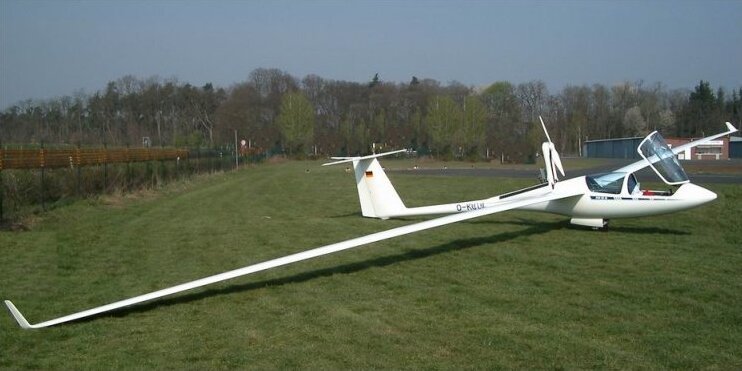
Dominating Competition Soaring
The ASH-25M transformed competitive gliding by combining the exceptional soaring performance of the ASH-25 with self-launching capability. As part of the broader ASH-25 series, which totaled 266 aircraft across all variants, the motorized version enabled pilots to reach optimal soaring conditions without ground support. This independence proved crucial in setting world records, with the type accumulating 26 official distance and speed records.
Hans-Werner Grosse established 14 world records in ASH-25 variants, while the partnership of Terry Delore and Steve Fossett claimed 11 more. Their most notable achievement came in December 2004 when they flew 1,287 kilometers from El Calafate to San Juan, Argentina, in 15 hours and 42 minutes. The husband-and-wife team of Manni and Gitti Albrecht pushed the ASH-25Mi beyond 2,000 kilometers, demonstrating the aircraft's extraordinary endurance capabilities.
Design Evolution and Innovation
Martin Heide designed the ASH-25 series, with the 'H' in the designation honoring his contribution to high-performance sailplane development. The ASH-25M evolved directly from the ASH-25E, incorporating proven Wankel engine technology first tested in the ASH-26E. This development path ensured reliability while providing the power necessary for unassisted takeoffs.
The aircraft's construction utilized advanced composite materials including carbon fiber, Aramid, and fiberglass. Variable wingspan configurations allowed pilots to optimize performance for specific conditions: 25.0 meters standard, 25.6 meters with winglets, or up to 26.4 meters with the taller winglets introduced in 2001. The T-tail configuration and mid-wing design contributed to the aircraft's exceptional aerodynamic efficiency.
Powerplant and Performance
The Norton AE 50R single-rotor Wankel engine solved many traditional problems associated with rotary engines. Norton Motors of the United Kingdom manufactured this liquid-cooled powerplant with forced-air rotor cooling, carburetion, dual electronic ignition, and electric starting. The 1999 fuel injection upgrade, combined with a Schleicher-tuned propeller, enhanced performance further in the ASH-25Mi variant.
With a maximum takeoff weight of 750 kilograms (1,654 pounds), the ASH-25M achieved its remarkable 54.3:1 lift-to-drag ratio during flight testing without turbulator tape. This performance, combined with water ballast capability, allowed pilots to optimize the aircraft for varying atmospheric conditions throughout extended flights.
Manufacturing Legacy
Alexander Schleicher GmbH & Co., founded in 1927, manufactured all ASH-25M aircraft at their Poppenhausen, Germany facility. The company began glider production in the early 1930s with designs like the Condor, created by Heini Dittmar in 1932 at Wasserkuppe. Operating continuously for over 95 years, Schleicher remains a leading sailplane manufacturer, holding EASA production approval DE.21G.0010.
Production of the ASH-25M spanned five years from 1994 to 1999, with each aircraft representing sophisticated engineering and meticulous construction. The broader ASH-25 series production ran from May 1986 to September 2008, establishing the type as the most successful Open Class sailplane in aviation history.
International Operations
New Zealand provided type acceptance for the ASH-25M on October 5, 1998, with the first aircraft registered as ZK-GRJ, serial number 167. This certification opened international markets and demonstrated the aircraft's compliance with stringent airworthiness standards. Private owners, gliding clubs, and competition pilots worldwide operated the type, transforming competitive soaring through record-setting endurance flights.
Current Status and Preservation
Several ASH-25M aircraft remain airworthy today, continuing to participate in competitive soaring events. The type's influence on sailplane design persists through its pioneering use of composite construction and self-launch technology integration. Examples like D-KMHG, which received its Permit to Fly in October 1994 and full registration in December 1997, demonstrate the aircraft's enduring operational capability.
The ASH-25M's legacy extends beyond mere statistics, representing a pivotal advancement in high-performance two-seat gliding technology. Its combination of exceptional soaring performance with practical self-launch capability established new standards for competition sailplanes that influence design philosophy today.