
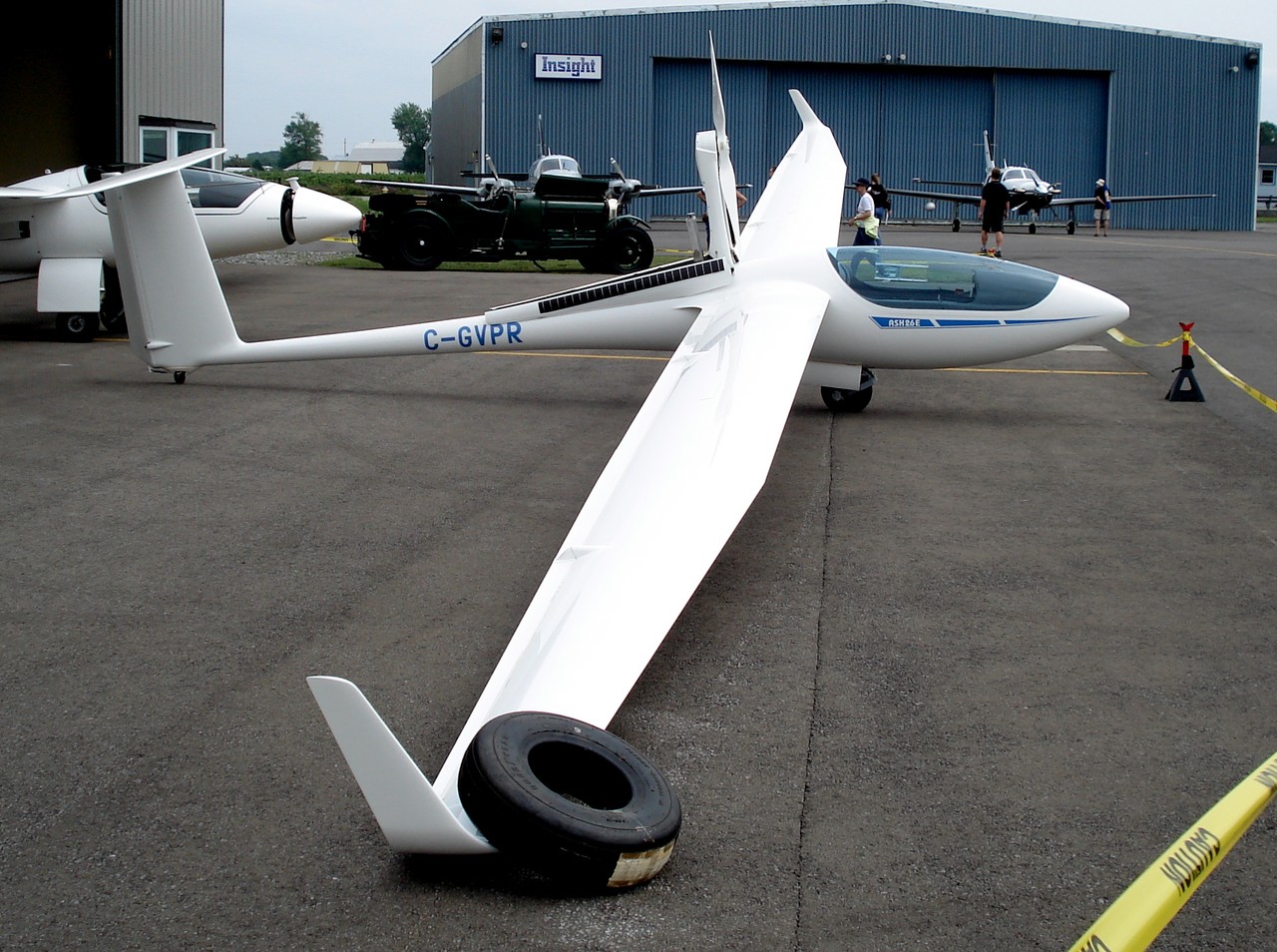
Design Innovation and Development
The ASH-26E emerged from the creative vision of Martin Heide, who joined Alexander Schleicher in 1981 and revolutionized motorglider design with his innovative retractable power plant system developed in 1992. Heide's breakthrough centered on integrating a single rotary engine that could be completely retracted into the fuselage, allowing the aircraft to function as a pure glider when the motor was stowed. This design philosophy became the foundation for all subsequent self-launching sailplanes produced by Schleicher and established new standards for the motorglider industry.
The aircraft's development focused on achieving Open Class glider performance within the constraints of the 18-meter competition class. Engineers accomplished this through sophisticated aerodynamic design featuring the DU 89-134/14 airfoil and pneumatic turbulators that maintain 95% laminar airflow along the wing's underside. The complex composite structure incorporates multiple advanced materials including carbon, aramid, and polyethylene fiber-reinforced plastics, resulting in exceptional strength-to-weight ratios and aerodynamic efficiency.
The Wankel Advantage
The ASH-26E's powerplant represents one of aviation's most successful applications of rotary engine technology. The 37-kilowatt Austro Engine AE50R Wankel engine, manufactured by Austro Engineering of Wiener Neustadt, Austria, weighs just 27.8 kilograms and operates at 7,750 rpm. This liquid-cooled, single-rotor engine displaces 294 cubic centimeters and delivers smooth, vibration-free operation that proved ideal for the sailplane application.
Schleicher selected the rotary engine configuration for multiple practical advantages: minimal vibration transmission to the airframe, quiet operation during climb phases, low fuel consumption rates, and simplified maintenance procedures. The engine's compact dimensions enabled the complete retraction system that distinguishes the ASH-26E from fixed-engine motorgliders. When retracted, the engine bay closes flush with the fuselage, eliminating drag penalties that compromise pure gliding performance.
Alexander Schleicher's Heritage
Alexander Schleicher GmbH & Co. brought decades of sailplane manufacturing expertise to the ASH-26E project. The German company resumed aircraft production in 1951 when Allied control restrictions were lifted on June 19 of that year, following World War II prohibitions on aircraft manufacturing. Under designer Gerhard Waibel's leadership, Schleicher pioneered composite sailplane construction beginning in 1964, culminating in the ASW 12 fiberglass sailplane that first flew on December 31, 1965.
This technological foundation proved crucial for the ASH-26E's development, as the aircraft demanded advanced materials science to achieve its performance objectives while accommodating the retractable engine system. The company's Poppenhausen facility became the center for high-performance motorglider development, with production techniques refined over decades of composite aircraft manufacturing.
Performance and Competition Success
The ASH-26E delivers performance figures that rival dedicated racing gliders while maintaining self-launch capability. Its maximum glide ratio of 50:1 at 115 kilometers per hour represents world-class efficiency, while the minimum sink rate of 0.48 meters per second enables pilots to exploit weak thermal conditions effectively. The aircraft's 4-meter-per-second climb rate under power provides rapid altitude gain for cross-country flights or competition positioning.
With water ballast capacity of 110 kilograms, pilots can optimize wing loading for varying conditions, achieving maximum takeoff weights of 525 kilograms for high-speed inter-thermal flight or operating at minimum weights for thermal soaring. The 280-kilometer-per-hour never-exceed speed provides substantial margin for high-speed flight between thermals during competitive cross-country flights.
Production Success and Market Dominance
Production began in the early 1990s and continued through at least 2018, with 258 examples completed by June of that year. This figure represents over 90 percent of all ASH-26 variants produced, demonstrating the overwhelming market preference for self-launching capability over pure glider configuration. The production numbers reflect the aircraft's success in combining competition-level performance with practical operational flexibility.
The ASH-26E found operators across multiple continents, with aircraft registered in Australia, Germany, and numerous other countries where competitive gliding flourishes. Its combination of high performance and self-sufficiency made it particularly attractive to pilots operating from airports without dedicated glider launching facilities or those seeking independence from ground support equipment.
Legacy and Continuing Influence
The ASH-26E established the template for modern high-performance motorgliders and validated the viability of retractable engine systems in competition sailplanes. Martin Heide's design innovations continue influencing contemporary motorglider development, with the retractable rotary engine concept becoming standard practice for self-launching sailplanes. The aircraft demonstrated that motor assistance need not compromise pure gliding performance when engineering integration is executed with precision.
Today, ASH-26E aircraft remain active in gliding clubs and competition circuits worldwide, their continued service testament to the design's fundamental soundness and enduring performance advantages. The type represents a pivotal moment in sailplane evolution, proving that hybrid propulsion systems could expand operational flexibility without sacrificing the pure flight experience that defines soaring as both sport and art form.