
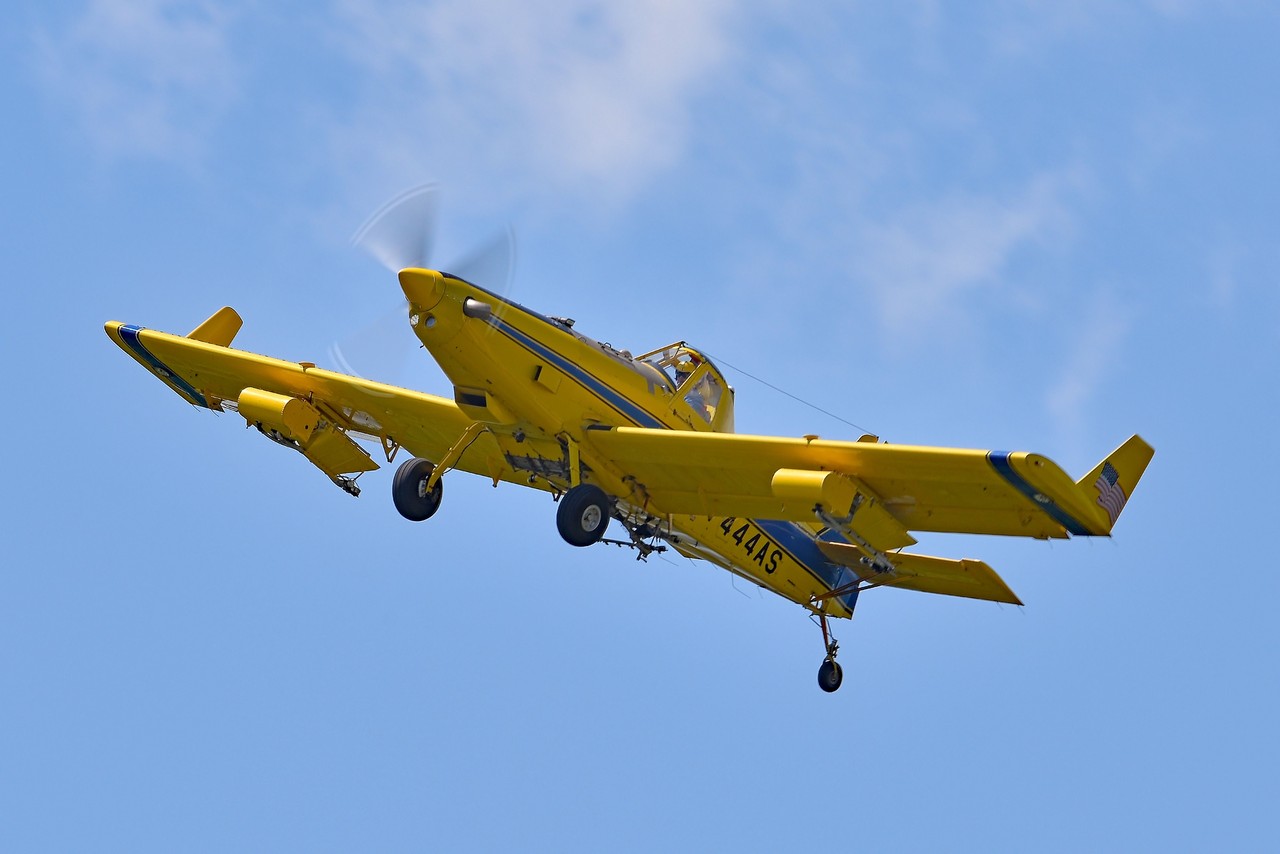
Revolutionary Design Philosophy
Leland Snow designed the AT-302 as part of his vision to modernize agricultural aviation through turbine power. Following his departure from Rockwell Standard in 1970, Snow spent 18 months creating over 600 drawings and 700 pages of engineering reports for his new AT-300 series. The AT-302 represented the culmination of this effort, combining Snow's decades of agricultural aviation expertise with the reliability advantages of turbine propulsion.
The aircraft's aerodynamically efficient airframe featured clean lines and optimized weight distribution specifically for agricultural operations. Unlike previous agricultural aircraft that adapted existing designs, Snow engineered the AT-302 from the ground up for spraying and fertilizing missions, incorporating larger payload capacity and improved performance characteristics.
Powerplant Evolution
Initial flight testing in 1976 utilized a Lycoming turbine engine, but Air Tractor switched to the Pratt & Whitney Canada PT6 turboprop by October 1977 when the company had produced its first 100 aircraft. The PT6A series engine provided superior power-to-weight ratio, enhanced reliability, and reduced maintenance requirements compared to piston alternatives.
The PT6 installation delivered immediate operational advantages, enabling pilots to carry larger chemical loads while maintaining safety margins. The turbine's consistent power delivery across varying atmospheric conditions proved particularly valuable for agricultural operations, where aircraft frequently operate at maximum gross weight in challenging weather.
Manufacturing and Production
Air Tractor, Inc. officially began operations in 1978 under Leland Snow's leadership, establishing manufacturing at a former military airbase in Olney, Texas. The company had relocated from Brownsville, Texas, following financing difficulties, but the Olney facility provided ideal conditions for aircraft production and testing.
By 1993, sixteen years after the AT-302's introduction, Air Tractor had delivered its 1,100th aircraft overall. The company reached its 2,000th delivery milestone by 2004, demonstrating sustained market acceptance of Snow's turbine-powered design philosophy. Production expanded rapidly as agricultural pilots recognized the operational advantages of turbine power.
Global Agricultural Impact
The AT-302 transformed international agricultural aviation beginning with its first exports in June 1979. Three AT-301s and one AT-302 shipped to Guatemala, with an additional AT-301 delivered to Australia, marking Air Tractor's entry into global markets. Throughout the 1980s, exports expanded to Egypt, Austria, Sweden, Venezuela, Cameroon, Saudi Arabia, Canada, Colombia, Brazil, Tunisia, Spain, Kenya, South Africa, and Korea.
Agricultural operators worldwide embraced the AT-302's combination of increased speed and payload capacity. The aircraft's ability to cover more acreage per flight hour while carrying larger chemical loads significantly improved operational economics for commercial spraying services.
Technical Innovation
The AT-302's single-seat cockpit featured simplified controls optimized for agricultural operations, with instrumentation focused on engine parameters and spray system management. The aircraft's low-wing configuration provided stable flight characteristics during low-altitude spraying runs while maintaining adequate ground clearance for chemical loading operations.
Snow's design incorporated structural reinforcement for the demanding agricultural mission profile, including repeated high-stress maneuvering and maximum gross weight operations. The airframe's robust construction enabled extended service life despite the challenging operational environment.
Industry Legacy
The AT-302's success established Air Tractor as the dominant manufacturer in turbine-powered agricultural aviation. The aircraft served as the foundation for subsequent models including the highly successful AT-502, introduced in 1987 and widely regarded as the most significant agricultural aircraft design.
By 2025, Air Tractor continues manufacturing approximately 200 aircraft annually, with models extending through the AT-802 series. The company's global reach spans the Americas, Europe, and Australia, directly tracing to the market acceptance established by the pioneering AT-302.
Operational Significance
The AT-302 arrived at an optimal moment in agricultural aviation history, as operators sought more efficient alternatives to aging piston-powered fleets. Its turbine reliability reduced maintenance costs while increasing operational availability, critical factors for time-sensitive agricultural applications.
The aircraft's introduction coincided with expanding global demand for professional aerial application services, positioning Air Tractor for sustained growth. The AT-302's performance advantages established turbine power as the preferred configuration for serious agricultural operations, fundamentally shifting industry standards toward the reliability and capability that define modern crop spraying aircraft.