
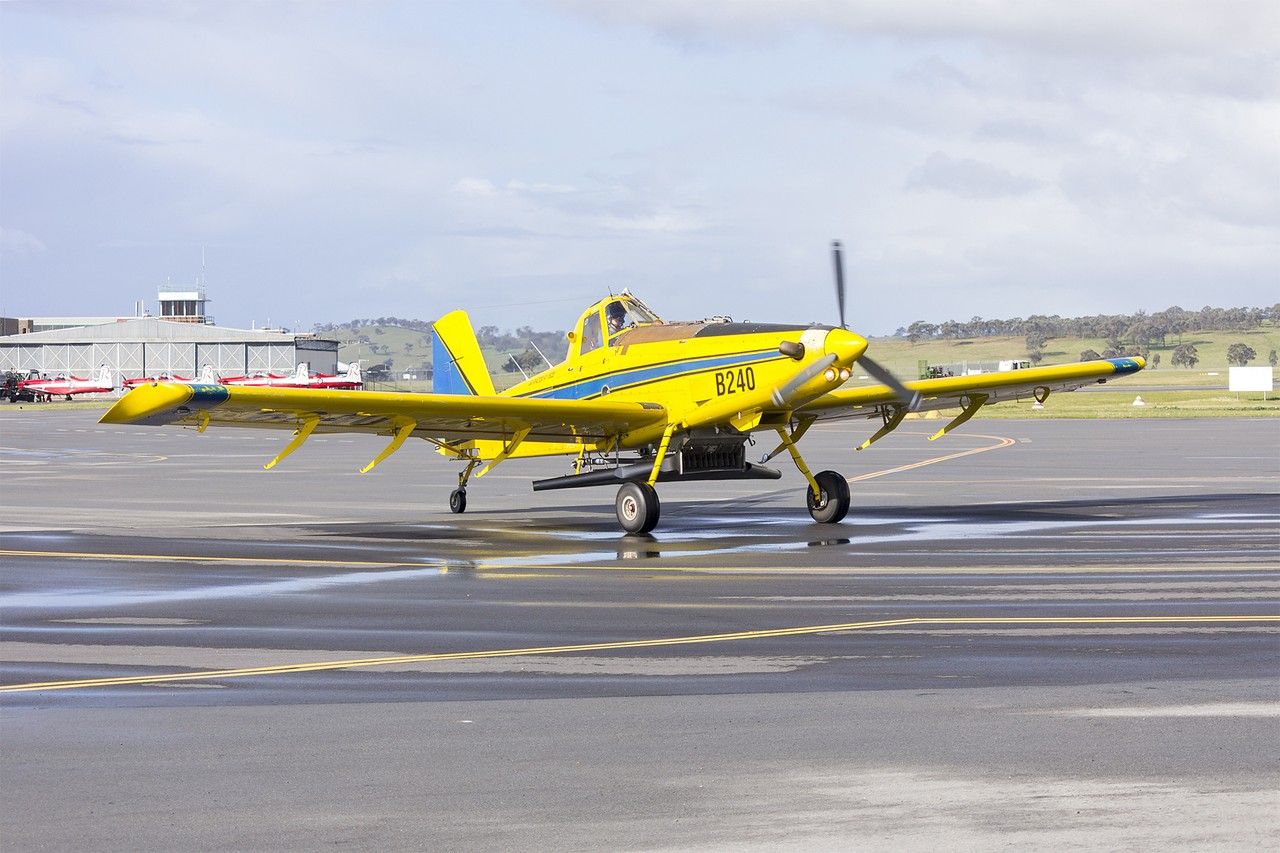
Agricultural Aviation Pioneer
The AT-501 emerged during a critical period in agricultural aviation when farmers demanded larger, more capable aircraft for crop protection operations. Production lasted just five years, but the aircraft's impact extended far beyond its brief manufacturing run. The AT-501 directly influenced the design of the AT-502, which became the world's best-selling agricultural aircraft from 2011 through 2018 with 388 deliveries.
Design Evolution and Innovation
Leland Snow's design team created the AT-501 as an enlarged development of the earlier AT-400, incorporating significant improvements that would define agricultural aviation for decades. The aircraft featured a 50-inch wingspan increase and 22-inch fuselage extension compared to its predecessor, allowing for substantially greater chemical capacity and operational flexibility. Unlike many agricultural aircraft of the era, the AT-501 included provisions for an observer seat, enabling training flights and field supervision missions.
The low-wing configuration represented a departure from the high-wing designs common in agricultural aviation, providing improved ground handling characteristics and enhanced structural integrity for the demanding pull-out forces encountered in aerial application work. The chemical hopper's strategic placement between the engine firewall and cockpit optimized weight distribution while maintaining pilot visibility and safety.
Powerplant and Performance
The Pratt & Whitney R-1340 radial engine delivered 600 shaft horsepower, providing the AT-501 with exceptional power-to-weight ratio crucial for agricultural operations. This nine-cylinder radial powerplant offered proven reliability in dusty, demanding environments where engine failure could prove catastrophic. The engine's robust construction and field-maintainable design made it ideal for operations from remote airstrips with minimal support facilities.
With a gross weight of 6,500 pounds and fuel capacity of 260 gallons, the AT-501 achieved operational ranges suitable for large-scale agricultural contracts. The aircraft's taildragger configuration, while challenging for inexperienced pilots, provided superior propeller ground clearance essential for operations from rough farm strips.
The Air Tractor Legacy
Air Tractor Inc., founded in 1978 by Leland Snow, had established itself as the premier manufacturer of purpose-built agricultural aircraft by the time AT-501 production began. Snow's aviation career stretched back to 1951 when he designed his first aircraft, the S-1, completing test flights in 1953. After working for Rockwell, Snow resigned to pursue his vision of specialized agricultural aircraft, beginning construction of the first Air Tractor model in 1972.
The company's growth paralleled the evolution of modern agricultural aviation. By 1993, Air Tractor had delivered its 1,100th airplane, reaching 2,000 Snow-designed aircraft by 1998. The AT-502B alone achieved 2,000 deliveries by 2004, demonstrating the success of design principles first established in the AT-501.
Operational Characteristics
Agriculture pilots praised the AT-501's handling characteristics, particularly its stability during low-level application runs and predictable stall behavior crucial for safety in agricultural operations. The aircraft's single-pilot operation reduced operating costs while the observer seat capability provided training opportunities for new agricultural pilots entering the profession.
The 500-gallon hopper capacity positioned the AT-501 in the medium-capacity agricultural aircraft category, suitable for mid-sized farming operations and contract applicators serving multiple clients. This capacity struck an optimal balance between payload and fuel efficiency, enabling economical operations across diverse agricultural markets.
Production and Market Impact
Manufactured exclusively at Air Tractor's Olney, Texas facility, the AT-501 benefited from the company's specialized production techniques developed specifically for agricultural aircraft. The five-year production run from 1986 to 1991 coincided with significant expansion in American agricultural aviation as farmers increasingly relied on aerial application for crop protection and fertilization.
While exact production numbers remain undocumented, the AT-501's influence on subsequent designs proved immeasurable. The aircraft served as a direct predecessor to the AT-502 series, which dominated agricultural aviation markets worldwide. Air Tractor currently produces approximately 200 aircraft annually, with total deliveries exceeding 4,000 aircraft across all models.
Contemporary Legacy
The AT-501's design philosophy continues influencing modern agricultural aircraft development. Its emphasis on pilot safety, operational efficiency, and structural durability established benchmarks that remain relevant in contemporary agricultural aviation. The broader AT-500 family, including the AT-502A, AT-502B, and AT-504, achieved 470 total deliveries and ranked among the world's most popular single-turboprop aircraft families during the 2011-2018 period, exceeded only by the Pilatus PC-12 and Cessna 208 Caravan family.
Today, Air Tractor Inc. continues operating independently from its original Olney, Texas headquarters, maintaining the engineering principles and manufacturing expertise first demonstrated in the AT-501. The aircraft's contribution to agricultural aviation safety, efficiency, and capability ensures its recognition as a pivotal design in the evolution of specialized agricultural aircraft.