
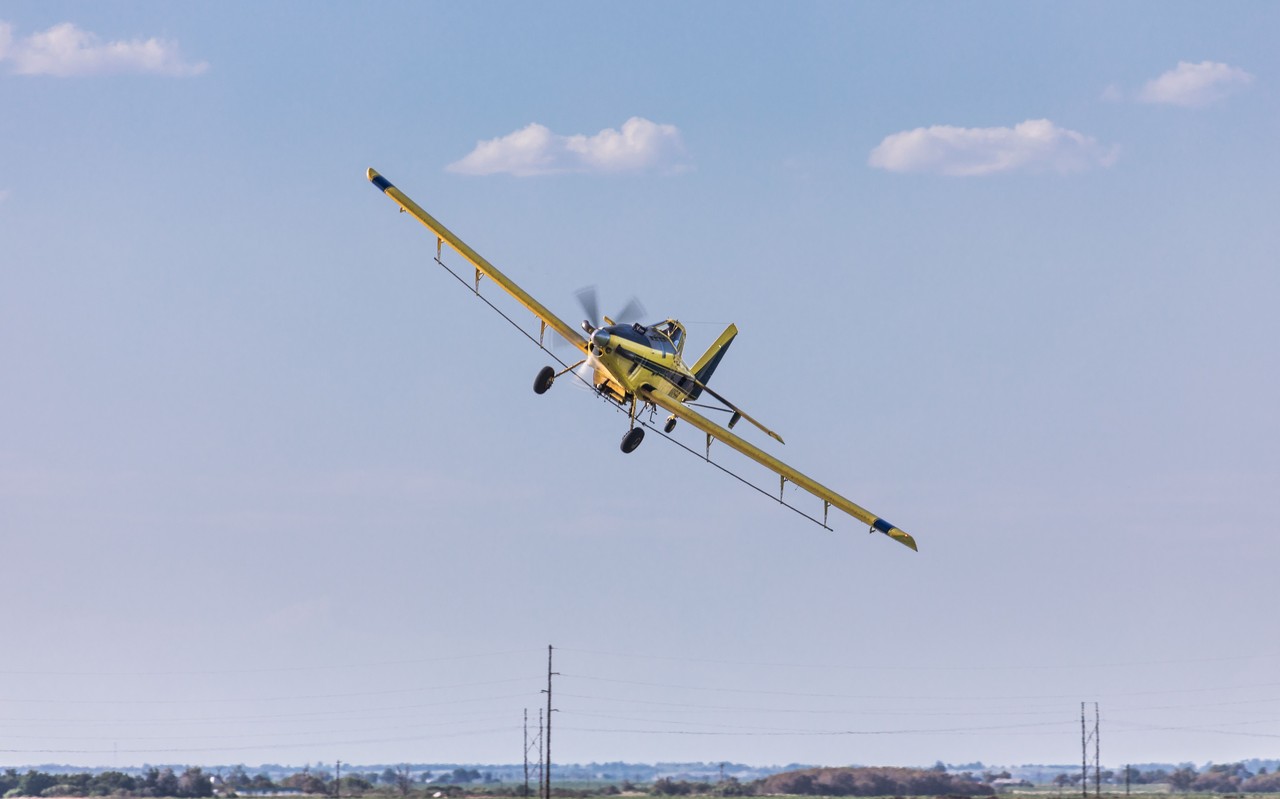
Agricultural Aviation Leadership
The AT-602 emerged during the mid-1990s as agricultural operations demanded greater efficiency and payload capacity. Air Tractor recognized a market gap between their 500-gallon AT-500 series and the massive 810-gallon AT-802, creating the AT-602 to serve operators requiring intermediate capacity without the operational complexity of larger aircraft. The type quickly gained acceptance among spray services seeking to cover more acreage per flight while maintaining manageable operating costs.
The Air Tractor Legacy
Air Tractor Inc. traces its origins to aviation pioneer Leland Snow, who established the company in 1978 after decades of agricultural aircraft development. Snow's journey began in 1951 with his first aircraft design, culminating in the successful S-2B model. After selling his original company to Rockwell-Standard in 1965 and serving as Vice President of the Aero Commander division, Snow resigned in the early 1970s to pursue his vision of the ideal agricultural aircraft.
Snow spent two years refining his Air Tractor concept before construction began on the AT-300 (later AT-301) in 1972. The prototype flew in 1973, establishing the foundation for what would become one of the world's most successful agricultural aircraft families. The company introduced its first turbine model, the AT-302, in 1977, marking Air Tractor's transition to turboprop power that would define its modern fleet.
By 2004, Air Tractor had delivered its 2,000th aircraft, demonstrating the enduring appeal of Snow's designs. The company remains headquartered in Olney, Texas, where Snow relocated his operations in 1958, continuing the town's six-decade tradition of agricultural aircraft manufacturing.
Engineering Excellence
The AT-602's powerplant selection proved crucial to its success. The Pratt & Whitney Canada PT6A-60AG delivers 1,050 shaft horsepower at 1,700 RPM, providing ample power for the aircraft's 12,500-pound maximum takeoff weight while maintaining the PT6A family's renowned reliability in harsh agricultural environments. The engine drives a Hartzell HC-B5MP-3C/M10876ANS propeller optimized for the low-altitude, high-power operations typical of crop spraying.
The aircraft's structure reflects decades of agricultural aviation experience. With an empty weight of 5,829 pounds including spray equipment, the AT-602 achieves a useful load of 6,900 pounds, allowing operators to carry substantial chemical loads while maintaining adequate fuel reserves. The 630-gallon hopper represents a 26-percent capacity increase over the AT-500 series, translating directly to reduced operational costs through fewer refill cycles.
Operational Characteristics
Pilots praise the AT-602's handling qualities despite its substantial size and weight. The aircraft maintains surprising control responsiveness throughout its operating envelope, with a typical working speed of 145 mph allowing efficient coverage of large agricultural areas. At 8,000 feet, the AT-602 achieves a cruise speed of 182 mph with a maximum range of 600 miles, providing flexibility for ferry flights between distant job sites.
The cockpit design emphasizes pilot comfort during long working days, with ergonomic controls and excellent visibility essential for precision agricultural operations. Operators report the ability to complete 1,000-acre treatments in morning sessions, representing a three-load savings compared to smaller aircraft and directly impacting profitability.
Performance Specifications
The AT-602's performance envelope reflects its specialized agricultural mission. With a rate of climb of 650 feet per minute at maximum weight, the aircraft provides adequate performance margins for obstacle clearance while departing short agricultural strips. The takeoff distance of 1,830 feet at maximum weight allows operations from most farm airstrips, though the aircraft's substantial size requires careful consideration of runway length and surface conditions.
Fuel capacity of 216 gallons provides operational flexibility, though the aircraft's 31.24 square meter wing area and relatively high wing loading demand respect during low-altitude maneuvering typical of spray operations.
Market Impact and Current Operations
The AT-602 entered service during a period of agricultural aviation growth, with operators seeking increased productivity to serve expanding farm operations. The aircraft found particular favor among large spray services operating across multiple states, where its capacity advantage over smaller aircraft translated to significant time savings and reduced operational costs.
Today, AT-602s continue active service worldwide, with aircraft registered in the United States, Australia, and other agricultural regions. Some examples have accumulated more than 8,000 flight hours, testament to the type's durability in demanding agricultural environments. The aircraft's continued operation more than 25 years after its introduction reflects both Air Tractor's engineering excellence and the ongoing demand for mid-capacity agricultural aircraft in modern farming operations.