
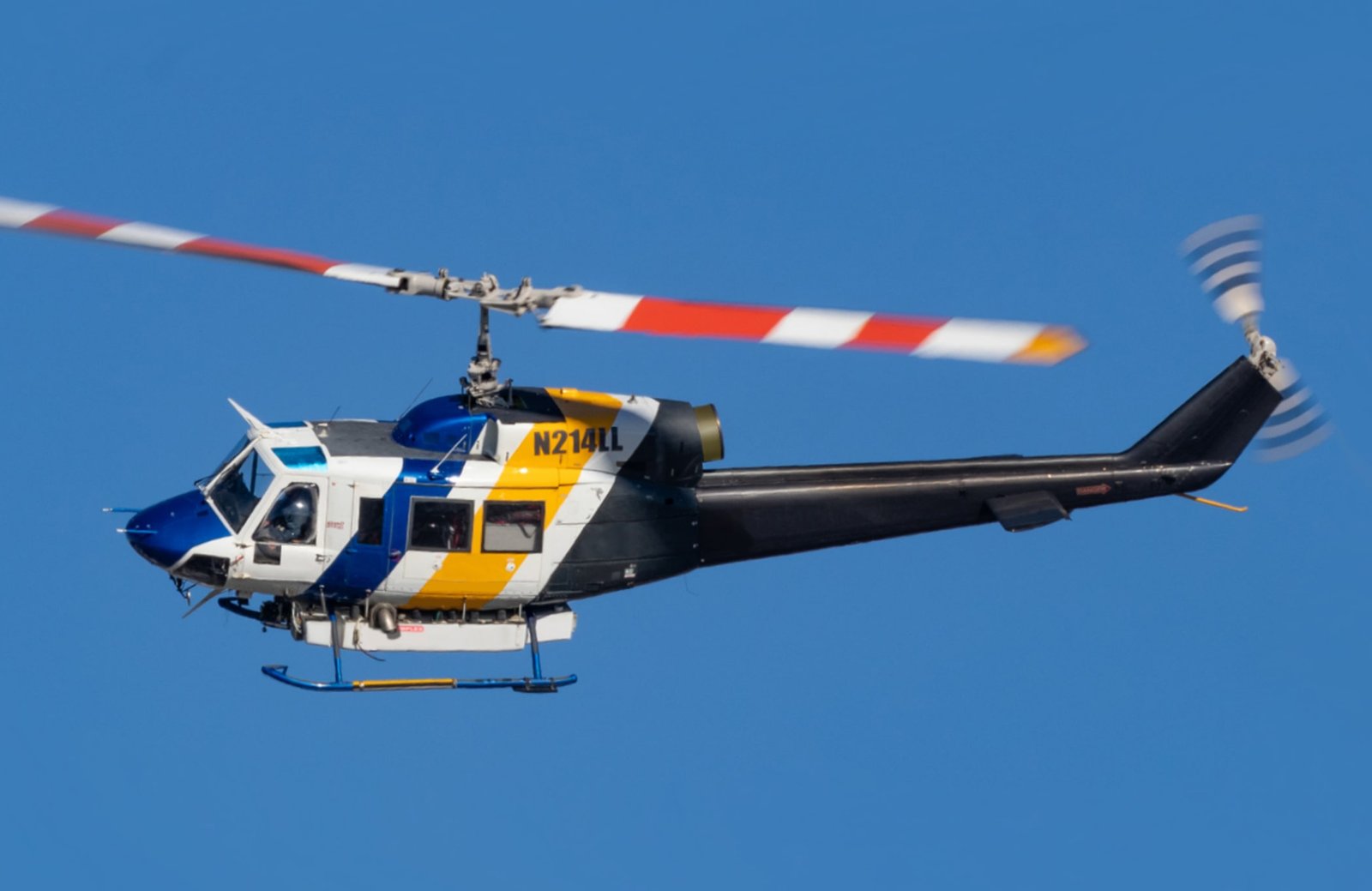
Service History
The Bell 214B carved out a specialized niche in commercial aviation, serving operators who needed exceptional lifting capability for demanding missions. By 2012, approximately 41 aircraft remained in active service across four nations: the United States operated 15 units, Canada flew 10, Australia maintained 6, and Singapore operated 3. These helicopters found their calling in heavy-lift operations for the oil and gas industry, forestry work, and firefighting missions where their substantial power-to-weight ratio proved invaluable.
The Federal Aviation Administration certificated the 214B on January 27, 1976, followed by the 214B-1 variant on February 3, 1976. The 214B-1 featured a lower gross weight configuration to meet specific certification requirements, expanding the model's operational flexibility for different mission profiles.
Military Heritage
While the 214B itself served purely civilian roles, its lineage traced directly to military requirements. Bell developed the helicopter as a commercial derivative of the Bell 214A "Isfahan," which had been created for the Imperial Iranian Army Aviation. The military connection proved significant when three 214B aircraft found their way into United Arab Emirates military service by 2012, demonstrating the type's adaptability to both civilian and military missions.
The design evolution began with the Bell 214 "Huey Plus" prototype, which incorporated lessons learned from the ubiquitous UH-1 Huey series. Bell's engineers focused on creating a medium-lift platform that could handle substantially heavier payloads than the earlier Bell 205, targeting operations in hot and high-altitude conditions where engine power became critical.
The Manufacturer
Bell Helicopter traced its origins to 1935 when Lawrence Dale Bell founded Bell Aircraft Corporation. The company entered the rotorcraft business after World War II, achieving early success with the Bell 47 in 1946. Textron acquired Bell in 1985, creating Bell Helicopter Textron, which continued operations until rebranding as Bell Textron in 2020.
In a significant development for 214B operators, Bell transferred the FAA Type Certificates for the 214B, 214B-1, and related 214ST to Erickson Incorporated of Central Point, Oregon in 2020. This transfer ensured continued support for the aging fleet while Bell focused resources on newer helicopter programs.
Engine & Technical Innovation
The heart of the 214B's capability lay in its Lycoming LTC4B-8D turboshaft engine, also designated as the T55-L-8D. This powerplant delivered 2,930 shaft horsepower (2,183 kW), representing a dramatic increase over earlier commercial helicopter engines. Lycoming, operating as a division of Textron (later acquired by Honeywell), had evolved this engine from the proven T55 series, emphasizing reliability in hot and high-altitude conditions.
Bell's engineering team upgraded the rotor drive system and transmission to handle the increased power, sharing these improvements with the military 214A variant. The robust transmission system became essential for the helicopter's heavy-lift missions, allowing operators to maximize payload capacity in challenging environments.
Performance Characteristics
The 214B achieved a maximum speed of 162 miles per hour, with typical cruising speeds around 150 mph depending on mission requirements and atmospheric conditions. The helicopter's performance envelope made it particularly valuable for time-sensitive operations where both speed and lifting capacity mattered.
Record-setting performance came early in the 214 family's history. On April 29, 1975, a Bell 214A flown by Major General Manucheher Khosrowdad of the Imperial Iranian Army Aviation and Bell assistant chief test pilot Clem A. established five altitude and time-to-height records, demonstrating the helicopter's exceptional climb performance and operational ceiling capabilities.
Production & Legacy
Bell manufactured the 214B from 1976 through 1981, with all production taking place at the company's Fort Worth facility. While exact production numbers for the 214B variant remain unspecified, it formed part of the broader Bell 214 family that totaled approximately 400 units across all military and civilian variants.
The 214B's legacy rests in its role as a bridge between military helicopter technology and commercial applications. By adapting proven military systems for civilian use, Bell created a helicopter that could handle missions previously impossible for commercial operators. The type influenced heavy-lift operations throughout the late 1970s and 1980s, particularly in resource extraction industries.
Today, the remaining 214B fleet continues operating in specialized roles, though advancing age and parts availability present ongoing challenges. The 2020 transfer of type certificates to Erickson Incorporated provides hope for continued support, ensuring these capable helicopters can serve operators who still require their unique combination of power and reliability.