
Engineering Solution to Market Demands
The Bell 230 emerged from Bell Helicopter's determination to salvage the promising but troubled Bell 222 program. By autumn 1989, Bell engineers recognized that the Bell 222's Lycoming LTS-101 engines had created sufficient reliability concerns to damage sales prospects. The 230 program represented a comprehensive engineering response, centered on replacing the problematic powerplants with proven Allison 250-C30G2 turboshaft engines while incorporating additional refinements throughout the airframe.
Two prototypes validated the design approach. The first aircraft, registered C-GEXP, achieved initial flight on August 12, 1991, followed by the second prototype C-GBLL on October 3, 1991. Transport Canada granted certification in March 1992, marking a significant milestone as the first type certificate approval achieved at Bell's Mirabel facility.
Power and Performance Revolution
The heart of the Bell 230's improvement lay in its Allison 250-C30G2 engines, each developing 695 shaft horsepower for continuous operations and 808 shaft horsepower for takeoff conditions limited to five minutes. During emergency single-engine operations, the remaining powerplant could produce 940 shaft horsepower for 30 seconds, 880 shaft horsepower for two minutes, or 835 shaft horsepower for extended 30-minute periods. This power range provided pilots with substantial safety margins unavailable in the earlier Bell 222.
The engines operated with gas producers spinning at 51,000 rpm at 100 percent N1, driving power turbines at 30,908 rpm and delivering output at 9,598 rpm to the transmission system. This power advantage translated into practical performance improvements: maximum cruise speed reached 140 knots with a service ceiling of 15,500 feet and operational range extending 378 nautical miles.
Market Positioning and Configuration Flexibility
Bell positioned the 230 across multiple civilian market segments through strategic configuration options. Executive versions accommodated six to eight passengers in club seating arrangements designed for corporate transportation. The utility variant maximized capacity with 10 forward-facing seats arranged in a 2-2-3-3 layout within the 3.8 cubic meter passenger compartment.
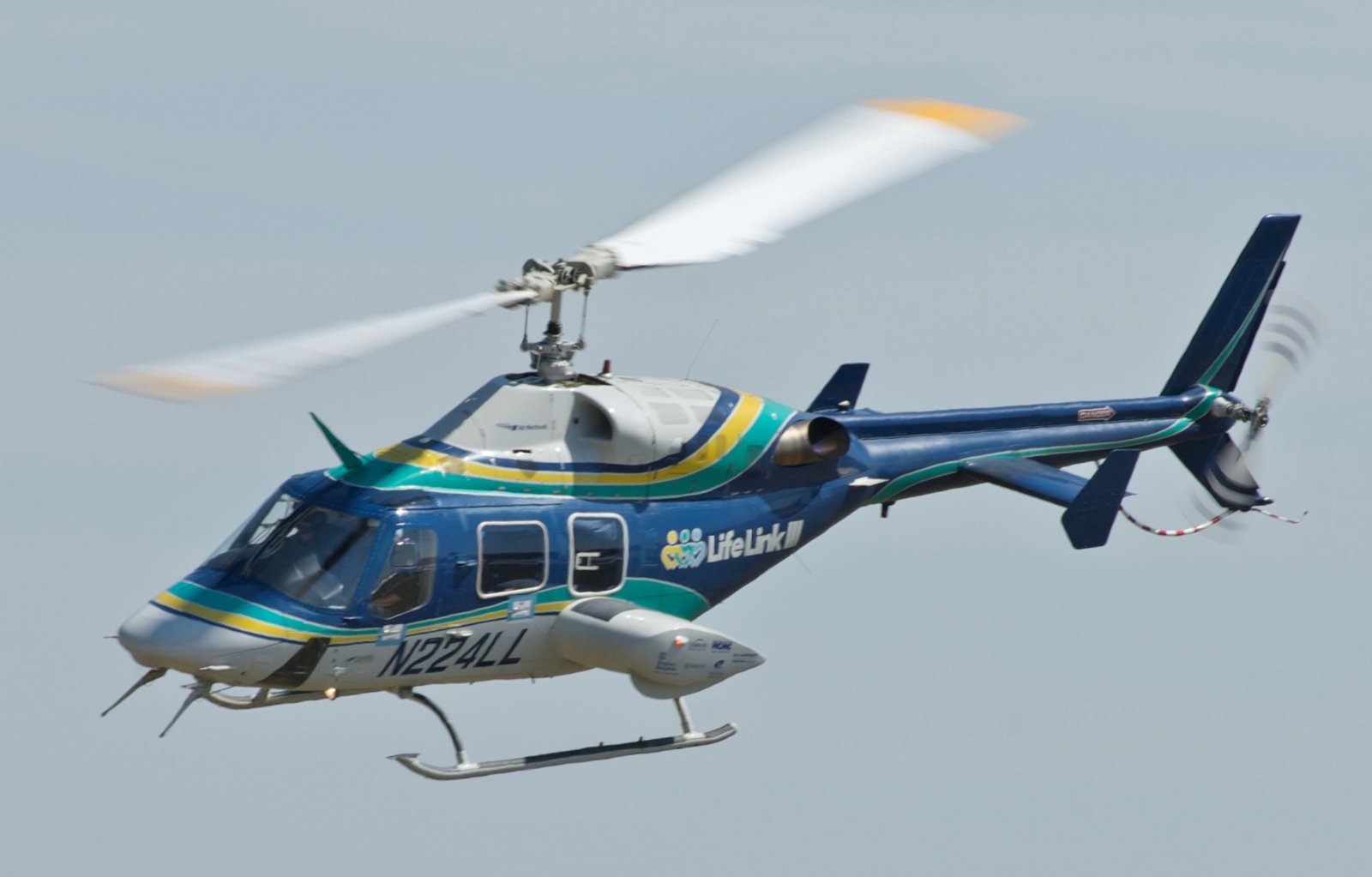
Emergency medical service configurations demonstrated the platform's versatility, featuring single-pilot operation capability with accommodation for one or two pivotable stretchers plus medical attendants. Standard seating arrangements placed nine occupants in a 2-2-2-3 forward-facing configuration, though customers could specify alternative layouts to meet specific operational requirements.
Manufacturing Reality and Market Reception
Production commenced at Bell's Mirabel facility following certification, with the first customer delivery occurring in November 1992. Mitsui & Co, serving as Bell's Japanese representative, placed an initial order for 20 aircraft with deliveries scheduled to begin in August 1992, signaling strong international interest.
Despite this promising start, total production reached only 38 aircraft over the four-year manufacturing period ending in 1995. The relatively modest production numbers reflected both the specialized nature of the executive helicopter market and the rapid evolution of Bell's product line.
Technical Innovation and Design Features
Bell engineers incorporated sophisticated systems throughout the 230's design. Dual hydraulic systems powered main rotor collective and cyclic controls, while a single hydraulic system operated the tail rotor. The electrical system featured dual 28-volt DC power supplied by two 30-volt, 200-ampere engine-mounted starter-generators, backed by a 24-volt, 28-ampere-hour nickel-cadmium battery.
Fuel capacity varied by configuration: skid-equipped versions carried 935 liters while wheeled variants held 710 liters, with both configurations offering optional 182-liter auxiliary tanks for extended range operations. Executive models featured hydraulically retractable tricycle landing gear with main wheels retracting forward into sponsons and a forward-retracting nose wheel, while utility versions employed conventional tubular skids.
Successor and Legacy
The Bell 230's production conclusion in 1995 coincided with development of its larger successor, the Bell 430. This stretched variant, featuring a four-bladed rotor system and increased passenger capacity, first flew in 1994 and received Transport Canada certification on February 23, 1996. The 430's 12-year production run through May 2008 demonstrated the market's preference for the larger platform's enhanced capabilities.
While the Bell 230's four-year production span appears brief, the program achieved its primary objective of demonstrating that reliable powerplants could transform helicopter market acceptance. The engineering lessons and manufacturing experience gained through the 230 program directly enabled Bell's success with the more commercially viable 430 series, establishing a foundation for the company's continued presence in the executive helicopter market.