
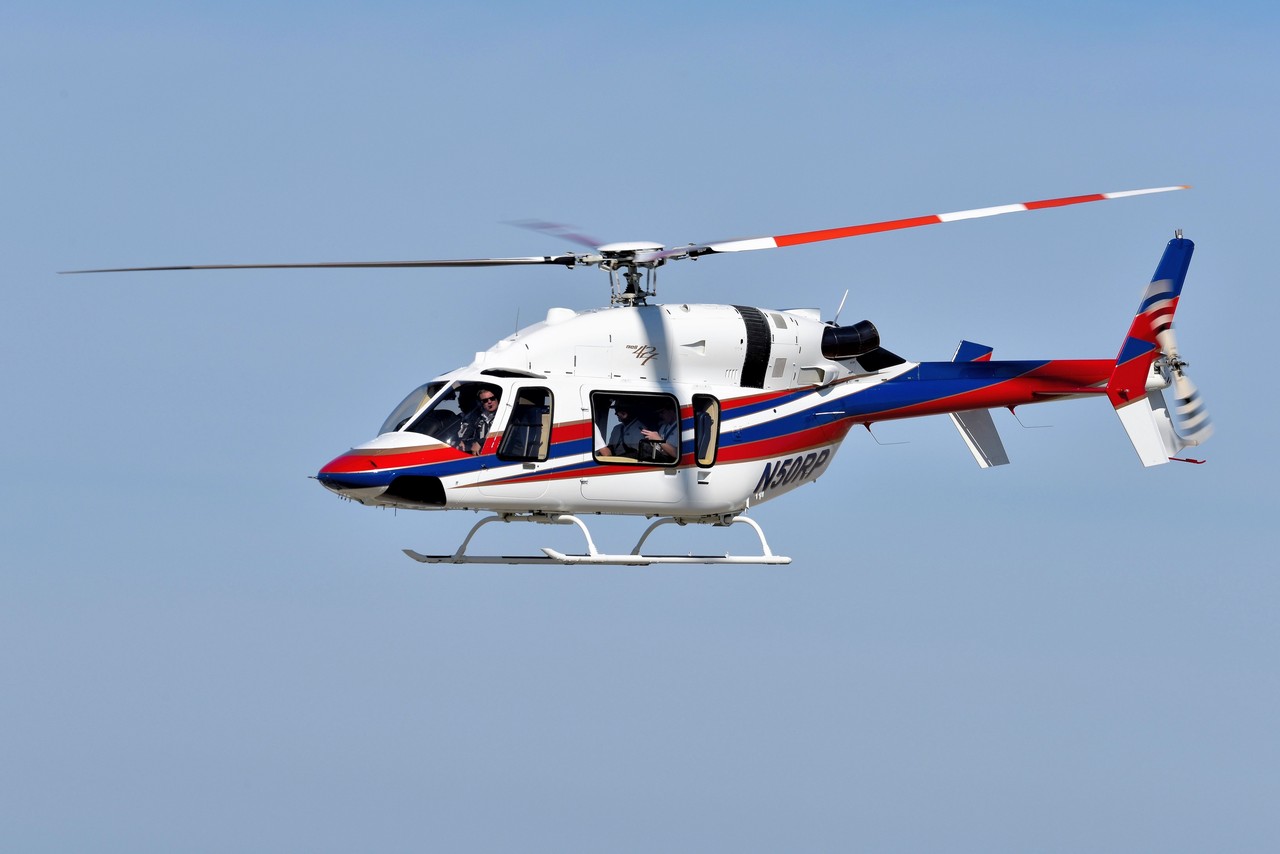
Revolutionary Design Philosophy
Bell Helicopter developed the 427 as a clean-sheet replacement for the aging Bell 206LT TwinRanger, targeting operators who needed twin-engine safety without sacrificing payload or range performance. The design team established ambitious goals: reduce cabin components by 33 percent compared to the Bell 407, cut transmission gears by 40 percent versus the Bell 430, and create the company's first fully computer-aided design helicopter. These objectives drove innovations that would influence Bell's future rotorcraft development.
The 427's most significant advancement was its spacious flat-floor cabin, eliminating the restrictive "bathtub" floor configuration that plagued earlier models. Engineers extended the composite fuselage 13 inches beyond the Bell 407's length, removing an obstructing roof beam that had limited passenger comfort and cargo flexibility. This design breakthrough allowed operators to quickly reconfigure between corporate transport, emergency medical services, and utility missions.
International Manufacturing Partnership
Bell Helicopter orchestrated a complex international production arrangement that demonstrated early globalization in aerospace manufacturing. While final assembly occurred at Bell's Mirabel facility in Quebec, flight dynamics systems originated from Fort Worth, Texas. Samsung Aerospace Industries, later acquired by Korea Aerospace Industries, manufactured fuselages and tailbooms at their Sachon plant in South Korea. This partnership distributed manufacturing expertise while maintaining Bell's quality standards and certification authority.
Two prototypes validated the design concept: C-GBLL completed its maiden flight on December 11, 1997, at Mirabel, followed by C-FCSS in February 1998. Flight testing revealed the need for more powerful engines, leading Bell to upgrade from the initially planned PW206D to the more capable PW207D turboshaft engines.
Advanced Powerplant Technology
Pratt & Whitney Canada's PW207D engines represented cutting-edge turboshaft technology for light twin helicopters. Each engine delivered 710 shaft horsepower with full authority digital engine control, providing automatic surge protection and rotor droop prevention during demanding flight operations. The FADEC system allowed single-pilot operations while maintaining the safety margins that twin-engine configurations provided over populated areas.
The 427's rotor system incorporated Bell's proven four-blade main rotor with rigid composite hub technology and "soft inplane" engineering, originally developed for the Bell 407. This configuration delivered smooth flight characteristics while reducing maintenance requirements. The two-blade tail rotor provided adequate anti-torque control while minimizing complexity and operating costs.
Commercial Service and Applications
Operators primarily utilized the Bell 427 for corporate transportation, emergency medical services, and general utility missions. The helicopter's twin-engine configuration qualified it for Category A certification up to 6,504 pounds, enabling operations over populated areas where single-engine helicopters faced restrictions. Emergency medical services particularly valued the removable fuel tank system that allowed rapid reconfiguration between transport and medical missions.
Corporate operators appreciated the 427's combination of speed, range, and comfort. With a service ceiling of 10,000 feet, rate of climb exceeding 2,000 feet per minute, and range of 394 nautical miles, the helicopter competed effectively with larger, more expensive twin turbines. The spacious cabin accommodated one or two pilots plus five to seven passengers in executive configurations.
Production Challenges and Legacy
Despite its technical innovations, the Bell 427 faced challenging market conditions that limited commercial success. Bell announced production termination on January 24, 2008, completing final deliveries in 2010 after manufacturing exactly 77 aircraft. The limited production run reflected intense competition in the light twin segment and operators' price sensitivity during economic downturns.
Bell had planned an upgraded 427i variant in 2004, partnering with Korea Aerospace Industries and Mitsui Bussan to offer glass cockpit displays, single-pilot instrument flight rules capability, and an additional 14 inches of fuselage length. However, the company canceled this program in 2005, transferring 80 existing 427i orders to the larger Bell 429 program that better addressed market demands.
Continuing Operations
Many of the 77 Bell 427s remain operational worldwide, with examples registered in North America, Europe, and Asia-Pacific regions. Low-time corporate aircraft occasionally appear on the used helicopter market, testament to the type's quality construction and limited utilization. Operators value the 427's reliability and performance characteristics, though parts support reflects the limited production numbers.
The Bell 427's most significant contribution was advancing light twin helicopter safety standards and demonstrating advanced manufacturing partnerships. Its flat-floor cabin design and FADEC engine technology influenced subsequent Bell models, while the international production model established templates for cost-effective rotorcraft manufacturing that continue today.