
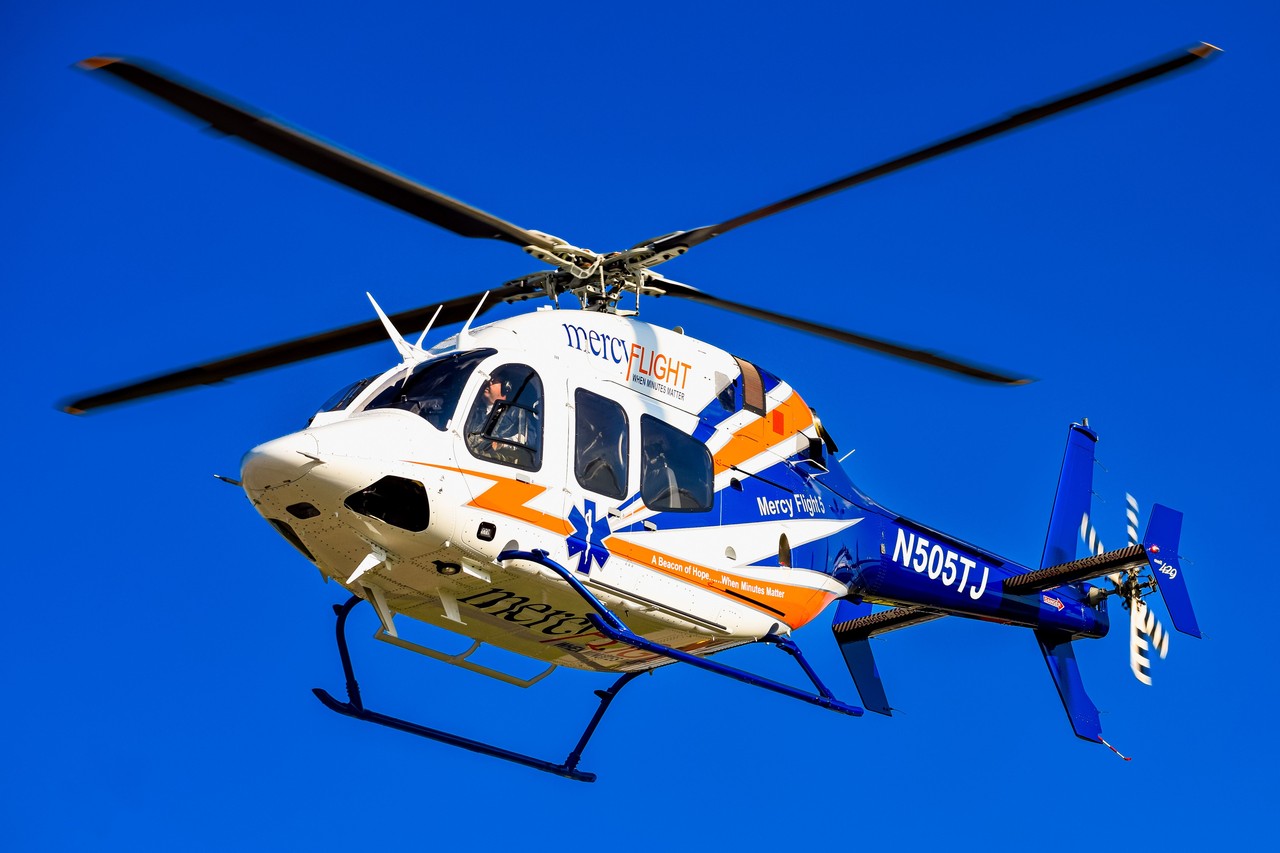
Service Dominance in Emergency Medical Services
The Bell 429 GlobalRanger quickly established itself as the preferred platform for air medical services worldwide. By July 2018, just nine years after entering service, 325 aircraft had accumulated 330,000 flight hours across police forces, air medical teams, and military units in 42 countries. This rapid adoption stemmed from the aircraft's ability to overcome critical limitations that plagued earlier helicopter designs, particularly the need for larger patient compartments and enhanced all-weather capabilities.
Air Methods Corporation, the launch customer, received the first production aircraft in August 2009 and immediately began demonstrating the type's superiority in medical evacuation missions. The helicopter's eight-seat configuration provided unprecedented flexibility for EMS operations, allowing medical teams to transport patients with full life support equipment while maintaining adequate space for attending personnel.
The Manufacturer's Innovation
Bell Helicopter, operating as Bell Helicopter Textron Canada, developed the 429 as part of their revolutionary Modular Affordable Product Line (MAPL) concept. This represented a fundamental shift from traditional helicopter manufacturing, incorporating standardized components that could be shared across multiple aircraft types to reduce costs and improve reliability. The 429 became the first Bell helicopter produced with MAPL components, establishing the foundation for future helicopter designs.
Bell partnered with Korea Aerospace Industries and Mitsui Bussan Aerospace of Japan during development, with Korean manufacturers responsible for cabin construction. This international collaboration allowed Bell to leverage specialized expertise while maintaining overall design control. The company's Mirabel, Quebec facility handled final assembly and flight testing, continuing Bell's tradition of Canadian helicopter production.
Engine Excellence and Technical Innovation
The twin Pratt & Whitney Canada PW207D1 turboshaft engines, each producing 625 horsepower, provide the 429 with exceptional performance characteristics. These engines drive a sophisticated rotor system featuring a four-bladed composite main rotor and an innovative four-bladed tail rotor configured in an X-pattern using two two-bladed units. This configuration significantly reduces noise levels compared to conventional tail rotor designs.
The aircraft achieved several industry firsts, becoming the initial helicopter certified using the Maintenance Steering Group-3 (MSG-3) process, which streamlined maintenance requirements and reduced operational costs. The 429 also earned single-pilot IFR certification, a crucial capability that earlier models like the Bell 206LT TwinRanger lacked, enabling operations in challenging weather conditions with reduced crew requirements.
Operational Excellence
Pilots praise the 429's handling characteristics and performance envelope. The helicopter cruises at 172.5 mph with a service ceiling of 20,000 feet, providing operational flexibility across diverse mission profiles. Its empty weight of 5,225 pounds allows for substantial payload capacity while maintaining excellent power-to-weight ratios.
The Royal Australian Navy recognized the 429's capabilities by leasing three aircraft from Raytheon Australia in 2012 for 723 Squadron operations at HMAS Albatross. These helicopters served training and utility missions, demonstrating the type's versatility beyond civilian emergency services.
Production Success and Global Impact
Market confidence in the 429 materialized early, with Bell holding Letters of Intent for 301 aircraft by certification in July 2009. CJ Systems Aviation Group placed the largest initial order for ten aircraft on February 26, 2006, recognizing the helicopter's potential to revolutionize their air medical operations across more than 80 base sites.
Production reached 550 units, with aircraft serving operators across six continents. By 2017, the 429 operated in Australia, Canada, Kuwait, Oman, Puerto Rico, Slovakia, Sweden, Turkey, the United Kingdom, and the United States. Operations expanded further by 2018 to include France, Indonesia, Switzerland, Thailand, and additional nations.
Design Legacy and Continuing Evolution
The 429's development traced back to the mid-1980s through Bell's evolution of twin-engine variants of the Bell 206L LongRanger. The progression from the 400/440 TwinRanger through the limited-production 206LT TwinRanger (13 built) and Bell 427 culminated in the 429's refined design that addressed market demands for increased cabin space and payload capacity.
The GlobalRanger continues in active production and service, representing Bell's commitment to advancing civilian helicopter technology. Its modular design philosophy influences current Bell helicopter development programs, while the type's proven reliability in emergency medical services ensures its continued relevance in critical life-saving missions worldwide.