
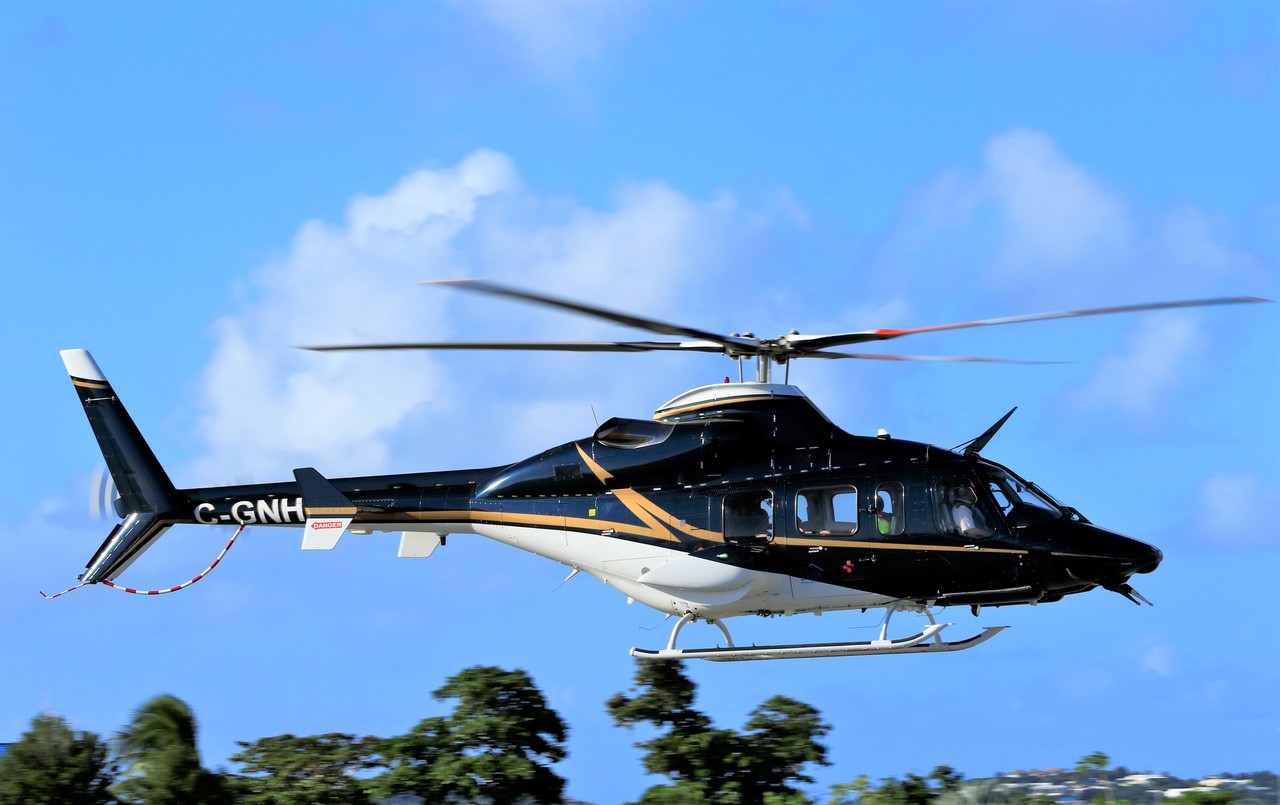
Service History
The Bell 430 entered commercial service in 1996 with 13 aircraft delivered in its inaugural year. By 1998, approximately 50 helicopters were in service worldwide, accumulating 9,000 total flight hours. Early operators included Daily Air Corp in Taiwan, which began operations in 1996, and Nakanihon Air Service in Japan, which started flying the type in 1997. The aircraft quickly established itself in the executive and corporate transport market, offering operators two additional passenger seats compared to the Bell 230 while delivering superior performance through advanced rotor technology.
Record-Setting Achievement
The Bell 430 gained international recognition on September 3, 1996, when Americans Ron Bower and John Williams set a round-the-world helicopter speed record flying westbound from the United Kingdom. Using the second production Bell 430, they completed the circumnavigation in 17 days, 6 hours, and 14 minutes, demonstrating the aircraft's reliability and range capabilities on a global stage.
The Manufacturer
Bell Helicopter originated as Bell Aircraft Corporation in 1935, founded by Lawrence Dale Bell with an initial focus on fixed-wing aircraft. The company transitioned into helicopter manufacturing after World War II, achieving early success with the Bell 47 in 1946. Textron acquired Bell in 1985, rebranding it as Bell Helicopter Textron before later integrating it simply as Bell under Textron Inc. The company established its Mirabel, Quebec facility in 1987 specifically for commercial helicopter production. By 1994, this Canadian plant was producing one-third of the world's commercial turbine helicopters, making it a crucial manufacturing hub for Bell's commercial aviation ambitions.
Engine & Technical Innovation
The Bell 430's powerplant consisted of twin Rolls-Royce (Allison) 250-C40B turboshaft engines, each delivering 10 percent more power than the engines used in the Bell 230. These engines, part of the renowned Rolls-Royce 250 series that has accumulated over 30,000 units built since 1959, provided the additional power necessary to operate the stretched fuselage design effectively. The twin-engine configuration ensured operational redundancy for enhanced safety in commercial operations.
The aircraft's most significant innovation was its four-blade, bearingless, hingeless composite main rotor system featuring a "soft-in-plane" fiberglass yoke. This advanced design eliminated traditional trunnions, bearings, and hinges found in conventional rotor systems, resulting in improved efficiency, reduced maintenance requirements, and enhanced flight smoothness compared to the Bell 230 and 222 series. The helicopter could be configured with either wheeled or skid landing gear, and optional EFIS avionics were available for operators seeking advanced cockpit technology.
Design Development
Bell Helicopter's engineering team at Mirabel led the 430's development as a stretched derivative of the Bell 230, which itself evolved from the successful Bell 222. The design team extended the fuselage by 1 foot 6 inches (46 centimeters) to accommodate two additional passenger seats, bringing total capacity to eight passengers plus crew. The first prototype, designated C-GBLL and known internally as a "dog ship" for testing purposes, completed its maiden flight on October 25, 1994, at Mirabel. A second prototype followed on December 19, 1994, as the development program progressed toward certification and production.
Production & Legacy
Bell manufactured the 430 exclusively at their Mirabel facility from 1995 through 2008, completing exactly 136 helicopters during this 13-year production run. The final delivery occurred in May 2008, marking the end of production for this evolutionary step in Bell's light twin helicopter lineage. The aircraft represented the culmination of Bell's 222-230-430 development progression, showcasing composite rotor innovations that would influence future helicopter designs.
The Bell 430's legacy lies in its role as a technology demonstrator for advanced rotor systems and its contribution to Bell's continued success at the Mirabel facility, which remains active today producing models including the 407GXi, 429, 412EPI, and 505. While production numbers were modest compared to Bell's most successful models, the 430 served as an important stepping stone in the evolution of commercial twin-engine helicopters, proving advanced composite rotor technology in commercial service and setting performance benchmarks for its class.