
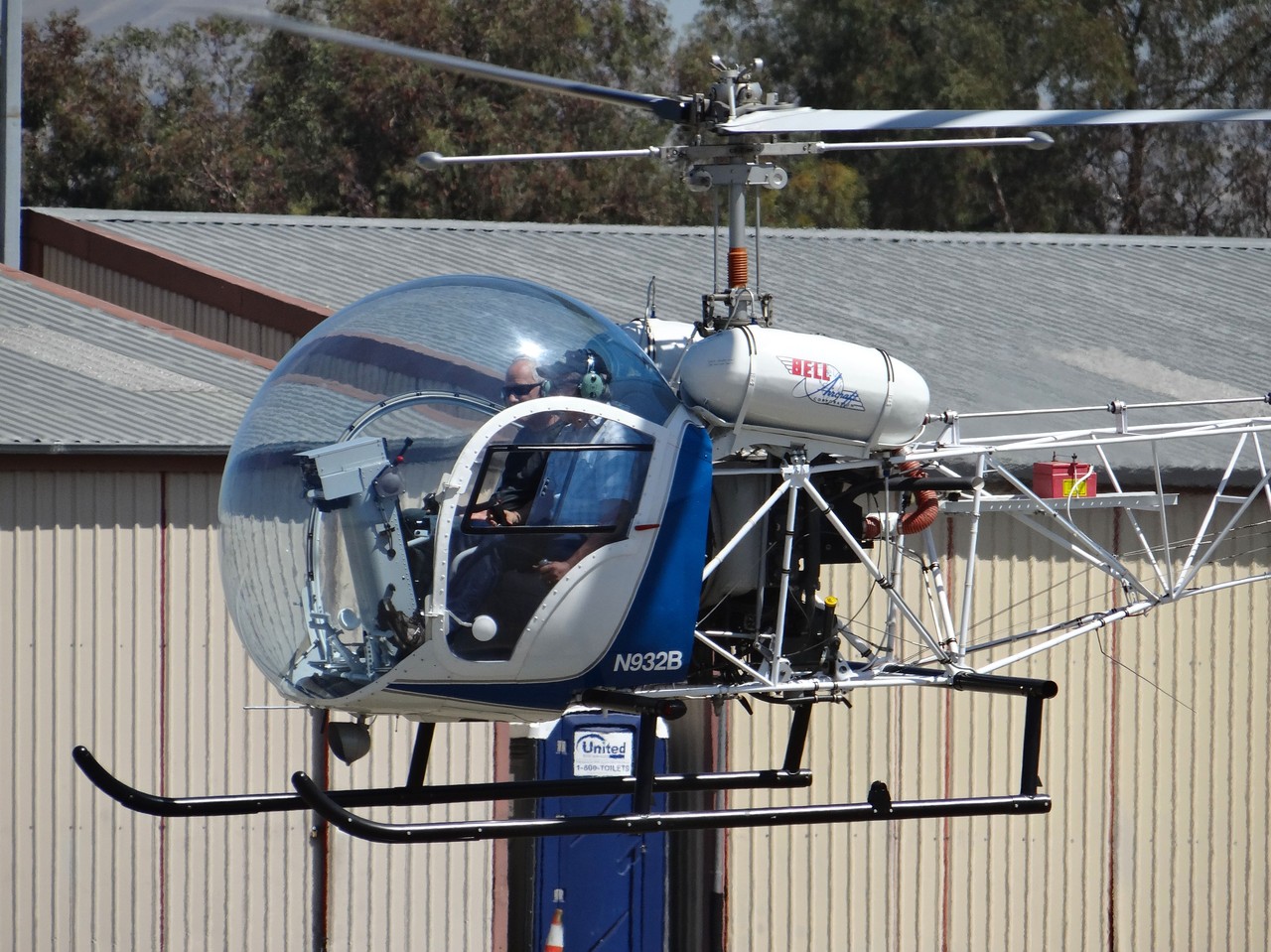
Service Dominance in Agricultural Aviation
The SOLOY Bell 47 conversion represented a revolutionary advancement in helicopter agricultural operations, extending the operational lifespan of aging Bell 47 airframes by decades. While the original Bell 47 production ceased in 1974 after more than 5,600 units were built, SOLOY Aviation's turbine conversions breathed new life into existing helicopters, with approximately 10 percent of the more than 7,000 Bell 47 helicopters built worldwide remaining in active service as of recent counts.
The turbine-powered versions proved exceptionally capable in crop dusting operations, mountain patrols, sea surveillance, and emergency medical services. With fuel endurance extending up to 2.5 hours and spray tank capacities reaching 450 litres, these converted aircraft became workhorses of agricultural aviation across multiple continents.
Technical Innovation and Performance
SOLOY Aviation's conversion program replaced the original Franklin and Lycoming piston engines with modern turbine powerplants. Early conversions utilized Allison turbine engines, while later modifications incorporated Rolls Royce turbine units. This transformation dramatically improved reliability, reduced maintenance requirements, and enhanced performance characteristics compared to the original piston-powered variants.
The aircraft retained the Bell 47's iconic two-blade rotor system and distinctive "goldfish bowl" Plexiglas cockpit, features that had made the original design instantly recognizable since its civilian certification on March 8, 1946. The open lattice pipe construction of the tail boom remained unchanged, preserving the structural simplicity that had contributed to the type's legendary reliability.
Design Heritage and Arthur Young's Vision
The foundation aircraft was designed by Arthur M. Young and represented a milestone in aviation history as the first helicopter to receive civilian certification, designated CAA Type Certificate H-1. Young's design, based on the third Bell 30 prototype, established the practical single-rotor configuration that would dominate helicopter design for decades.
The first civilian delivery occurred on December 31, 1946, to Helicopter Air Transport, marking the beginning of commercial helicopter operations. This pioneering aircraft taught thousands of pilots helicopter flying techniques and established the helicopter as a viable civilian aircraft for diverse applications.
Manufacturing Legacy and International Production
Bell Helicopter originally manufactured the Bell 47 at their Fort Worth, Texas facility, but production expanded internationally through licensing agreements. Agusta in Italy, Kawasaki Heavy Industries in Japan, and Westland Aircraft in the United Kingdom all produced variants under license, contributing to the type's global presence.
In February 2010, Scott's Helicopter Services in Le Sueur, Minnesota, acquired the Bell 47 type certificates and announced plans for a new turboshaft-powered version designated 47GT-6, with deliveries projected from 2016. However, development of this modernized variant stalled, and no production models materialized by 2025.
Record-Breaking Performance
The Bell 47's capabilities were dramatically demonstrated on September 17, 1952, when pilot Elton J. Smith flew a Bell 47 D-1 model a distance of 1,958.8 kilometers between Hurst, Texas, and Buffalo, New York. This remarkable flight established a distance record for piston-engined helicopters that remains unbroken, testament to the fundamental soundness of Young's original design.
Operational Examples and Restoration
The Flying Bulls' Bell 47 SOLOY, registered as OE-XDM and built in 1966, exemplifies the type's operational history and endurance. Sold in 1988, the aircraft was transported from the United States to Europe for crop spraying operations. After suffering damage from a heavy landing in 1998, it underwent extensive restoration by Christian Haiml, requiring 1,200 man-hours of meticulous work. The aircraft completed its post-restoration test flight in December 2002 and joined the Flying Bulls fleet in 2003.
Contemporary Status and Legacy
With approximately 16,000 Bell 47 models manufactured in various configurations worldwide, the type achieved unprecedented production success for a helicopter design. The SOLOY turbine conversion program demonstrated how thoughtful modernization could extend an aircraft's operational life far beyond its original design expectations.
Today, SOLOY Bell 47 helicopters continue operating in agricultural, patrol, and specialized transport roles across multiple continents. Their combination of proven reliability, turbine engine performance, and relatively simple maintenance requirements ensures their continued relevance in an industry increasingly dominated by more complex modern designs. The type's legacy as the foundation of civilian helicopter operations remains secure, while the turbine conversions represent successful adaptation to changing operational requirements.