
Development and Innovation
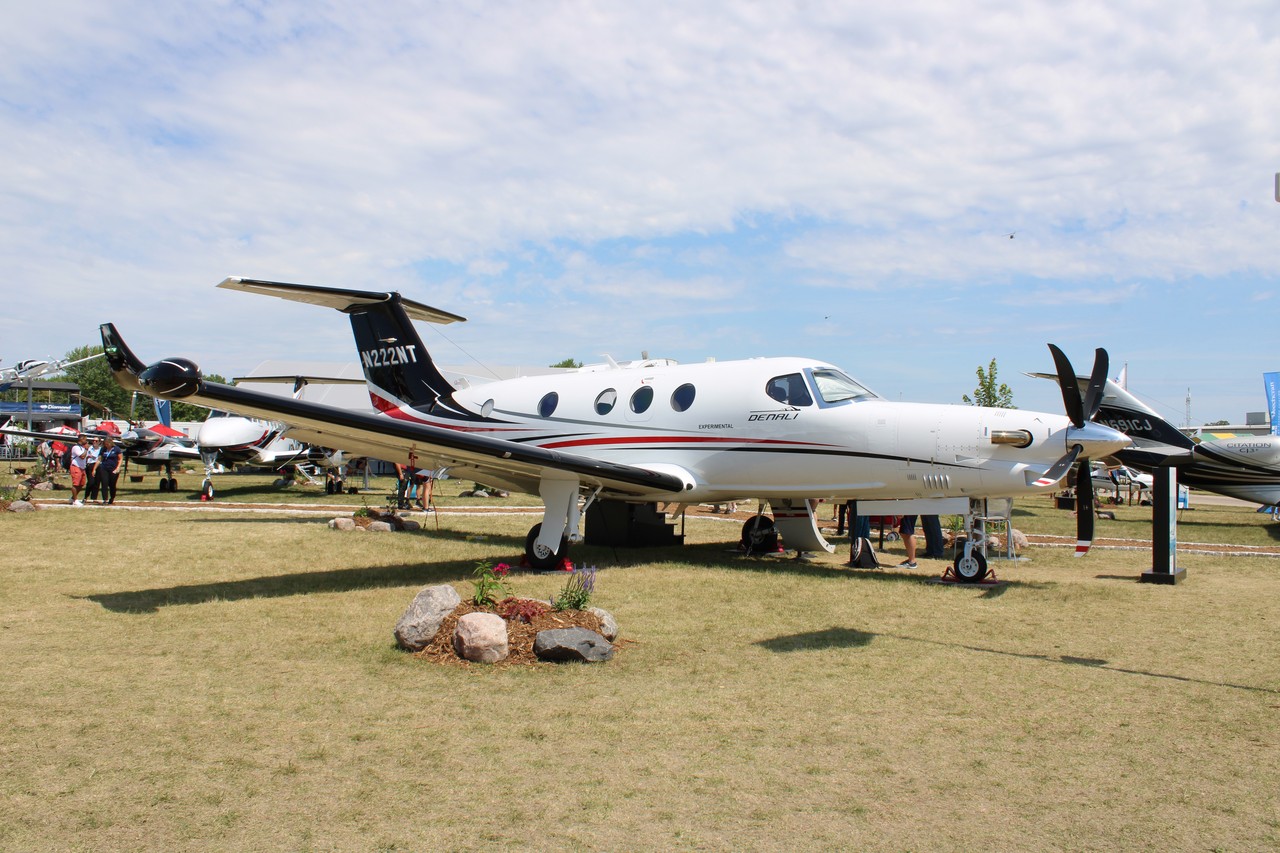
The Beechcraft 220 Denali emerged from Textron Aviation's ambitious goal to revolutionize the single-engine turboprop market. Announced at EAA AirVenture Oshkosh on July 27, 2015, the aircraft began as the Textron Single Engine Turboprop (SETP) before briefly being called the Cessna Denali and finally receiving its Beechcraft designation. Unlike previous Textron aircraft, the Denali represents a completely clean-sheet design with no heritage from existing models.
Assembly of the first prototype began in February 2018 at Textron Aviation's Wichita facilities, where engineers employed advanced manufacturing techniques including monolithic machined wing spars cut from single aluminum billets and chemical-milled titanium firewalls. The development program faced significant challenges, primarily centered around the powerplant certification timeline.
The GE Catalyst Engine
At the heart of the Denali's performance lies the revolutionary GE Catalyst engine, a 1,300-shaft-horsepower turboprop that promised to deliver 20 percent better fuel efficiency than competing engines. Originally announced in November 2015 as the GE Advanced Turboprop (ATP), the Catalyst features Full Authority Digital Engine Control (FADEC) technology that reduces pilot workload through single-lever power and propeller control.
The engine's certification proved more challenging than anticipated, with delays pushing the original 2022 timeline back to February 2025 when the FAA finally granted approval after more than 8,000 test hours. The Catalyst drives a five-bladed McCauley composite propeller measuring 105 inches in diameter, featuring full feathering capability, reversible pitch, and integrated ice protection systems.
Flight Testing Program
Senior test pilot Peter Gracey and chief test pilot Dustin Smisor conducted the Denali's maiden flight on November 23, 2021, departing from Wichita's Eisenhower International Airport. The inaugural flight lasted 2 hours and 50 minutes, reaching 180 knots and climbing to 15,600 feet. This milestone marked the beginning of an intensive certification campaign involving three flying prototypes and three ground test airframes.
By September 2025, the flight test program had accumulated an impressive 1,340 flights totaling 3,330 hours across the prototype fleet. Senior Vice President of Engineering & Programs Chris Hearne oversaw the testing progression, which systematically expanded the aircraft's operating envelope while validating performance predictions.
Advanced Avionics and Safety Features
The Denali incorporates a sophisticated Garmin G3000 avionics suite featuring touchscreen controllers, integrated autothrottle, Automatic Flight Control System (AFCS), and Flight Management System (FMS). Perhaps most significantly, the aircraft comes standard with Garmin's Emergency Autoland system, a breakthrough technology that can automatically land the aircraft at a suitable airport in case of pilot incapacitation.
This integration of advanced avionics represents Textron's commitment to reducing pilot workload while enhancing safety margins. The autothrottle system works seamlessly with the GE Catalyst's FADEC controls, providing unprecedented automation for the single-engine turboprop category.
Performance Specifications
Textron designed the Denali to achieve segment-leading performance metrics that would redefine single-engine turboprop capabilities. The aircraft delivers a maximum cruise speed of 328 miles per hour (285 knots) with a service ceiling of 31,000 feet and a takeoff distance of just 2,950 feet. With one pilot and four passengers aboard, the Denali can fly 1,600 nautical miles at high-speed cruise settings.
The aircraft's full-fuel payload capacity of 1,100 pounds enables practical mission flexibility, while the aft cargo door facilitates loading of bulky items. These specifications position the Denali for demanding routes such as Los Angeles to Chicago, New York to Miami, or London to Athens.
Manufacturing Heritage
Textron Aviation, formed in 2014 through the merger of Beechcraft and Cessna operations, brings over 95 years of aviation manufacturing experience to the Denali program. The company has produced more than half of all general aviation aircraft worldwide across its Beechcraft, Cessna, and Hawker brands. Beechcraft's heritage traces through Raytheon Aircraft (1980-2006) and Hawker Beechcraft (2006-2014) before Textron's acquisition rescued the company from bankruptcy proceedings.
Market Position and Legacy
With an equipped price forecast at $6.45 million in 2023, the Denali targets business operators, charter services, and owner-pilots seeking superior speed and efficiency. The aircraft represents Textron's first clean-sheet turboprop design in decades and pioneers the integration of sustainable aviation fuel compatibility alongside traditional operational capabilities.
As the certification program nears completion in 2026, the Denali stands poised to influence single-engine turboprop development for years to come, establishing new benchmarks for speed, efficiency, and technological sophistication in general aviation.