
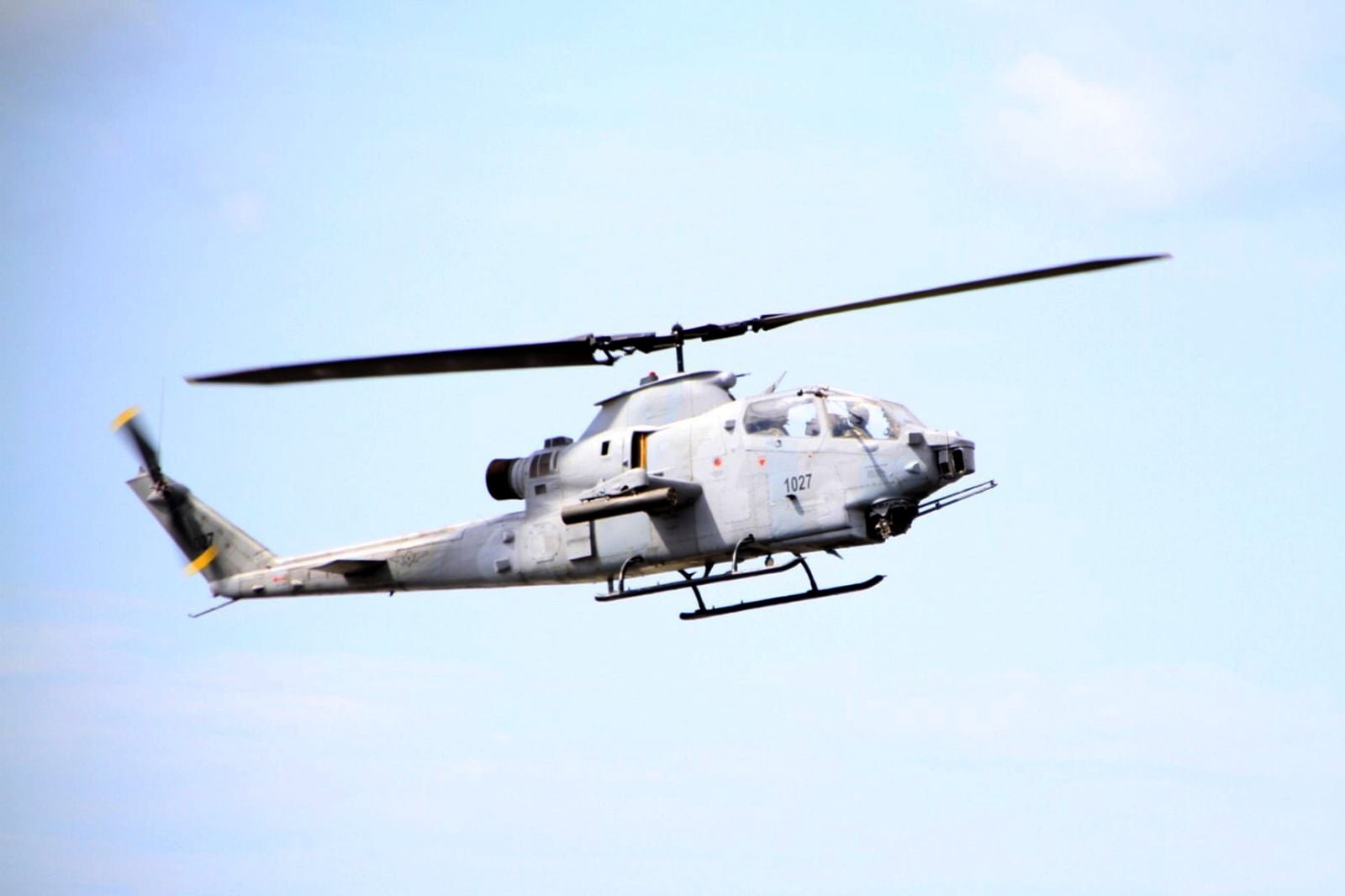
Developed by Bell Helicopter in Fort Worth, Texas, the AH-1 Cobra (Model 209) represents a pivotal shift in military aviation as the first helicopter specifically designed for attack roles rather than converted from transport models. The conceptual origin of the aircraft is attributed to Bell engineer Mike Folse, who sketched an early gunship configuration that eventually evolved into the Cobra line. The prototype first flew on September 7, 1965, utilizing the transmission, rotor system, and engine of the Bell UH-1 Iroquois (Huey) to maximize parts commonality.
Production began in 1966 following a U.S. Army order for 110 AH-1G aircraft on April 13, 1966. Between 1967 and 1973, approximately 1,110 to 1,126 aircraft were delivered to the U.S. Army and U.S. Marine Corps. The original AH-1G was powered by a single Lycoming T53 turboshaft engine. To optimize combat effectiveness, the design featured a narrow fuselage with a tandem cockpit—placing the gunner in front and the pilot behind—and a chin-mounted gun turret. Stub wings were added to carry rocket pods and, in later variants, M65 TOW anti-tank missiles and M197 20 mm cannons.
The Cobra entered combat in Vietnam in late 1967, with the first six aircraft arriving at Bien Hoa in August of that year. The first combat kill occurred on September 4, 1967, when a Cobra destroyed a Viet Cong sampan near Muc Hoa. During the Vietnam War, approximately 300 aircraft were lost to accidents and combat. The AH-1 served as the primary attack helicopter for the U.S. Army until the introduction of the AH-64 Apache in the 1980s and 1990s, with the Army officially retiring the type from active service in March 1999.
Beyond the U.S. Army, the U.S. Marine Corps adopted twin-engine derivatives, including the AH-1J SeaCobra and the AH-1Z Viper, the latter of which is expected to remain in service into the 2040s. International operators included Israel, Turkey, Japan, South Korea, Bahrain, Jordan, and Pakistan. Notably, the Israeli Air Force used the Cobra extensively during the 1982 Lebanon War, while Turkey employed them against Kurdish insurgents. In civilian service, surplus AH-1 airframes have been converted for aerial firefighting. Today, the aircraft is preserved in institutions such as the National Air and Space Museum and the Pima Air & Space Museum.