
Design Revolution
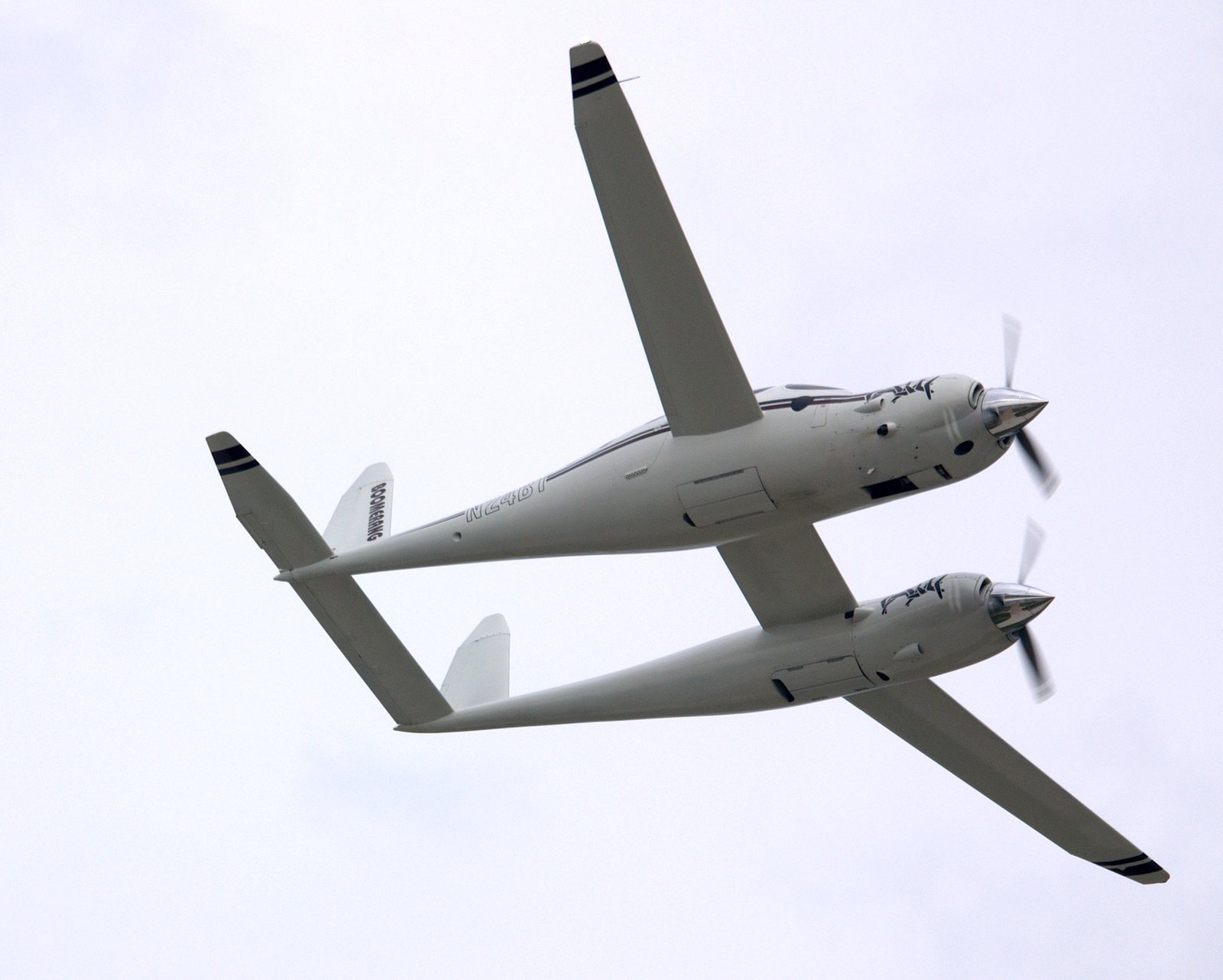
The Boomerang emerged from Burt Rutan's personal quest to eliminate the deadly engine-out characteristics that made conventional twin-engine aircraft dangerous for average pilots. Traditional twins create severe asymmetrical thrust when one engine fails, often leading to loss of control. Rutan's solution was counterintuitive: instead of making the aircraft symmetrical, he deliberately designed every component asymmetrically to balance the forces.
The aircraft's unconventional appearance reflects this philosophy. One wing spans nearly 5 feet shorter than the other, while forward-swept wing geometry shifts the aerodynamic center forward to counterbalance the front-mounted engine weight. A small boom extends from the left fuselage, and even the tail surfaces differ between sides. This systematic asymmetry ensures that engine failure produces manageable handling characteristics rather than catastrophic thrust imbalance.
Engineering Without Convention
Remarkably, Rutan designed the Boomerang without wind tunnel testing or computer-aided design tools. The aircraft was built after hours by Rutan and volunteer Scaled Composites employees, representing grassroots experimental aviation at its finest. The forward-swept wings incorporate full-span ailerons functioning as flaperons for increased efficiency at high speeds, while the continuous wing spar passing through the fuselage necessitated staggered front seats positioned at an angle.
Performance Achievement
Powered by two Lycoming TIO-360 turbocharged engines—one rated at 200 horsepower on the right, another at 210 horsepower on the left—the Boomerang achieved impressive performance figures. Maximum speed reached 311 mph with cruise speeds of 304 mph, while the five-seat cabin provided more interior space than Rutan's earlier Long-EZ design. Empty weight of 2,370 pounds represented exceptional efficiency through carbon fiber construction, weighing approximately 1,367 pounds less than a comparable pressurized Beechcraft Baron.
Public Debut and Recognition
The Boomerang made its public debut at the 1996 Oshkosh AirVenture following its November 1996 first flight. Aviation enthusiasts marveled at the aircraft's unconventional appearance and innovative engineering approach. After sitting idle for nine years, the aircraft was pulled from storage in February 2011 and returned to flight status by March 2011, coinciding with Rutan's April 1 retirement ceremony from Scaled Composites.
The Designer's Vision
Burt Rutan, renowned for designing the Voyager aircraft that completed the first non-stop, non-refueled flight around the world, considered the Boomerang his greatest achievement in general aviation. His design requirements included five-seat capacity, high speed and efficiency, twin-engine safety for night and over-water operations, and centerline thrust characteristics without traditional push-pull configuration drawbacks.
Scaled Composites Legacy
The Boomerang represented Scaled Composites' experimental philosophy of solving aeronautical challenges through unconventional thinking. Founded by Burt Rutan, Scaled Composites became famous for innovative aircraft designs including SpaceShipOne, the first privately-funded spacecraft to reach space twice within two weeks. The company's composite construction expertise enabled the Boomerang's exceptional strength-to-weight ratio.
Production That Never Was
Despite its innovative design and impressive performance, only one Boomerang was ever constructed. Serial number 001, registered as N24BT, remains the sole example of this revolutionary design. Rutan initially planned production through Oregon-based Morrow Aircraft, but this arrangement never materialized. The prototype remains registered with the FAA, with current registration valid until July 31, 2028.
Technical Innovation Impact
The Boomerang's wing loading of approximately 41 pounds per square foot and maximum fuel capacity of 1,026 pounds demonstrated the feasibility of asymmetrical design in solving fundamental aerodynamic problems. The aircraft proved that unconventional approaches could deliver both safety improvements and performance gains, influencing experimental aircraft design philosophy.
Current Status and Legacy
The single Boomerang remains airworthy today, serving as a testament to experimental aviation ingenuity. While it never achieved commercial success or entered production, the aircraft stands as proof that radical thinking can solve longstanding aviation challenges. The design has influenced subsequent experimental aircraft development and continues to inspire aerospace engineers exploring unconventional solutions to traditional problems.
Rutan's willingness to abandon symmetrical design conventions in favor of functional asymmetry demonstrated that effective engineering sometimes requires rejecting fundamental assumptions. The Boomerang remains one of the most innovative experimental aircraft ever created, representing the pinnacle of individual aerospace engineering achievement.