
Service History
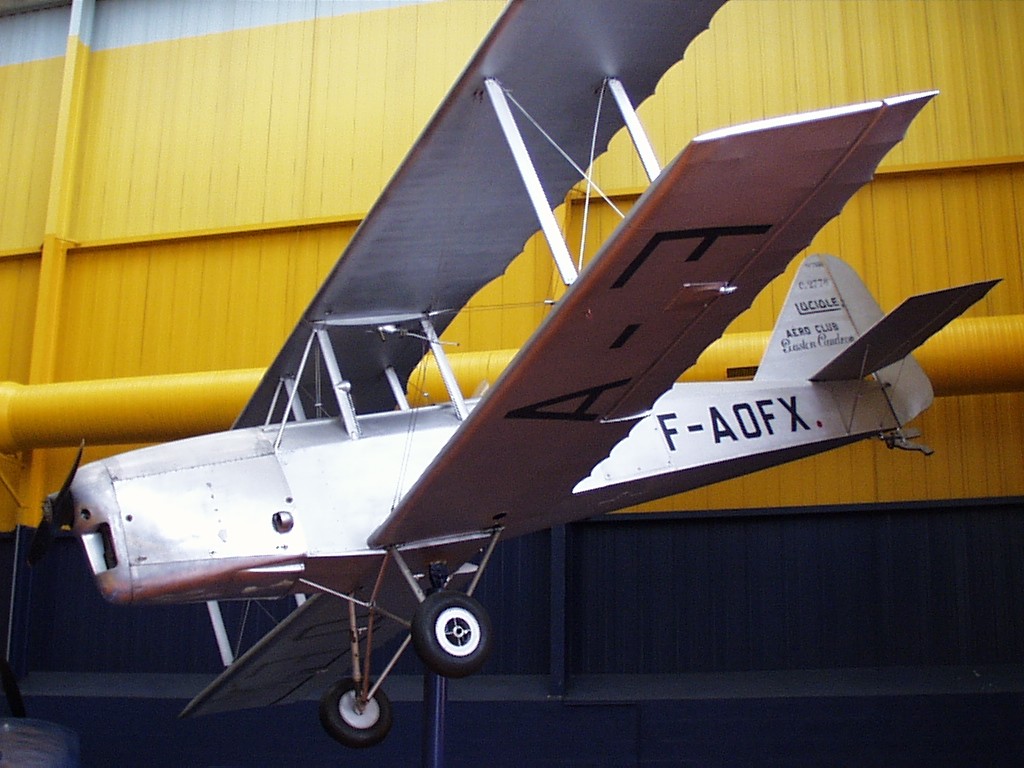
The Luciole achieved remarkable success in fulfilling its primary mission of mass pilot training, with the French government purchasing 296 aircraft for the Armée de l'Air following the 1936 Ministry of Air training contest. The aircraft dominated French aero-clubs throughout the 1930s, serving as the backbone of civilian flight training under the Aviation Populaire initiative. This program aimed to create a large pool of trained pilots who could quickly transition to military service if needed, a prescient strategy given the approaching war.
Design Innovation and Development
Paul Deville, Caudron's chief design engineer, developed the C-270 as an evolution of the earlier C-230 series, incorporating several innovative features that set it apart from contemporary trainers. The aircraft featured fabric-covered construction rather than the C-230's heavier wooden fuselage, significantly reducing weight and manufacturing costs. Most notably, Deville designed a simplified wing-folding mechanism that allowed the aircraft to be stored in standard hangars, addressing the space constraints faced by flying clubs across France.
The tandem open-cockpit configuration provided excellent visibility for both instructor and student, while the equal-span biplane layout offered inherent stability crucial for novice pilots. At 46,500 francs with a four-month build time, the Luciole represented exceptional value in the training aircraft market.
Powerplant Evolution
The C-270 series employed three primary engine types throughout its production run. Early variants utilized the Salmson 7Ac radial engine producing 95 horsepower, later upgraded to the 7Ac2 variant with 105 horsepower. The C-274 variant featured the more powerful Chaise 4Ba inline engine delivering 137 horsepower, while the most numerous C-275 variant employed various versions of the Renault 4Pb inline engine producing between 95 and 140 horsepower.
While the early Salmson-powered versions proved robust for basic training, pilots found them lacking in power for aerobatic maneuvers. The later Renault-powered variants addressed this limitation, providing sufficient performance for advanced training exercises while maintaining the aircraft's reputation for reliability and ease of maintenance.
Wartime Service
Despite its civilian training origins, the Luciole saw limited military service during the Spanish Civil War from 1936 to 1939, with examples operating on both Republican and Nationalist sides. Spanish Air Force records show aircraft like the C-275 numbered 30-171 serving in liaison roles rather than combat missions.
During World War II, surviving French examples continued serving as liaison aircraft and target tugs at facilities like the Salon-de-Provence air school. The aircraft's unarmed configuration and lightweight construction made it unsuitable for combat roles, but its reliability and economy ensured continued utility in support functions throughout the conflict.
The Caudron Legacy
Caudron Frères, founded around 1912 by brothers Gaston and René Caudron, had evolved from humble beginnings on the family farm where a mare named Luciole pulled their first aircraft. This touching origin inspired the C-270's nickname. The company operated from Issy-les-Moulineaux near Paris until merging with Renault in 1933 to form Société des Avions Caudron-Renault.
The merger proved successful during the Luciole's peak production years, but the company ceased aircraft manufacturing by the 1950s. While Renault continues as an automotive manufacturer today, the Caudron name disappeared from aviation, making the surviving Luciole examples important artifacts of French aviation heritage.
Production Achievement
With 720 aircraft built across all variants, the C-270 series represented one of France's most successful light aircraft programs. The C-275 variant alone accounted for 433 units, making it the most numerous version. Production continued steadily from 1931 until the outbreak of World War II in 1939, when manufacturing facilities were converted to wartime production.
Current Survivors
Approximately a dozen Luciole examples survive today, though none are confirmed as currently airworthy. Notable survivors include F-AZVO (construction number 6607/32), built in 1932 for the Armée de l'Air and now preserved as a testament to the aircraft's military service. Jean-Baptiste Salis's collection at La Ferté-Alais, France, maintains another example, while two C-275 variants appear in recent preservation records.
The Luciole's cultural impact extends beyond aviation museums, with appearances in various media productions documented in film databases. More significantly, the aircraft's role in training over 700 pilots during France's crucial pre-war period established it as a foundational element in French aviation development, demonstrating how thoughtful design and government support could democratize flight training on a national scale.