
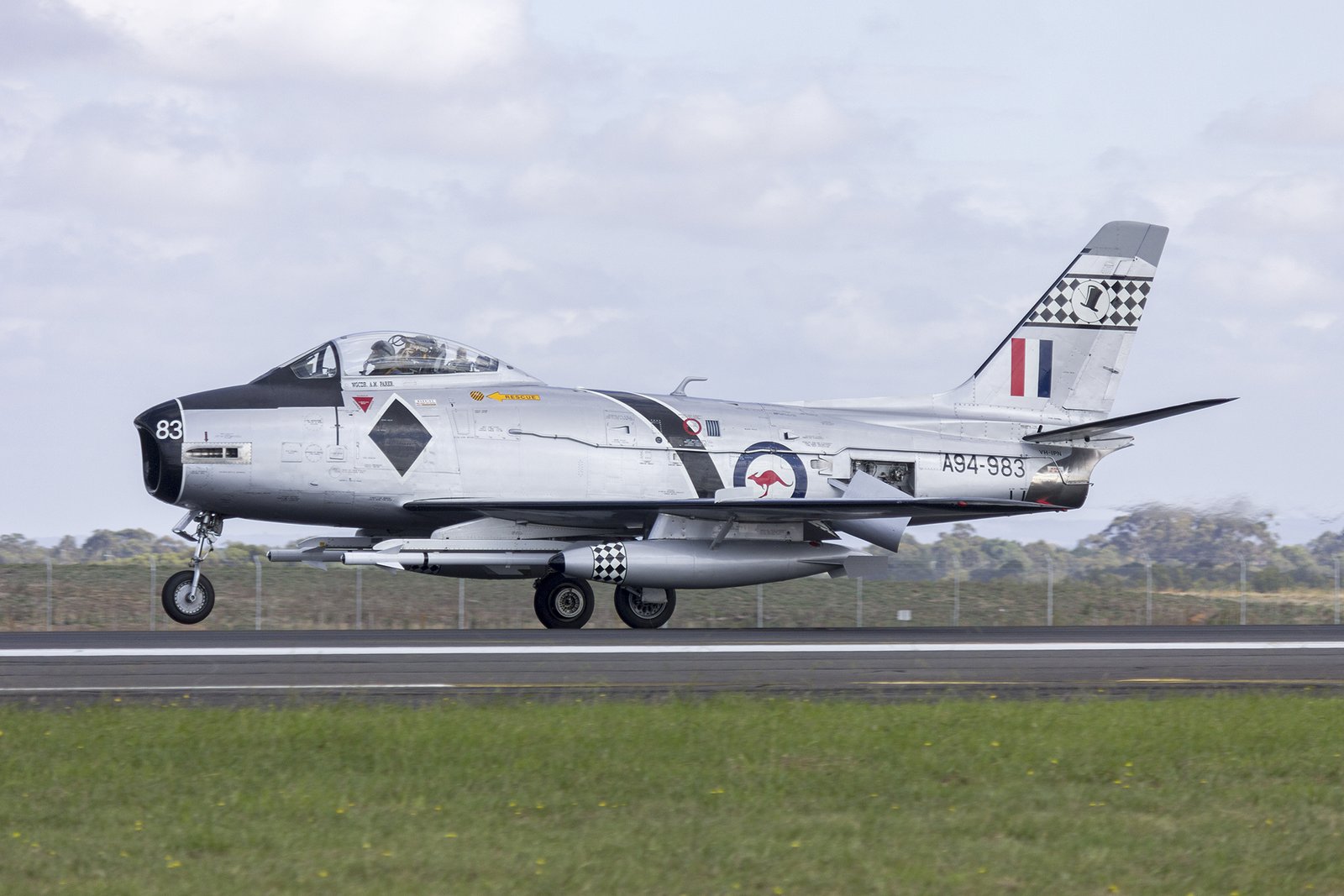
The Commonwealth Aircraft Corporation (CAC) CA-27 Sabre, also known as the Avon Sabre, was a significant Australian engineering adaptation of the North American F-86. Developed to meet the requirements of the Royal Australian Air Force (RAAF), the aircraft featured a major redesign of the fuselage and a 25% increase in air intake size to accommodate a license-built Rolls-Royce Avon turbojet. This engine provided approximately 7,500 lbf of thrust, granting the CAC Sabre superior climb and speed in the transonic regime compared to the original F-86. Furthermore, the standard six 0.50-inch machine guns were replaced with two 30 mm ADEN cannons, making it one of the most heavily armed and powerful variants of the Sabre family.
Production took place at CAC's facilities in Fishermans Bend, Melbourne, Victoria, with flight testing conducted at Avalon. The prototype, designated CA-26, first flew on August 3, 1953, piloted by Flight Lieutenant William H. Scott. Serial production followed, with the first CA-27 delivered to the RAAF's Aircraft Research and Development Unit (ARDU) on August 19, 1954. A total of 112 aircraft were built, consisting of the CA-26 prototype and 111 production units, including 22 Mk 30, 20 Mk 31, and 69 Mk 32 variants. Production concluded between 1960 and 1961.
In military service, the RAAF operated the Sabre from 1954 until 1971, utilizing it in No. 3 Squadron, No. 77 Squadron, and No. 2 Operational Training Unit. During the Malayan Emergency, Sabres from No. 78 (Fighter) Wing conducted air strikes against communist targets from RAAF Butterworth. In June 1962, eight aircraft were deployed to Ubon Air Base in Thailand to provide air defense during a period of regional insurgency. The aircraft also provided border defense during the Indonesia–Malaysia confrontation of the 1960s. Following their RAAF retirement, ex-service aircraft were transferred to the Royal Malaysian Air Force and the Indonesian Air Force, where some remained operational until 1982.
Technically, the Mk 32 configuration featured a maximum speed of 1,126 km/h (Mach 0.93) and a service ceiling of 52,000 feet. The aircraft's legacy is preserved through various static exhibits, including airframe A94-983 in the RAAF Heritage Collection and examples at the Moorabbin Air Museum and the South Australian Aviation Museum.