
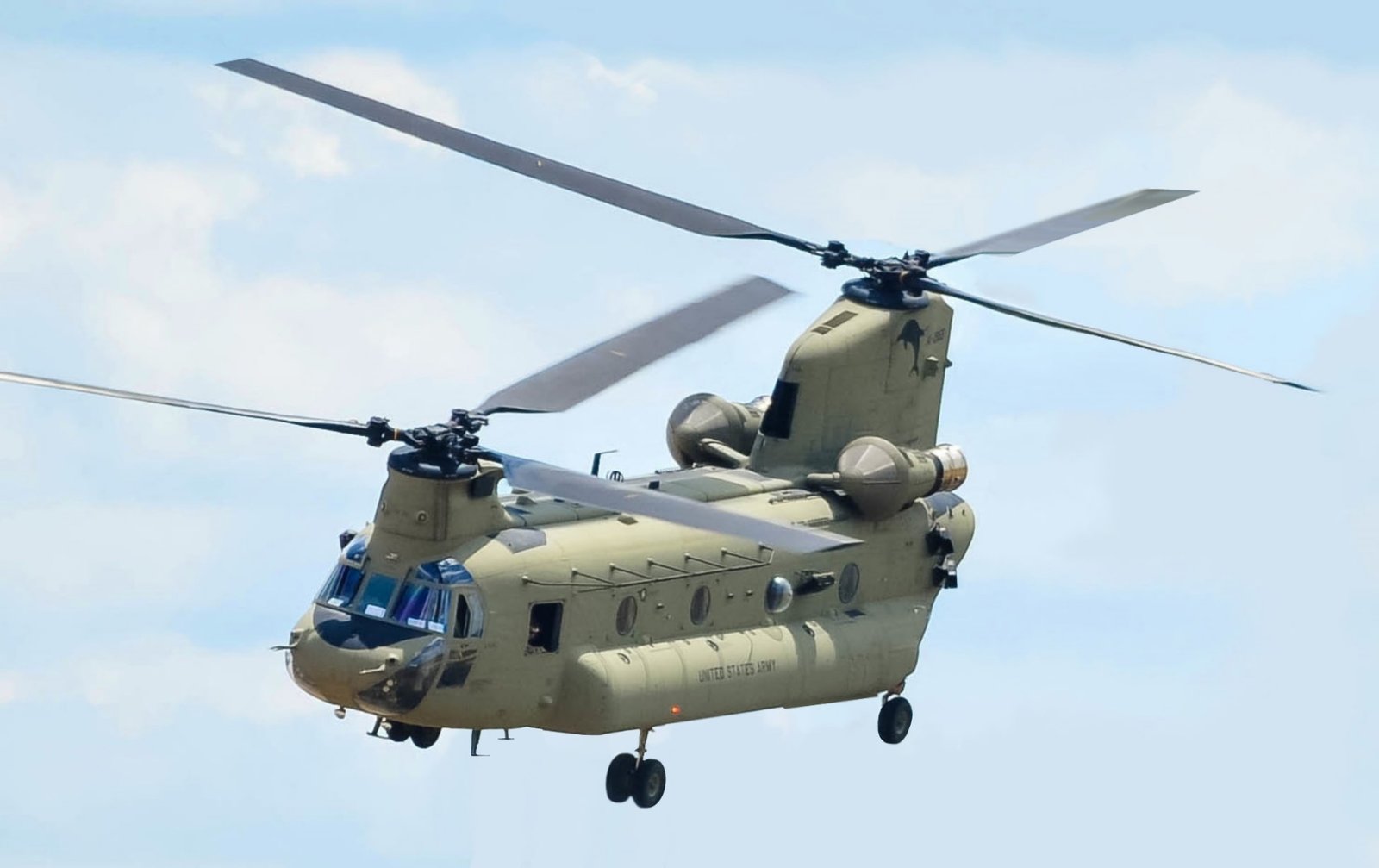
The Boeing CH-47 Chinook is a twin-engine, tandem-rotor heavy-lift helicopter that has remained in continuous production since 1962. Originally developed by the American rotorcraft company Vertol—which evolved from Frank Piasecki's firm—the aircraft's design is a direct descendant of Piasecki's "banana-shaped" tandem-rotor concepts from the 1940s and 1950s, such as the H-21. The Boeing Company acquired Vertol in 1960, and the aircraft is currently manufactured by Boeing Defense, Space & Security at their plant in Ridley Park, Pennsylvania.
First flown on September 21, 1961, the Chinook is designed for maximum efficiency and payload, utilizing two counter-rotating main rotors to eliminate the need for a tail rotor. This configuration allows it to be the second-heaviest lifting Western helicopter, capable of transporting up to 55 troops, artillery, or large vehicles. Its versatility is enhanced by a large internal cargo bay, a rear loading ramp, and three underslung cargo hooks for external loads. Modern variants, such as the H-47, are capable of operating at altitudes up to 20,000 feet.
Production has been extensive, with over 1,200 units built as of 2012. Beyond U.S. production, Kawasaki Heavy Industries has produced license-built versions for Japan since 1984, delivering more than 110 CH-47J and CH-47JA aircraft to the Japan Ground Self-Defense Force and Japan Air Self-Defense Force. Additionally, AgustaWestland (now Leonardo Helicopters) partnered with the Italian Army to produce the ICH-47F.
In military service, the CH-47 entered U.S. Army service in 1962 and saw extensive use during the Vietnam War, where it retrieved 11,500 disabled aircraft. It has since served in nearly every major U.S. Army campaign, including operations in Iraq, Kuwait, and Afghanistan. Beyond the U.S., it is operated by at least 20 other nations, including the United Kingdom, Canada, and Australia. Civil operators such as Columbia Helicopters and Billings Flying Service utilize the type for firefighting, logging, and construction.
Technical specifications for the CH-47D variant include a length of 98 feet and a maximum speed of 200 mph. Modern versions are powered by two Honeywell T55-GA-714A turboshaft engines, each producing 4,777 shaft horsepower. A notable surviving example is "My Old Lady," a 1962-built CH-47D that served for 54 years before retiring in 2017 and is now preserved at the Museum of Flight in Seattle.