
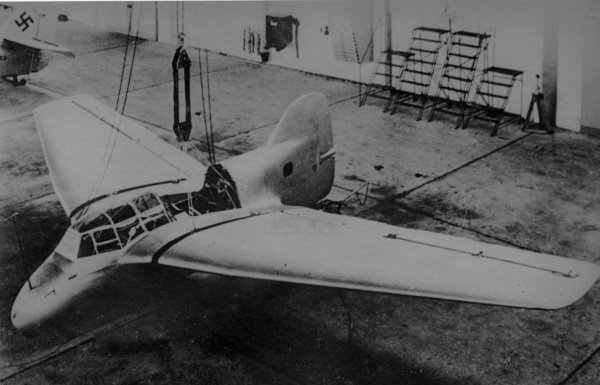
The DFS 194 was a one-off experimental research aircraft developed in late-1930s Germany. Designed by Alexander Lippisch, a specialist in delta-wing and tailless configurations, the aircraft was based on his earlier DFS 40 designs. Originally conceived as a tailless aircraft powered by a conventional piston engine driving a pusher propeller, the airframe in this initial configuration was completed in March 1938. However, the Reichsluftfahrtministerium (RLM) identified Lippisch's tailless designs as a viable foundation for a rocket-powered fighter, leading to a significant shift in the project's direction.
In January 1939, Lippisch and his design team were transferred from the Deutsche Forschungsanstalt für Segelflug (DFS)—a state research institute for sailplane flight—to the Messerschmitt company under a program known as "Project X." Under Messerschmitt's direction, the existing DFS 194 airframe was modified to accommodate a liquid-fuel rocket engine, specifically the Walter R I-203 produced by Hellmuth Walter's firm, Walterwerke. This engine provided thrust on the order of 4 kN, with some sources citing approximately 3.9 kN (882 lbf) and others noting a rating of 500 kp (~4.9 kN).
Testing of the rocket-powered configuration began at Peenemünde, with engine tests conducted in October 1939 followed by gliding trials in early 1940. The first powered flight occurred in August 1940, piloted by Heini Dittmar. During these tests, the DFS 194 reached a maximum speed of approximately 550 km/h (343 mph), which surpassed the performance of the earlier Heinkel He 176. The aircraft also demonstrated a rate of climb of about 1,615 m/min. These flights proved that a tailless rocket aircraft was controllable and safe at speeds nearly double what had been anticipated.
While the DFS 194 never saw combat or operational service, its success was critical to the development of the Messerschmitt Me 163A and Me 163B rocket fighters. The aircraft's dimensions included a wingspan of 10.4 m, a length of 6.4 m, and a loaded weight of 2,100 kg. No examples of the DFS 194 survive today, as the sole prototype is presumed to have been lost or scrapped by the end of World War II.