
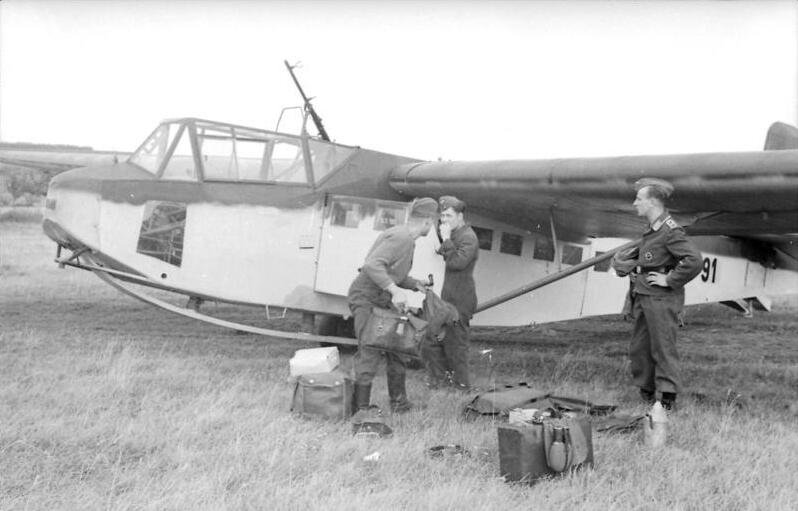
The DFS 230 was a specialized military assault glider developed by the Deutsche Forschungsanstalt für Segelflug (DFS) in Darmstadt-Griesheim. Designed under the leadership of Hans Jacobs between 1936 and 1939 under strict secrecy, the aircraft first flew in 1937. It was conceived to solve the tactical problem of dispersed parachute drops by allowing a concentrated group of nine fully equipped paratroopers to land silently and immediately combat-ready at a specific target.
Technically, the DFS 230 was an unpowered aircraft towed by various Luftwaffe planes, including the Junkers Ju 52, Ju 87, Heinkel He 111, Henschel Hs 126, and Messerschmitt Bf 110. Towing was achieved using either a 40-meter steel cable or a 1.5-meter rigid steel-tube tow bar. The glider featured a wingspan of 22.30 meters and a length of 11.24 meters. To facilitate landings in confined areas, it employed a braking parachute that allowed for steep descents with sink rates reaching 60 m/s. For defense, the aircraft could be equipped with a 7.9 mm machine gun on the right side of the fuselage, operated by a soldier positioned behind the pilot.
Production began in earnest around 1939, with approximately 1,480 units built by April 1942. Total production reached roughly 1,600 aircraft by 1944, after which the Luftwaffe shifted focus toward larger glider models. The aircraft's maximum payload was 1,257 kg, and while it primarily carried troops on a removable bench, it was also used for freight and the evacuation of wounded personnel.
In combat, the DFS 230 gained notoriety during the attack on the Belgian fortress of Eben-Emael on May 10, 1940, where it successfully delivered engineer assault teams to the fort's roof. It was later used during the 1941 invasion of Crete, though these operations resulted in significant losses. On the Eastern Front, the glider played a critical role in resupply efforts for encircled troops, most notably during the Battle of Stalingrad. Many of these missions were effectively one-way trips due to the lack of adequate landing zones. The DFS 230's operational success influenced later Allied glider designs, such as the Airspeed Horsa and General Aircraft Hamilcar.