
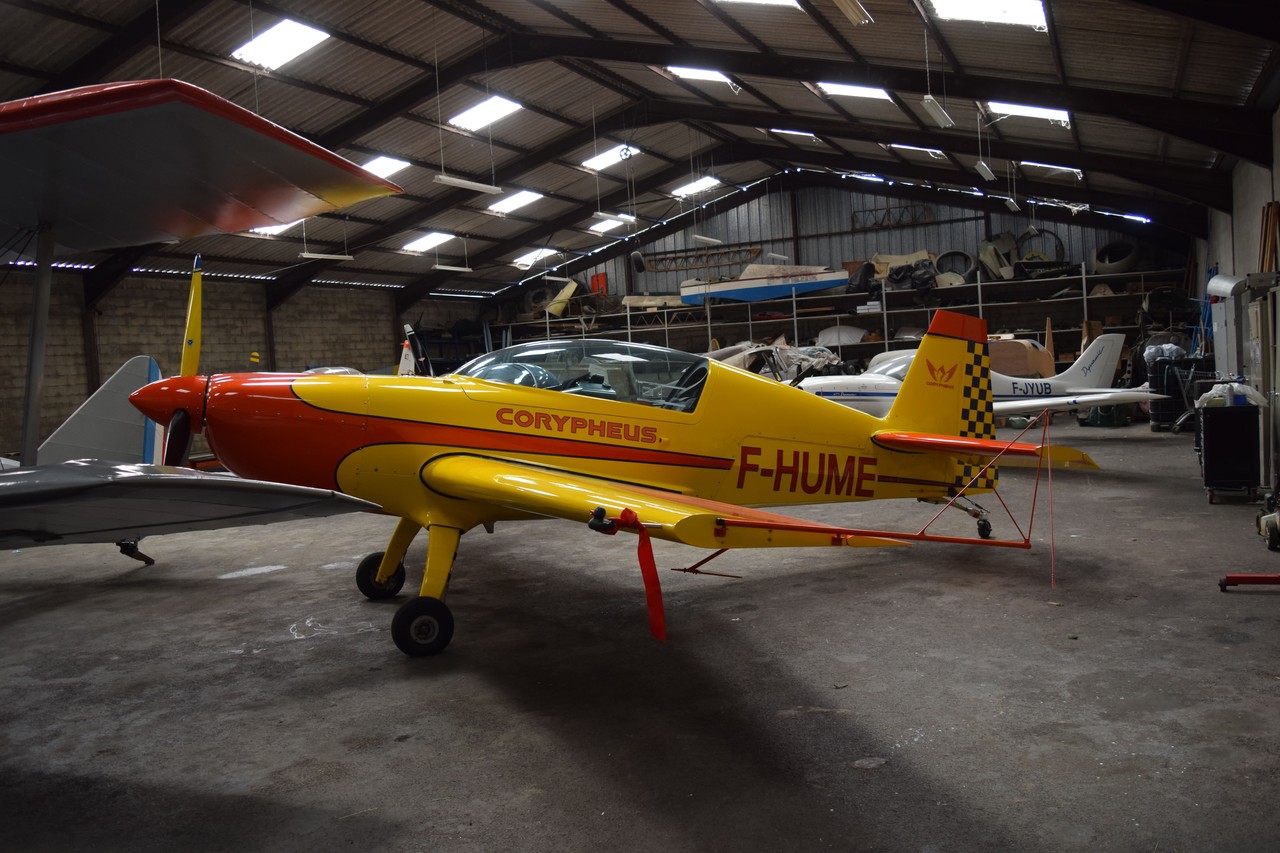
Market Impact and Service History
The EA-200 transformed the aerobatic aircraft market by providing unlimited-category competition capability at $170,000 in 1996, compared to $235,000 for the larger Extra 300. This price advantage made advanced aerobatic training accessible to flying clubs and individual pilots previously priced out of the market. American buyers dominated sales from the beginning, accounting for 88 percent of all production despite the aircraft's German manufacture.
Production followed an unusual pattern reflecting the specialized nature of the aerobatic market. After prototype demonstrations at EAA Sun 'n' Fun in April 1996, Extra delivered five aircraft that year, followed by 15 in 1997, five in 1998, two in 1999, and one in 2000. By 2003, total production reached 31 aircraft before manufacturing ceased during Extra Flugzeugbau's financial difficulties.
The Extra Company Legacy
Walter Extra founded his aircraft company in the 1980s, beginning with the wood-winged Extra 230 in 1981. His methodical approach to aerobatic aircraft development produced the Extra 260 prototype in 1987, followed by the renowned Extra 300 in 1988. The EA-200 represented Extra's attempt to expand market reach beyond the premium segment dominated by his earlier designs.
The company faced bankruptcy during development of the ambitious EA-500 turboprop, but Ken Keith's leadership team revived Extra Flugzeugbau in August 2003. Under new management, limited EA-200 production resumed in 2007, with base pricing increased to $225,000. The company continues manufacturing aerobatic aircraft today, maintaining Walter Extra's original vision of precision-engineered competition machines.
Technical Innovation and Design
Walter Extra designed the EA-200 as a scaled-down version of his successful Extra 300, retaining the larger aircraft's flight characteristics while reducing operating costs. The composite construction provided strength for unlimited aerobatic maneuvers while minimizing weight. At 540 kilograms empty weight and 870 kilograms maximum takeoff weight, the aircraft achieved an impressive power-to-weight ratio of 0.1713 kilowatts per kilogram.
The Textron Lycoming AEIO-360-A1E engine produces 149 kilowatts through a three-blade MT-Propeller constant-speed propeller. This powerplant combination delivers a maximum cruise speed of 214 knots and climb rate of 686 meters per minute. Standard fuel capacity of 117 liters provides a range of 1,080 kilometers, extensible to 185 liters with optional long-range tanks.
Performance Characteristics
Certification testing demonstrated the EA-200's capability for professional aerobatic competition. The aircraft withstands positive and negative 10-G loads with single occupancy, reduced to 8 Gs with two aboard. These specifications enable execution of all unlimited-category maneuvers including knife-edge flight, lomcevaks, and sustained inverted flight.
Operational performance figures reflect the aircraft's dual training and competition roles. Stall speed ranges from 53 to 59 knots depending on configuration, while maneuvering speed reaches 154 knots. The never-exceed speed of 217 knots provides adequate margin for aerobatic sequences. Service ceiling of 4,573 meters accommodates most competition box altitudes while maintaining engine performance.
Certification and Production Revival
German certification occurred on June 15, 1996, followed by FAA approval on December 20, 1996, initially in the Experimental/Exhibition category. The rapid certification process reflected Extra's experience with regulatory authorities and the aircraft's straightforward design philosophy.
Current production continues on a limited basis, with 2024 pricing approaching $250,000. Notable operators include Freestyle Aviation in Australia, which operated aircraft VH-XRB from December 2007, and numerous competition pilots throughout the United States and Europe. The EA-200's legacy lies in expanding aerobatic aviation accessibility while maintaining the exacting standards demanded by unlimited-category competition flying.