
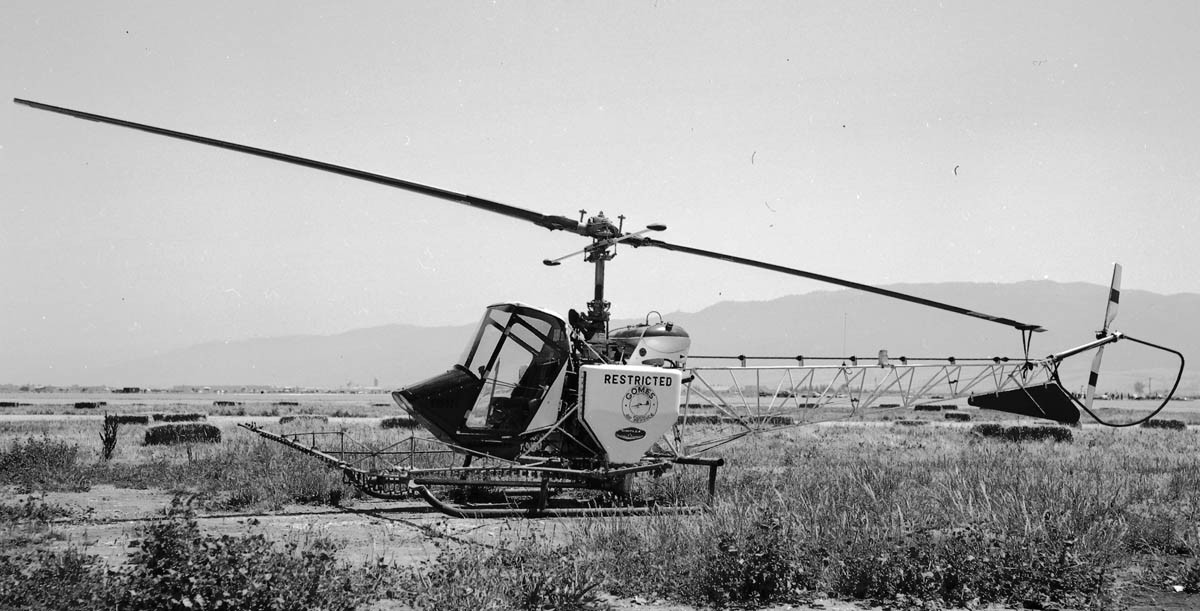
Development and Design Philosophy
The El Tomcat emerged during the agricultural aviation boom of the late 1950s when crop dusting operations demanded purpose-built aircraft rather than makeshift conversions. Continental Copters recognized that helicopters offered significant advantages over fixed-wing aircraft for precision spraying work, including the ability to hover over specific areas and operate from confined spaces near farmland. The company's founder, John L. Scott, established his Fort Worth operation in 1959 specifically to capitalize on this growing market by converting surplus Bell 47 airframes into dedicated agricultural platforms.
The conversion process involved extensive modifications to the basic Bell 47G-2 structure. Engineers relocated the cockpit, installed chemical tanks, and added specialized spray equipment while maintaining the aircraft's inherent stability and reliability. The first El Tomcat Mk.II received its FAA supplementary type certificate shortly after its maiden flight in April 1959, validating the design approach and opening the door for commercial production.
Evolution Through Eight Variants
Continental Copters pursued an aggressive development program, introducing new variants almost annually through the 1960s. The Mk.III first flew in April 1965 with improved systems and the option of three different Franklin engines: the 200-horsepower 6V4-200-C32, the 210-horsepower 6V-335-A, or the 235-horsepower 6V-350-A. Each powerplant offered different performance characteristics suited to specific operational requirements.
The Mk.IIIA variant, introduced in January 1966, standardized on Franklin engines while incorporating pilot feedback from early operators. However, the most significant redesign came with the Mk.IIIB and Mk.IIIC variants in May 1968, which featured a modified fiberglass nose, repositioned windscreen, and lowered cabin roof that improved pilot visibility during low-level spraying runs.
The Lycoming-Powered Revolution
June 1968 marked a pivotal moment with the first flight of the El Tomcat Mk.V, which abandoned Franklin engines in favor of Lycoming powerplants. The initial Mk.V used a 220-horsepower Lycoming VO-435-B1A engine, but subsequent variants pushed power levels higher. The Mk.V-A featured a 260-horsepower Lycoming VO-435-A1F engine and introduced a foldable jump-seat that allowed operators to transport a flagman to remote work sites, eliminating the need for separate ground transportation.
The final production variant, the Mk.V-B, represented the pinnacle of El Tomcat development with its 265-horsepower Lycoming VO-435-B1A engine. This powerplant provided the best power-to-weight ratio in the series and enabled operations at maximum gross weight even in challenging hot-and-high conditions common in agricultural work.
Operational Characteristics
Pilots praised the El Tomcat's stability during low-level spraying operations, where aircraft typically flew between 5 and 15 feet above crop level. The helicopter's 65-mile-per-hour cruise speed provided an optimal balance between coverage area and application precision. The 9-foot 5-inch height allowed operations under power lines and other obstacles that would ground fixed-wing agricultural aircraft.
The aircraft's 1,375-pound empty weight and 2,450-pound maximum gross weight provided substantial payload capacity for chemicals while maintaining acceptable performance margins. Operators particularly valued the ability to vary application rates in real-time and make multiple passes over irregular field boundaries without the turning radius limitations of conventional aircraft.
Continental Copters' Broader Operations
Beyond the El Tomcat program, Continental Copters Inc. operated as a comprehensive helicopter remanufacturer, assembling complete Bell 47 helicopters from spare parts and surplus components. This parallel business provided steady revenue while supporting El Tomcat development costs. The company's expertise in Bell 47 systems made it a natural choice for agricultural operators seeking reliable, cost-effective conversions.
In the late 1970s, Continental Copters expanded its conversion work to larger helicopters, developing single-seat agricultural versions of the Bell 204 and Bell 206. The Bell 206 conversion flew as the Jet-Cat, representing the company's evolution toward turbine-powered agricultural aircraft as the market matured.
Production Legacy
Continental Copters produced 44 aircraft total during its operational period, though not all were El Tomcat variants. The relatively small production numbers reflected the specialized nature of agricultural helicopter operations and the limited market for single-seat conversions. Each aircraft was essentially hand-built to customer specifications, allowing for customization of spray equipment, tank capacity, and operational features.
The El Tomcat program demonstrated the viability of helicopter conversions for specialized roles and established precedents for agricultural aircraft certification that influenced subsequent designs. While Continental Copters' current operational status remains unclear, the company's innovative approach to niche market development left a lasting impact on agricultural aviation practices throughout the 1960s and beyond.