
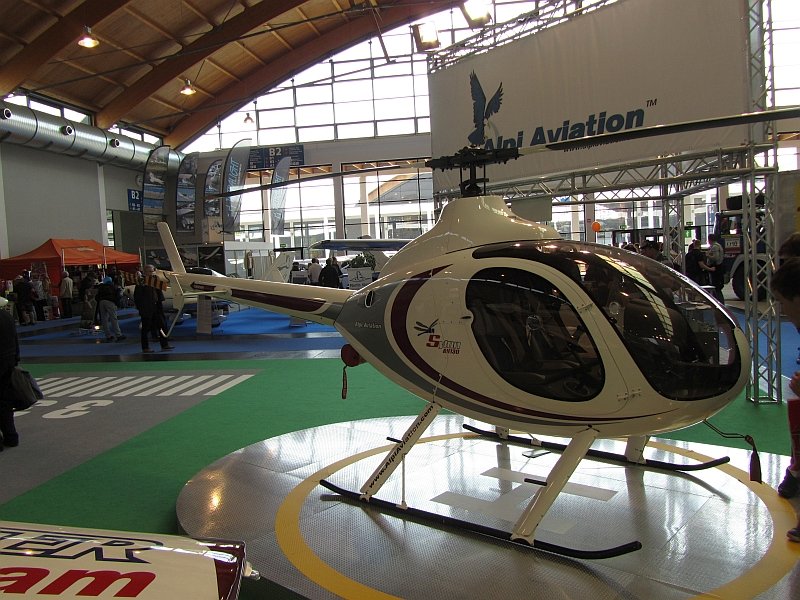
Development and Design Philosophy
The AH-130 Syton emerged from ALPI Aviation's ambitious goal to democratize turbine helicopter ownership through innovative engineering and cost-effective manufacturing. In 2008, ALPI Aviation acquired the rights to the AvioTecnica ES-101 Raven design, itself a 1996 turbine development of the American RotorWay Executive. This acquisition provided the foundation for creating an ultralight helicopter that could operate at just 150 euros per flight hour, making turbine-powered rotorcraft accessible to private owners.
The design team at ALPI Aviation focused on combining modern composite materials with proven aerodynamic principles. The aircraft features a distinctive two-bladed main rotor system with a diameter of 7.63 meters and a chord of 20 centimeters, optimized for efficient autorotation characteristics critical for ultralight helicopter safety. The composite rotor blades represent a significant advancement over traditional aluminum construction, offering improved fatigue resistance and performance consistency.
Technical Innovation and Powerplant
The Syton's most remarkable feature lies in its powerplant selection: the Solar T62 turboshaft engine. Originally manufactured by Solar Turbines, a Caterpillar subsidiary, as an auxiliary power unit for larger aircraft, ALPI Aviation ingeniously adapted this 97-kilowatt (130-horsepower) engine for primary propulsion. This repurposing of APU technology demonstrated exceptional engineering creativity, as the T62 brought proven reliability from its service generating electricity and providing pneumatic power in commercial aviation applications.
The airframe incorporates a nitrogen-charged AISI 4130 steel frame, an innovative approach that enables easy detection of leaks and structural cracks through pressure monitoring. This safety feature, combined with extensive use of aluminum and composite materials, resulted in an empty weight of just 290 kilograms while maintaining structural integrity for a maximum takeoff weight of 580 kilograms.
Performance and Operational Characteristics
With its turbine powerplant, the AH-130 achieves impressive performance figures for an ultralight helicopter. Maximum speed reaches 210 kilometers per hour, with cruise speeds between 160 and 185 kilometers per hour. The aircraft demonstrates exceptional climb performance at 8.5 meters per second, enabling rapid altitude gains that surpass most piston-powered ultralight helicopters.
Operational ceiling extends to 5,000 meters, though practical ceiling at maximum takeoff weight under International Standard Atmosphere conditions is 3,800 meters. Range varies significantly based on fuel load and operating conditions, spanning from 275 to 600 kilometers. The 90-liter fuel capacity allows for extended cross-country flights while maintaining reserve requirements.
Manufacturing and Production
ALPI Aviation established production facilities in Pordenone, Italy, launching the Syton as a kit-built aircraft in 2001. The kit approach allowed the company to offer the sophisticated helicopter at accessible prices while ensuring builders gained intimate knowledge of their aircraft's systems. Production continued through at least 2013, though exact manufacturing numbers remain undisclosed by the company.
Known examples include aircraft serial I-9347, constructed in 2008, and construction number 024, demonstrating the aircraft's successful transition from prototype to production reality. The limited production run reflects the specialized nature of turbine ultralight helicopters and the targeted market of experienced builders seeking advanced rotorcraft technology.
Operational Experience and Legacy
The AH-130 operates under Visual Flight Rules as a two-seat private helicopter, accommodating one pilot and one passenger in side-by-side configuration. Useful load capacity reaches 290 kilograms, allowing for full fuel and two occupants with baggage, or reduced fuel for maximum passenger and cargo flexibility. The aircraft's payload of 225 kilograms with full fuel provides practical utility for personal transportation and training missions.
Skid landing gear simplifies ground handling and maintenance while reducing complexity compared to retractable systems. The 8.84-meter overall length and 1.60-meter width enable storage in standard hangars, addressing practical ownership concerns for private operators.
Current Status and Future Prospects
As of 2013, ALPI Aviation continued Syton production, though current manufacturing status remains unclear. The aircraft's significance extends beyond its limited production numbers, establishing important precedents for ultralight turbine helicopter development. By successfully adapting auxiliary power unit technology for primary propulsion and demonstrating viable composite rotor systems in the ultralight category, the Syton influenced subsequent developments in affordable rotorcraft design.
The aircraft's legacy lies in proving that sophisticated turbine helicopter technology could be successfully scaled down and marketed to private builders. While exact numbers of currently airworthy examples remain unknown, the Syton's contribution to advancing ultralight helicopter capabilities continues to influence modern kit-built rotorcraft development, particularly in the integration of turbine powerplants and composite construction techniques.