
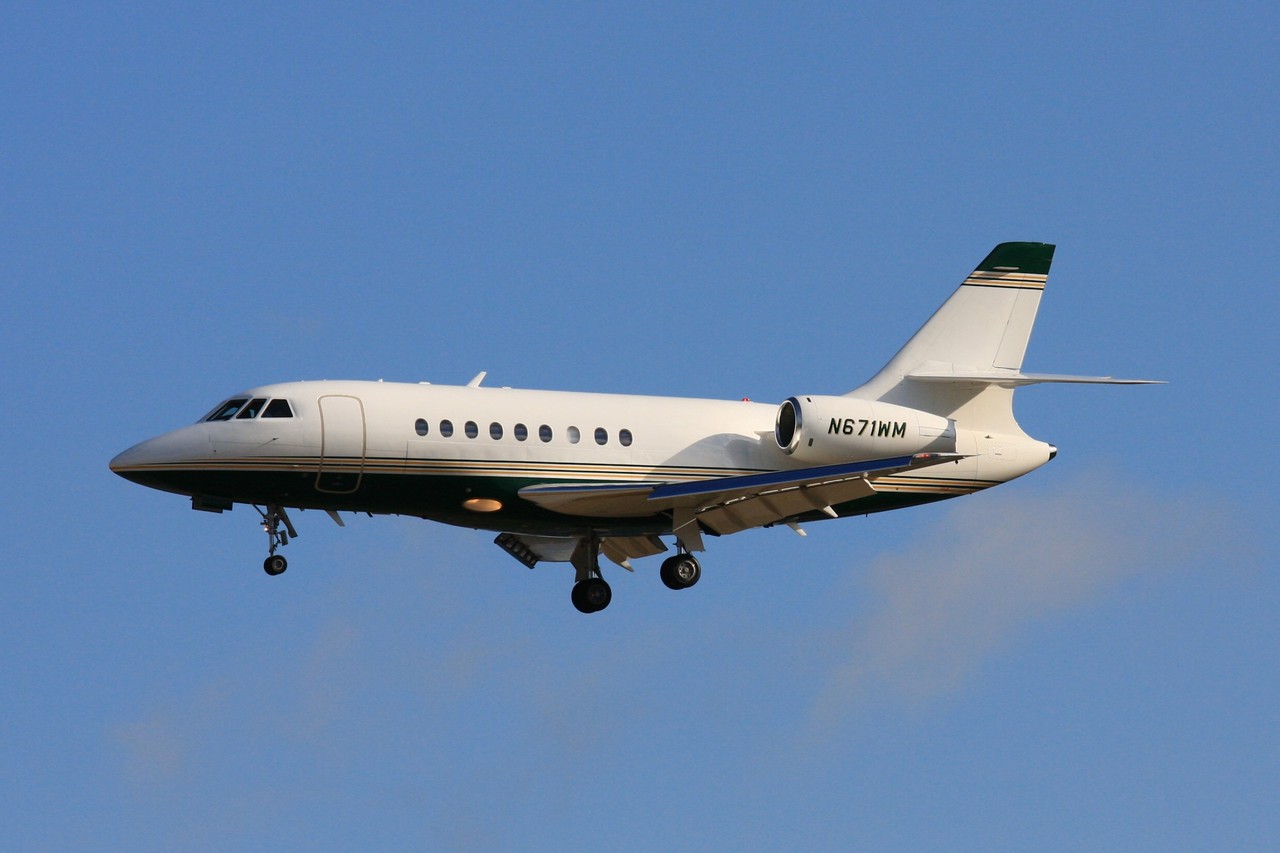
Service History
The Falcon 2000LX carved out a significant niche in corporate aviation by offering airlines-quality range in a more economical twin-engine package. Charter operators like Air Charter Service adopted the type for its ability to connect city pairs such as New York to Berlin nonstop, a capability that distinguished it from shorter-range competitors. The aircraft's 4,000 nautical mile range, extended to 4,769 miles in optimal conditions, made it particularly attractive to international business travelers seeking to avoid fuel stops on transcontinental routes.
The Manufacturer
Dassault Aviation traces its aviation heritage to 1929 and established the Falcon brand with the Falcon 20's rollout in 1963. By 2013, the company had delivered over 2,100 Falcon jets to operators in 67 countries, cementing its position as a premier business aircraft manufacturer. The company achieved a significant milestone in 2009 with the delivery of its 2,000th Falcon across all variants. Dassault pioneered digital aircraft design with the original Falcon 2000 series in the mid-1990s, making it the first private jet designed entirely using computer-aided design systems. Today, Dassault Aviation continues operations under its original name, producing advanced variants including the Falcon 7X and 8X, while expanding manufacturing through partnerships such as Dassault Reliance Aerospace Ltd in Nagpur, India, established in 2017.
Engine & Technical Innovation
The 2000LX's performance stemmed from its twin Pratt & Whitney Canada PW308C turbofan engines, each generating 7,000 pounds of thrust. This powerplant selection represented a strategic departure from the CFE738 engines used on earlier Falcon 2000 variants, providing the additional thrust necessary for extended range operations. The aircraft inherited the Falcon 900's proven fuselage diameter and wing design philosophy while incorporating revolutionary winglet technology that contributed significantly to its impressive range capabilities.
Dassault's engineering team derived the 2000 series from the three-engine Falcon 900, which first flew in 1984, adapting the design for twin-engine efficiency. The original Falcon 2000 achieved its maiden flight on March 4, 1993, with certification following in 1994. The 2000LX variant incorporated advanced Honeywell Primus Epic avionics through the EASy flight deck system, reducing pilot workload while enhancing safety margins.
Pilot Perspective
Pilots appreciated the 2000LX for its short-field performance capabilities, requiring approximately 800 meters for landing operations. The aircraft typically operated with a two-pilot crew and maintained an approach speed of roughly 210 kilometers per hour, providing comfortable margins for operations at challenging airports. The combination of range and runway performance made it particularly valuable for accessing smaller airports while maintaining the ability to complete long-range missions without fuel stops.
Production & Legacy
Dassault manufactured the Falcon 2000LX from 2007 through 2014, when production transitioned to the improved 2000LXS variant. While exact production numbers for the 2000LX remain unspecified, its successor 2000LXS reached 96 units built with 89 remaining in active operation by recent counts. The 2000LX's historical pricing reflected its premium positioning, with 2009 examples commanding over $30 million, compared to $28.5 million for the earlier 2000DX variant in 2007.
The aircraft represented a crucial step in business aviation evolution, demonstrating that twin-engine jets could achieve previously unattainable range performance. Its baggage capacity accommodated 12 suitcases plus hand luggage, while passenger configurations typically seated 8-10 travelers in executive layouts, though certification allowed up to 19 passengers.
The 2000LX's legacy continues through Dassault's ongoing Falcon production and the upcoming Indian manufacturing initiative. The first Indian-assembled Falcon 2000 is scheduled for flight testing in 2028, representing a significant expansion of the program's global footprint. The 2000LX established performance benchmarks that influenced subsequent super-midsize business jet development across the industry, proving that digital design techniques could optimize both aerodynamic efficiency and operational economics in the competitive corporate aviation market.