
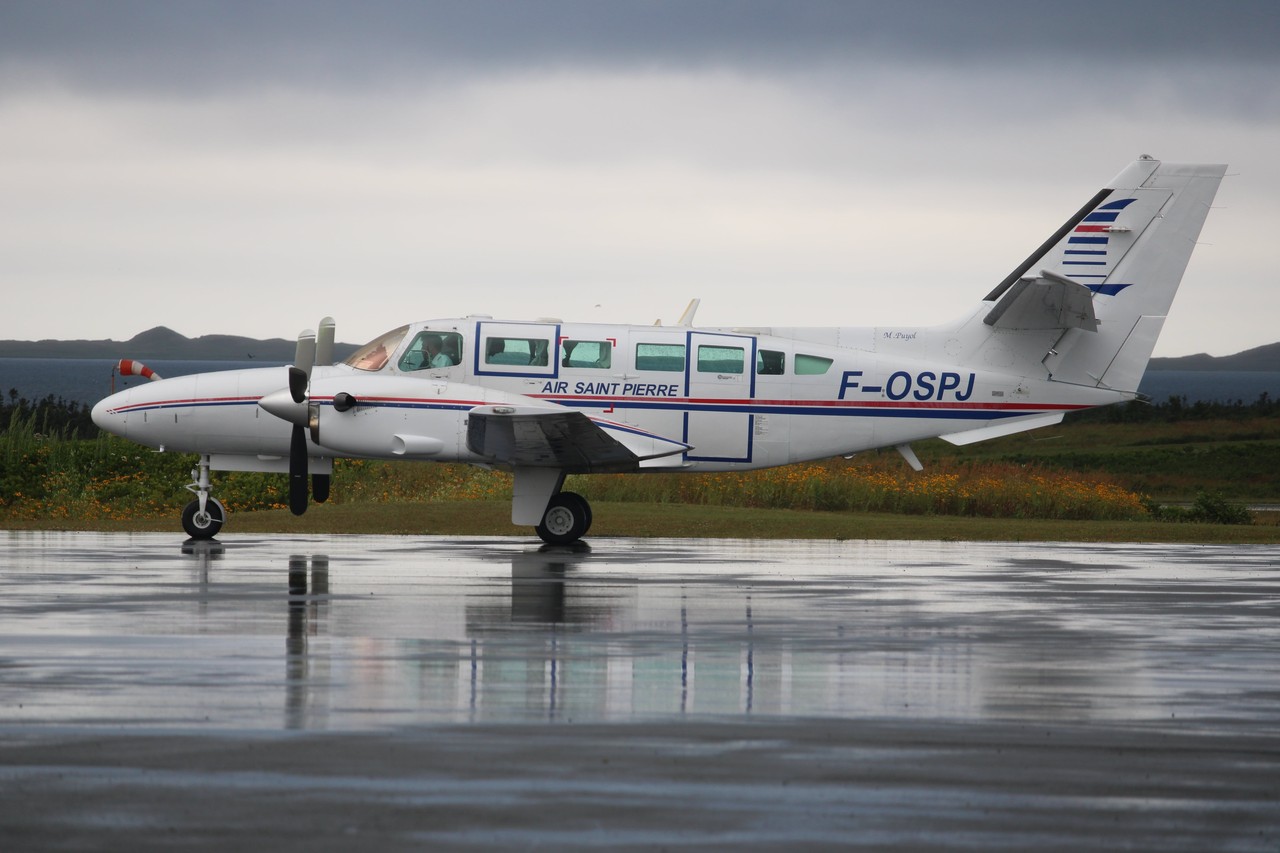
Service History
The F406 carved out a unique niche in commercial aviation by addressing European regulations that prohibited single-engine aircraft from conducting commercial instrument flight operations. This regulatory advantage made it particularly attractive to regional carriers across Africa and Asia, where its combination of twin-engine reliability and substantial payload capacity proved invaluable. During sustained production periods in the 1990s and 2000s, Reims Aviation manufactured approximately eight aircraft annually, with the type becoming especially popular within the European Union for commercial operations.
The aircraft demonstrated remarkable versatility in passenger configurations, typically seating 8-10 passengers in standard layout, though executive variants accommodated 6-7 passengers and maximum density configurations could handle up to 14 passengers. Its cargo capabilities were equally impressive, with belly-mounted cargo pods expanding luggage capacity to approximately eight suitcases beyond the standard cabin storage.
The Manufacturer
Reims Aviation brought substantial aviation experience to the F406 program, having previously manufactured over 6,000 Cessna-designed aircraft before undertaking this ambitious project. By 1975, the French company had reached peak production of nearly 1,000 aircraft per year, primarily building F150 and F172 models under license from Cessna.
The F406 began as a joint venture between Cessna and Reims Aviation, but ownership dynamics shifted significantly in 1989 when Cessna sold its interest to Reims Aviation, making the French company sole owner of the design rights. This transition reflected Reims' commitment to the program, even as the company had ceased general aircraft manufacturing in the late 1970s to focus exclusively on the F406. However, financial pressures ultimately proved insurmountable, and Reims Aviation filed for bankruptcy in 2013, ending three decades of F406 production.
Engine & Technical Details
The F406's powerplant consisted of two Pratt & Whitney Canada PT6A turboprops, initially the PT6A-112 model producing 500 horsepower each. Later variants upgraded to the more powerful PT6A-135 engines generating 635 shaft horsepower, paired with four-blade propellers for enhanced performance. These engines provided the reliability and efficiency that made the PT6A series one of aviation history's most successful turboprop families.
Design innovation centered on adapting the twin-engine concept from the piston-powered Cessna 404 Titan, replacing its engines with turboprops while maintaining the proven airframe geometry. The aircraft featured a low-wing monoplane configuration with aluminum construction, steel engine components, and unpressurized cabin. Wing area measured 253 square feet, supporting a maximum takeoff weight ranging from 9,360 to 10,361 pounds depending on configuration.
Operational Performance
The F406's operational capabilities made it suitable for medium-range regional routes, with sufficient range to fly non-stop from London to Nice or New York to Boston. Its two-pilot crew requirement and twin-engine configuration provided operational flexibility that single-engine competitors could not match, particularly in challenging weather conditions or over water.
Empty weight of 5,033 pounds allowed for substantial payload capacity, with maximum cargo loads exceeding 4,000 pounds in freight configuration. This performance envelope made the aircraft attractive not only to passenger carriers but also to specialized operators requiring reliable cargo transport capabilities.
Specialized Military and Government Variants
While designed primarily for civilian use, the F406 found limited but significant government and military applications. The French Army acquired two examples for target-towing operations, which could be quickly reconfigured for freight and passenger duties. The F406 Vigilant variant, equipped with Ferranti Seaspray radar, served fisheries protection and customs duties for maritime patrol missions.
Coastguard services in France, Britain, and Greece operated the type for maritime patrol duties, while Korean military forces also incorporated the aircraft into their fleet. These specialized applications demonstrated the F406's adaptability beyond pure commercial transport roles.
Production Legacy
Total production spanned exactly 30 years from 1983 to 2013, with manufacturing concentrated at Reims Aviation's French facility, though some components were produced at Cessna's Wichita, Kansas plant before shipment to France for final assembly. The aircraft achieved worldwide distribution despite its relatively modest production rate, finding operators across multiple continents.
Despite production ending with Reims Aviation's bankruptcy in 2013, the F406 remains in active service worldwide as of 2024. The type's continued operation reflects its fundamental design soundness and the ongoing viability of twin-turboprop aircraft for regional transport missions. Its legacy represents successful international aerospace cooperation and demonstrates how regulatory requirements can create market opportunities for specialized aircraft designs.