
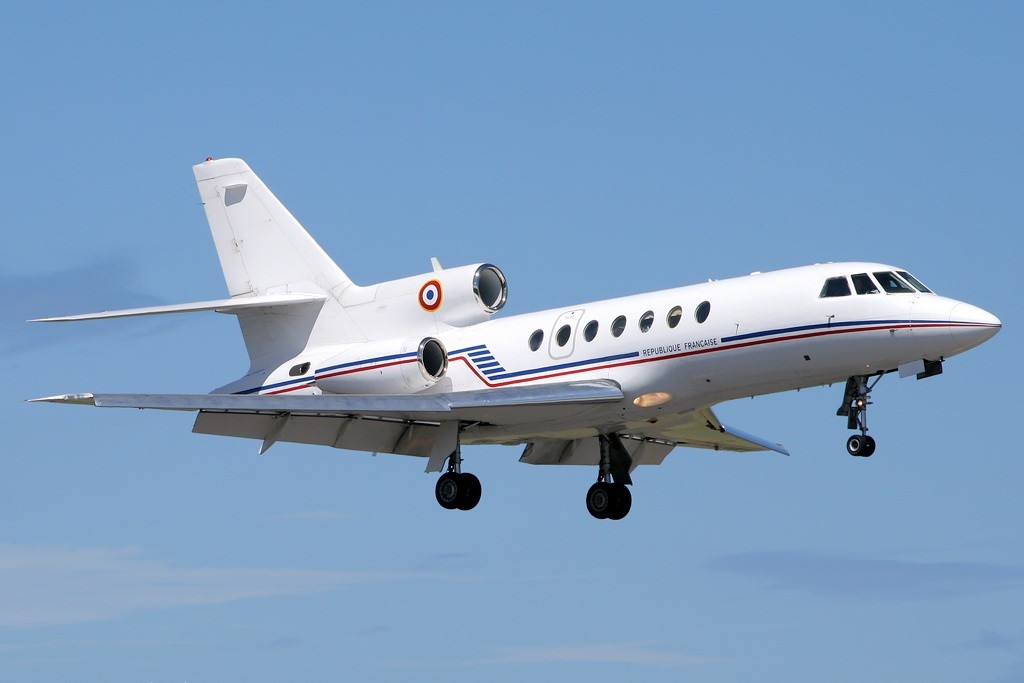
Revolutionary Business Aviation
The Falcon 50EX emerged from Dassault Aviation's ambitious 1974 project to create the world's first transatlantic-capable business jet operating under public transport regulations. This aircraft transformed corporate aviation by enabling non-stop flights between continents that previously required commercial airline connections or fuel stops. The enhanced EX variant, which began deliveries in 1997, represented the pinnacle of this design philosophy with improved engines and avionics that extended its already impressive capabilities.
Development and First Flight
Dassault's engineering team, responding to growing American demand for longer-range business aircraft following the 1973 oil crisis, began development of the original Falcon 50 in 1974. The base model first flew on November 7, 1976, from Bordeaux-Mérignac Airport with test pilots Hervé Leprince-Ringuet and Gérard Joyeuse at the controls. Twenty years later, the improved 50EX variant took to the skies on April 10, 1996, piloted by Jean Bongiraud and Etienne Faurdessus from the same Mérignac facility.
The aircraft incorporated revolutionary supercritical wing technology adapted from Dassault's military fighter experience. This aerodynamic breakthrough, later utilized on the larger Falcon 900 and 2000 series, enabled the relatively compact trijet to achieve transatlantic range while maintaining excellent high-altitude performance characteristics.
Manufacturing Excellence
Production of the Falcon 50EX demonstrated Dassault's sophisticated manufacturing network across France. Aerospatiale constructed the fuselage and 55 percent of the airframe at their Saint-Nazaire facility, while Dassault produced the wings at their Colomiers plant. Final assembly and testing occurred at Dassault's primary facility in Mérignac, Nouvelle-Aquitaine. This distributed manufacturing approach allowed each facility to specialize in their areas of expertise while maintaining Dassault's exacting quality standards.
From 1996 to late 2007, Dassault manufactured 99 Falcon 50EX aircraft with serial numbers 253 through 352, continuing the numbering sequence from the original Falcon 50 series. The final 50EX was delivered in early 2008, marking the end of a production run that totaled 347 aircraft across both variants.
Advanced Powerplant Technology
The 50EX's three Honeywell TFE731-40 turbofan engines represented a significant advancement over the original Falcon 50's TFE731-3 powerplants. Each engine incorporated Digital Electronic Engine Control (DEEC) technology, providing more precise fuel management and improved reliability. This enhanced propulsion system enabled the aircraft to climb to its service ceiling of 41,000 feet in just 23 minutes, significantly faster than its predecessor.
The trijet configuration, unusual in business aviation, provided exceptional safety margins for overwater flights while offering superior climb performance from shorter runways. This engine arrangement became a signature feature of Dassault's long-range business jets, distinguishing them from competing twin-engine designs.
Operational Capabilities
Configured for 8 to 9 passengers, the Falcon 50EX could carry up to 1,080 kilograms of payload with full fuel tanks. The aircraft's baggage compartment accommodated 10 standard suitcases, making it practical for extended international travel. The spacious cabin, measuring 60 feet 9 inches in overall length with an 18-foot 6-inch wingspan, provided comfortable accommodations for transcontinental journeys.
Operators praised the aircraft's ability to access shorter runways while maintaining full payload capacity, a crucial advantage for reaching airports with limited infrastructure. The 50EX's performance capabilities revolutionized corporate travel by eliminating the need for fuel stops on routes between major business centers in North America, Europe, and beyond.
Dassault Aviation Heritage
Dassault Aviation's development of the Falcon 50EX built upon more than 60 years of aviation excellence. Founded originally as Société des Avions Marcel Bloch in 1936, the company evolved through post-war nationalization as Société Nationale Industrielle Aéronautique before Marcel Dassault regained control in 1967, establishing Dassault Aviation. By 2023, the company had produced 2,700 Falcon aircraft across 27 different models, with 2,100 still in active service worldwide.
This family-owned enterprise successfully navigated the challenging post-1973 oil shock environment and intense international competition while maintaining its position as a leading manufacturer of both civil and military aircraft. The company's fighter jet expertise directly contributed to the Falcon 50EX's exceptional performance characteristics and structural integrity.
Legacy and Succession
Production of the Falcon 50EX concluded in 2008 as Dassault transitioned to newer designs including the larger Falcon 7X and the subsequently announced SMS variant. The 50EX's pioneering role in transatlantic business aviation established design principles that influenced an entire generation of long-range corporate aircraft.
While exact numbers of airworthy 50EX aircraft remain undocumented, the type's robust construction and continued support from Dassault ensure many examples remain in active service. The aircraft's legacy endures through its demonstration that business jets could match airline capabilities for intercontinental travel, fundamentally changing executive transportation expectations worldwide.