
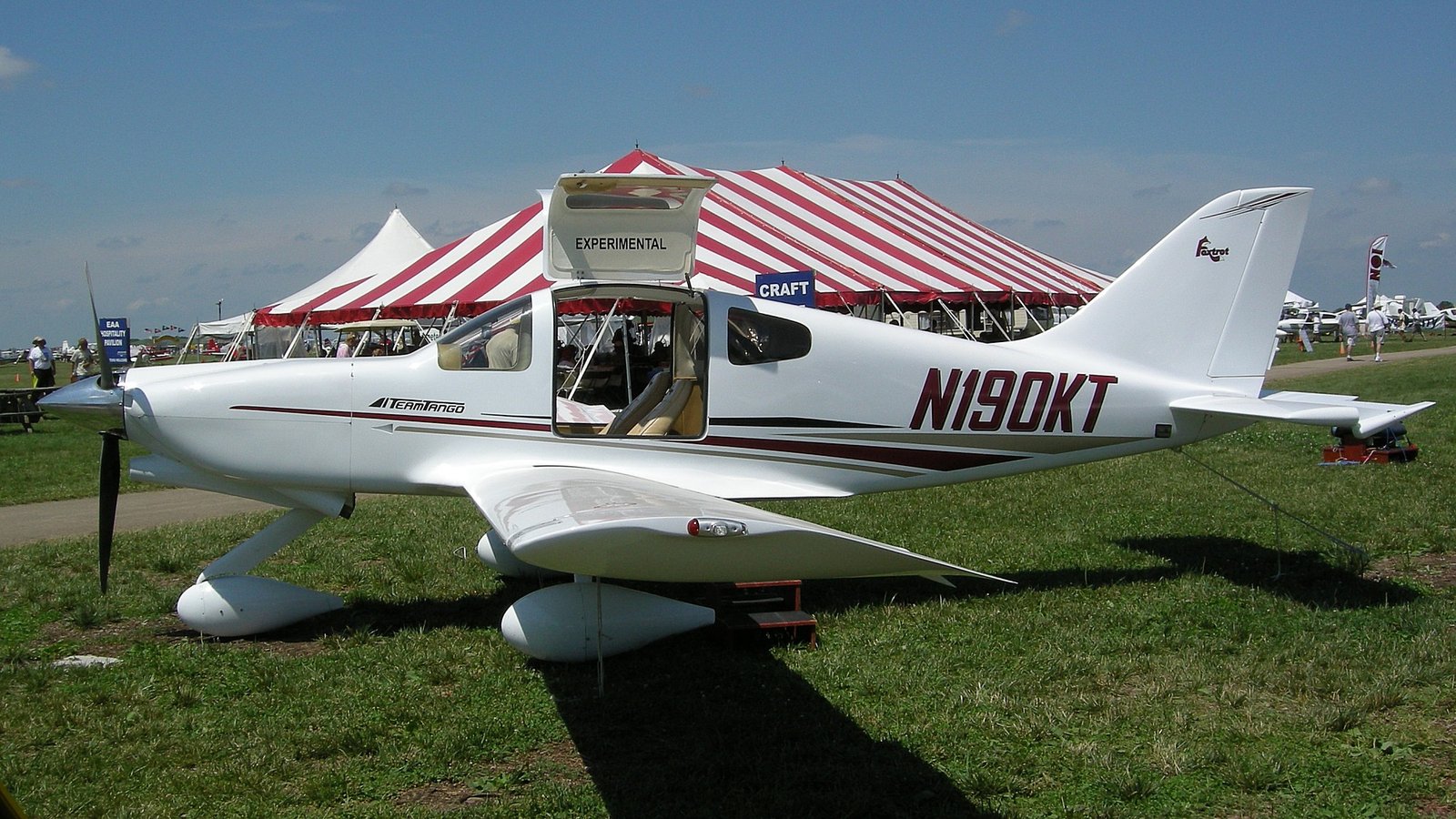
Development and Design Philosophy
The Foxtrot 4 emerged from Team Tango's ambition to create an affordable four-seat alternative to expensive certified aircraft. Development began in 1999 as an evolution of the company's successful Tango 2 two-seater, with engineers focusing on composite construction using vinylester resin rather than traditional epoxy for faster cure times and easier builder assembly.
Designers incorporated a NACA 64-415 airfoil across the 32-foot wingspan, achieving an efficient 8:1 aspect ratio that would prove crucial to the aircraft's impressive performance figures. The prototype, registered as N747F, underwent engine runs on August 27, 2001, marking a significant milestone toward first flight.
Test Flight Program
Test pilot Denny Funnemark, bringing over 2,000 hours of experience from military fighters including the F-4, F-5, and F-15, plus commercial time in the Saab 340, conducted the maiden flight on December 23, 2002. By May 2003, Funnemark had accumulated more than 35 hours on the prototype, providing valuable feedback on handling characteristics and performance optimization.
Early flight testing revealed the aircraft's potential, with cruise speeds exceeding 200 mph and service ceiling capabilities reaching 24,000 feet. However, initial evaluations noted high aileron friction in the prototype, leading to improved aileron and flap alignment in subsequent kit versions.
Production and Builder Support
Team Tango, based in Williston, Florida, began kit production with factory assistance options available for builders seeking professional guidance. By mid-2003, two additional aircraft beyond the prototype had achieved first flight, demonstrating the kit's buildability and appeal among amateur constructors.
The company offered the Foxtrot 4 with standard fuel capacity of 100-110 gallons, though wet wing configurations could accommodate up to 200 gallons for extended range missions. Maximum takeoff weight options ranged from 2,579 pounds standard to an upgraded 3,000-pound configuration for builders requiring higher payload capability.
Technical Specifications and Performance
Powered primarily by Lycoming O-540 or IO-540 six-cylinder engines producing 200-350 horsepower, the Foxtrot 4 typically employed 300-horsepower configurations for optimal performance. Cost-conscious builders could specify the four-cylinder IO-360 option, though with reduced performance expectations. Three-bladed constant-speed propellers became standard equipment.
The aircraft's composite construction resulted in empty weights ranging from 1,398 to 1,900 pounds, creating favorable power-to-weight ratios. Wing loading calculations of 23.4 to 25.7 pounds per square foot contributed to the design's 75 mph stall speed and positive handling characteristics. Structural limits of +5/-4 G's provided adequate margins for normal aerobatic maneuvers.
International Operations
By 2011, at least three Foxtrot 4 aircraft had reached completion, with international interest growing steadily. Serial number 006, registered as VH-AYN, entered service in Queensland, Australia, in 2015, demonstrating the design's global appeal and regulatory acceptance in foreign markets.
The Australian registration represented successful navigation of that country's experimental aircraft certification process, opening potential markets for additional international sales and builder support.
Production Transition and Evolution
Team Tango's original Foxtrot 4 production ceased by 2012, but the design's potential attracted Revolution Aviation Inc., which developed the evolved RAI-6 Foxtrot. This updated version retained the proven wing and aft fuselage design while incorporating a taller cabin for improved headroom, addressing one of builders' primary comfort concerns.
Revolution Aviation also built several original Foxtrot 4 aircraft for overseas customers, maintaining continuity with the established design while developing their expanded product line. Related models including the RAI-3 Tiluchi, RAI-4 Gavilan, and RAI-5 Rapier proved short-lived or customer-specific, with the Foxtrot variant remaining their primary focus.
Legacy and Current Status
The Foxtrot 4's significance lies in democratizing high-performance four-seat aviation for homebuilders. Its 200+ mph cruise capability rivaled certified aircraft costing several times more, while composite construction techniques pioneered manufacturing approaches later adopted throughout the kit aircraft industry.
Revolution Aviation continues supporting the type through parts availability and builder assistance, ensuring existing aircraft remain airworthy. Though exact production totals remain undocumented, the design's evolution into the RAI-6 demonstrates its fundamental soundness and continued relevance in amateur-built aviation.
Incomplete spin testing during the original certification process highlighted the experimental nature of kit aircraft development, where builders accept responsibility for flight envelope exploration that certified manufacturers must complete before sales.