
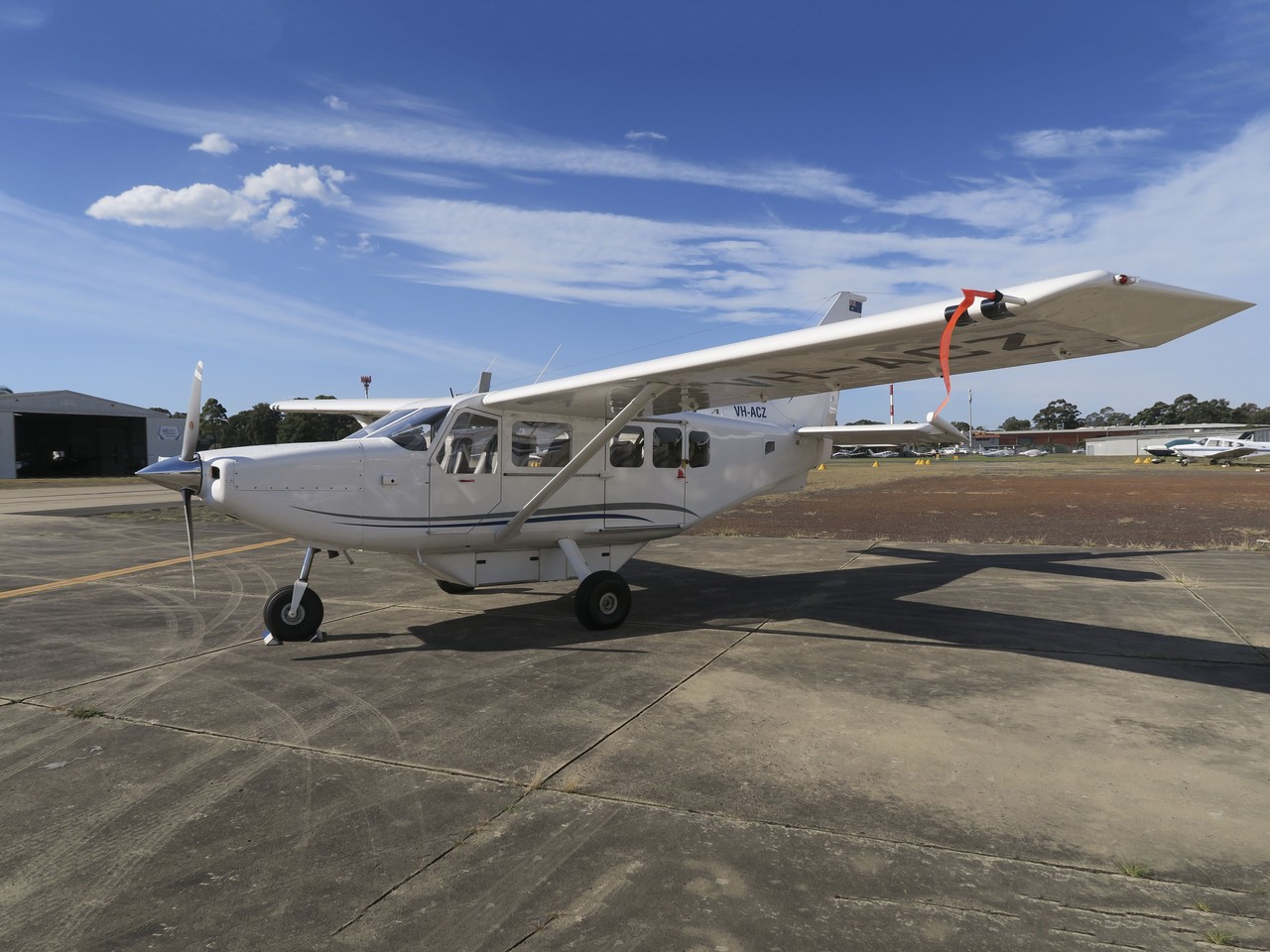
Service History
The GA-8 Airvan carved out a unique niche in commercial aviation by serving operators who needed more capacity than a Cessna 206 but found the Cessna 208 Caravan too large for their missions. Air Fraser Island became the first operator when they took delivery of VH-RYT on December 22, 2000, using the aircraft for tourist flights over Queensland's Fraser Island. The type quickly proved its worth in challenging environments, with operators like Alligator Airways, Slingair in Western Australia, and Wrights Air in the Northern Territory adopting the aircraft for remote area operations.
International sales began in December 2001 when Maya Island Air in Belize received the eighth production aircraft, registered V3-HGI. By 2005, the GA-8 was operating in seven countries, with sixteen aircraft delivered to United States operators alone following successful high-altitude trials in Colorado in February 2003. The aircraft demonstrated its hot-and-high capabilities at Leadville, Colorado, at an elevation of 3,026 meters, outperforming the competing Cessna 206.
The Manufacturer
Gippsland Aeronautics emerged from the agricultural aviation sector in the mid-1980s, initially building the GA-200 Fatman crop sprayer at Latrobe Valley Airport in Victoria. Company cofounders Peter Furlong and George Morgan launched the GA-8 project in early 1994, drawing on their experience with rugged agricultural aircraft design. By February 2007, the company had produced 110 GA-8 Airvans alongside 50 GA-200 agricultural aircraft.
In a significant corporate development, India's Mahindra Group acquired Gippsland Aeronautics and rebranded the aircraft as the Mahindra Airvan 8 at EAA AirVenture Oshkosh on July 28, 2014. However, the COVID-19 pandemic forced Mahindra Aerospace to cease production in November 2020 after completing at least 262 aircraft. The story came full circle in November 2023 when cofounder George Morgan repurchased the company from Mahindra, restoring the GippsAero name and resuming production in June 2025 with serial number 263.
Engine & Technical Details
The GA-8's powerplant evolved throughout its production run, beginning with the Textron Lycoming IO-540 six-cylinder engine producing 224-239 kilowatts (300-320 horsepower) at 2,450 rpm. Later variants incorporated the more powerful IO-580 engine, tested in 1997, and a turbocharged TIO-540 variant introduced with aircraft serial number GA-8-03-025 (VH-FGN). The turbocharged version enabled the aircraft to maintain performance at high altitudes and became the configuration that achieved a notable milestone on July 8, 2010, when a GA8-TC320 became the first Australian-built aircraft to circumnavigate the globe.
Designer Peter Furlong emphasized simplicity and robustness in the aircraft's configuration. The high-wing design provides excellent ground clearance for rough airstrip operations, while the squared-off fuselage maximizes internal volume for the eight-seat cabin arrangement of one pilot plus seven passengers. The aircraft carries 340 liters of fuel and received a maximum takeoff weight increase of 91 kilograms from serial number 163 onward through a service bulletin modification.
Development and Certification
The GA-8's development began with an unregistered proof-of-concept prototype powered by a 186-kilowatt (250-horsepower) Lycoming O-540 engine. Peter Furlong piloted this first flight on March 3, 1995, using the callsign VH-GAE. Tragically, this prototype was destroyed on February 7, 1996, during spin testing. The program continued with a second flying prototype, VH-XGA (construction number GA-8-96-03), which flew in August 1996 with an interim 224-kilowatt (300-horsepower) Lycoming IO-540K1A5 engine.
By November 1998, the second prototype had accumulated 350 flight test hours, leading to Australian Civil Aviation Safety Authority type certification to FAR Part 23 Amendment 48 standards on December 15, 2000. International approvals followed with certification updated to Amendment 54 in early 2003, Federal Aviation Administration approval in 2004, and European Aviation Safety Agency certification in 2005.
Production and Legacy
Production began modestly with four aircraft delivered in 2001, growing to twelve in 2002 and nineteen in 2003. The company achieved significant milestones including twenty aircraft per year by February 2003 and fifty annually by 2005, with projections reaching 400 per year by 2007 including planned licensed production. The 100th GA-8 rolled out on August 23, 2006, destined for Missionary Aviation Fellowship operations in Papua New Guinea.
The GA-8 Airvan proved that Australia could still produce commercially viable aircraft in the modern era, joining the select company of post-World War II Australian successes like the Government Aircraft Factory Nomad. With production resuming under the restored GippsAero banner and new aircraft expected to become operational in 2026, the GA-8 continues serving operators who need reliable short-field performance in an eight-seat package. The aircraft's legacy lies not just in its 262-plus production run, but in demonstrating that niche aircraft markets remain viable for focused engineering and persistent entrepreneurship.