
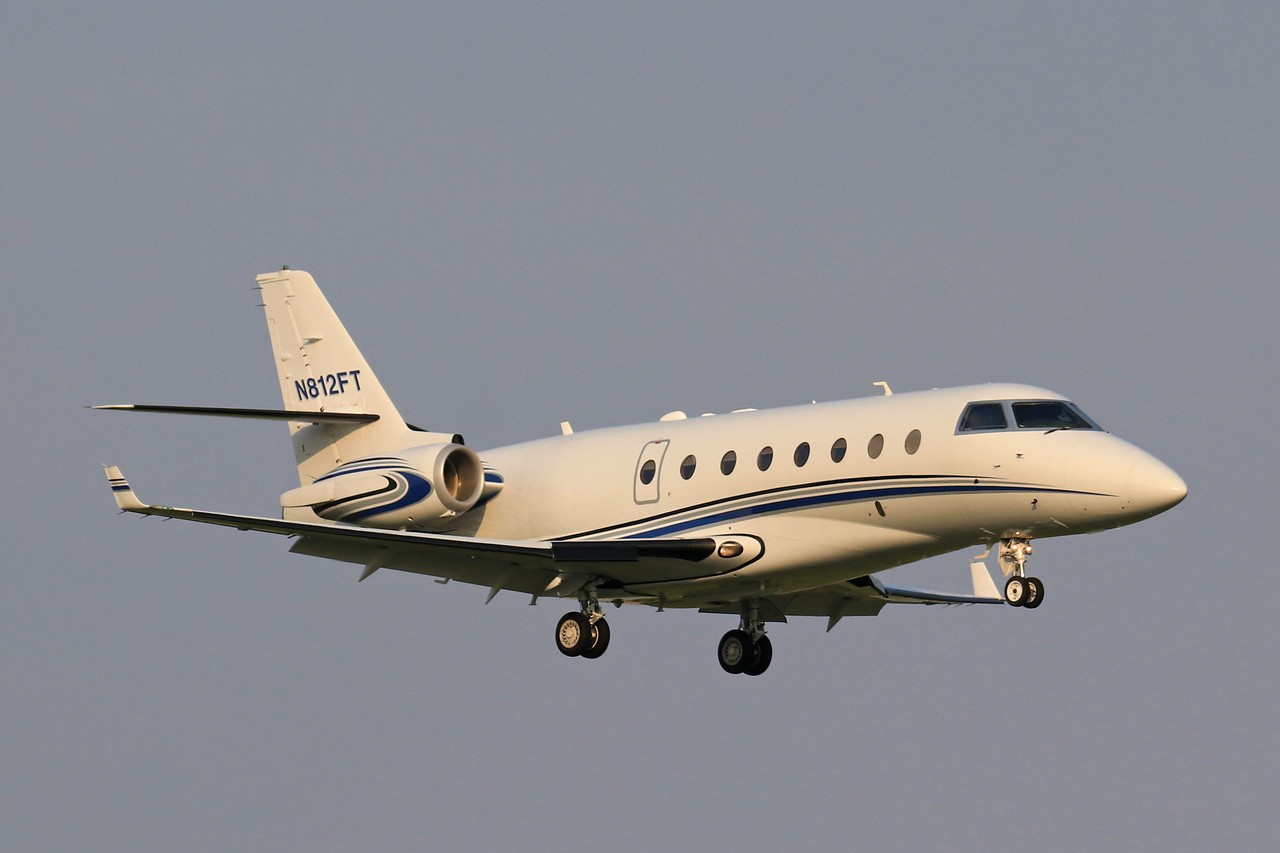
Development and Design
The G200's origins trace back to the late 1980s when Galaxy Aerospace Inc., a subsidiary of Israel Aircraft Industries (IAI), began developing a new super-midsize business jet. The program officially launched in September 1993, initially involving a risk-sharing partnership with Soviet Yakovlev OKB, which was responsible for manufacturing the forward fuselage and empennage. However, production delays forced the termination of this partnership in 1995, with EADS Sogerma subsequently taking over these manufacturing responsibilities.
Design objectives centered on creating an aerodynamically efficient twin-engine business jet that could serve medium-range corporate travel markets. Engineers incorporated wings derived from the Astra SPX design, enhanced with integrated winglets and modified high-lift devices. The aircraft featured advanced ProLine 4 avionics systems and utilized 3D structural analysis techniques to optimize aerodynamic performance. Construction employed primarily aluminum, titanium, and steel materials.
Manufacturing Partnership
The relationship between IAI and Gulfstream Aerospace evolved significantly during the G200's development. While IAI served as the design authority and prime contractor for manufacturing, Gulfstream Aerospace acquired Galaxy Aerospace in June 2001. This acquisition led to the aircraft's rebranding from the IAI Galaxy to the Gulfstream G200, bringing it under the umbrella of the Savannah, Georgia-based manufacturer.
Gulfstream Aerospace itself originated in the late 1950s through Grumman Aircraft Engineering Company's development of the original Gulfstream I. By the time of the G200 program, Gulfstream had become a wholly-owned subsidiary of General Dynamics and had produced over 2,000 aircraft since 1958, establishing itself as a premier business aviation manufacturer.
Certification and Market Entry
The G200 achieved its first flight milestone on December 25, 1997, with certification from both US and Israeli aviation authorities following by December 1998. Commercial deliveries commenced in 1999, marking the aircraft's entry into the competitive super-midsize business jet market.
The timing proved advantageous, as the G200 filled a crucial gap in Gulfstream's product line between smaller midsize jets and larger cabin aircraft. Its 869 cubic foot cabin volume provided substantial space while maintaining the efficiency characteristics that corporate operators demanded for medium-range missions.
Powerplant and Performance
Powering the G200 were two Pratt & Whitney Canada PW306A turbofan engines, each delivering 6,040 pounds of thrust. These high-standard powerplants consumed a combined 278 gallons of fuel per hour and featured overhaul intervals of 6,000 hours. In 2004, Gulfstream offered auto-throttles as an optional enhancement, further reducing pilot workload during flight operations.
Performance specifications positioned the G200 competitively within its market segment. Maximum cruise speed reached 470 knots (870 km/h), while long-range cruise operations could be conducted at 430 knots (796 km/h). The aircraft achieved a maximum range of 3,312 nautical miles under NBAA IFR conditions with four passengers, enabling transcontinental and intercontinental missions that were previously impossible for aircraft in this size category.
Operational Characteristics
The G200 typically accommodated 8 to 11 passengers in standard configurations, though maximum seating could reach 19 passengers plus 2 pilots. An innovative design feature included an optional extra seat located in the lavatory area. With a maximum gross weight of 35,450 pounds and empty weight of 20,200 pounds, the aircraft could carry a maximum payload of 4,050 pounds or 15,000 pounds of fuel.
Corporate and charter operators formed the primary customer base, utilizing the aircraft for missions that exemplified its capabilities, such as non-stop London-New York or Dubai-Singapore routes. These operational examples demonstrated how the G200 changed business aviation by offering super-midsize efficiency for previously challenging route structures.
Production History and Legacy
Production continued for 12 years, from 1999 through December 19, 2011, when the final G200 rolled off the production line at IAI facilities. Exactly 250 units were manufactured during this period, representing a successful production run for the specialized business aviation market.
By May 2020, flight tracking indicated that 241 G200s remained active, with only 9 aircraft retired from service. Market analysis showed that 84% of the fleet consisted of pre-owned aircraft, with 11.6% available for sale averaging 224 days on the market. These statistics reflected the aircraft's strong retention in active service and stable resale market.
The G200's production concluded as Gulfstream transitioned to its successor models, the G250 and G280, which launched in 2008. The G200's legacy lies in its role as a pioneering super-midsize business jet that successfully bridged 1990s Israeli aerospace design expertise with Gulfstream's established business aviation portfolio, setting performance and capability standards that influenced subsequent aircraft development in this market segment.