
Design Philosophy and Development
Yves Gardan conceived the GY-80 Horizon in the late 1950s with an ambitious goal: creating a European alternative to established American touring aircraft like the Cessna 172, Piper Cherokee, and Beech Musketeer. Gardan's design philosophy emphasized combining aerobatic capability with practical touring functionality, resulting in a sophisticated low-wing monoplane featuring retractable landing gear and all-metal construction.
The prototype's maiden flight on July 21, 1960, validated Gardan's innovative approach. The aircraft incorporated trapezoidal wings with a NACA 4413.6 airfoil at the root transitioning to NACA 63517 at the tip, creating a forward-swept leading edge that enhanced performance characteristics. Split flaps provided versatility for various flying conditions, while electrically operated systems and optional IFR equipment positioned the Horizon as a modern touring aircraft.
Manufacturing Evolution
Sud Aviation acquired Gardan's design license in 1960 and established production facilities at Nantes and Rochefort, France. Serial production commenced in 1963, marking France's serious entry into the competitive light aircraft market. The manufacturing landscape shifted significantly in 1966 when Sud Aviation purchased the bankrupt Morane-Saulnier company and created SOCATA as its general aviation subsidiary.
This corporate restructuring proved beneficial for the Horizon program, as SOCATA specialized in light aircraft production and marketing. The aircraft became known as the SOCATA GY-80 Horizon during this transition period. Production continued steadily until economic pressures and market competition forced termination at the end of 1974, with between 267 and 273 aircraft completed during the eleven-year production run.
Technical Specifications and Variants
The GY-80 Horizon utilized proven Lycoming powerplants throughout its production life. Initial aircraft featured either the 150-horsepower O-320-A2C or 160-horsepower O-320-B2B engines operating at 2,700 rpm. By 1966, SOCATA introduced a 180-horsepower O-360-A option while phasing out the 150-horsepower variant by 1967. These four-cylinder, air-cooled, opposed-piston engines provided reliable operation and were paired with either fixed or constant-speed Hartzell propellers.
The aircraft's fuel system incorporated two tanks with a total capacity of 160 liters, providing adequate range for touring missions. Maximum takeoff weight reached 2,535 pounds, allowing the pilot and three passengers to travel comfortably. The sophisticated landing gear system retracted electrically, contributing to improved cruise performance compared to fixed-gear competitors.
International Market Penetration
Despite American dominance in the light aircraft sector, the GY-80 Horizon achieved modest international success. French pilots formed the primary customer base, appreciating the aircraft's European engineering and aerobatic capabilities. Export markets included Switzerland, Germany, and the United Kingdom, where the type gained recognition among discerning pilots seeking alternatives to mass-produced American designs.
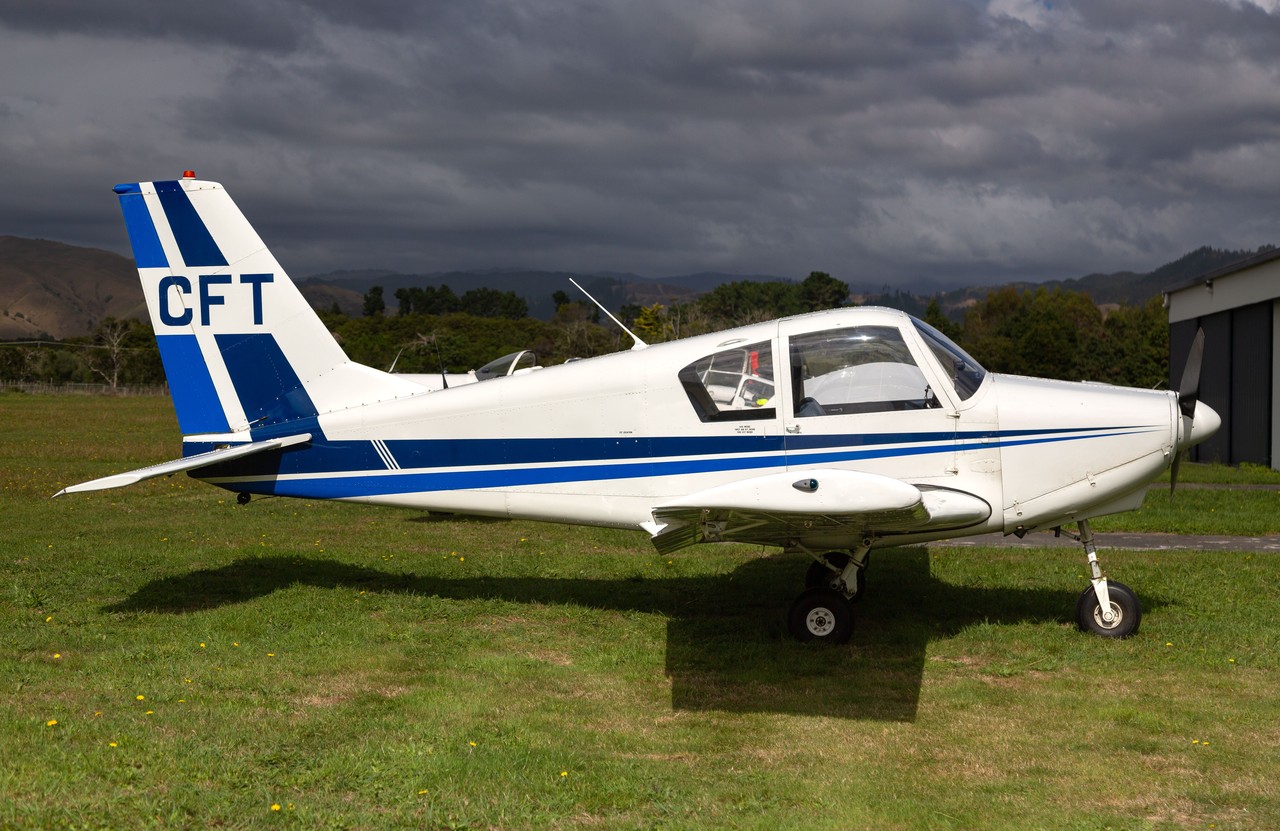
The aircraft found particular success in Australia and New Zealand markets. Notable Australian registrations included VH-KJC (construction number 182, built in 1966) and VH-CJZ (construction number 215, imported in 1967). New Zealand operators embraced the type for both training and personal use, with aircraft like ZK-BXM (construction number 128, assembled in 1966) serving the Auckland Flying School and ZK-CFT "Tahatu" operating from 1964.
Operational History and Training Role
The GY-80 Horizon carved out a niche in flight training operations, where its responsive handling characteristics and retractable gear provided valuable learning experiences. The Central Flying School in New Zealand utilized the type extensively, while various flying clubs and private operators appreciated its combination of performance and economy.
Clyde Engineering served as New Zealand agents, promoting the aircraft's capabilities in the competitive Pacific market. The type's four-seat configuration made it attractive to flying syndicates and small companies requiring efficient transportation. In 1963, the aircraft gained international attention when a GY-80 was presented to King Hussein of Jordan, highlighting its diplomatic significance.
Legacy and Continuing Service
Production ceased in 1974 as market pressures and competition from established American manufacturers limited sales potential. However, the GY-80 Horizon's robust construction ensured many examples remained active decades later. As of 2014, aircraft continued operating across multiple continents, including G-AZRX in the United Kingdom and D-EEKH/D-EGZB in Germany.
The Horizon represented Yves Gardan's successful evolution from his earlier GY-20 Minicab design and laid groundwork for subsequent developments including the Super Horizon 200 and ST-10 Diplomate. While never achieving the commercial success of American competitors, the GY-80 demonstrated European capability in light aircraft design and manufacturing, contributing to SOCATA's eventual evolution into Airbus's general aviation division. Today, surviving examples serve as testament to French engineering ambition during the aviation industry's rapid expansion of the 1960s.